Tron | Crypto
"Tron" in Crypto feed
-
Cryptonews.com - 14:05 Jan 12, 2026
On January 11, 2026, Tether froze over $182 million in USDT across five Tron wallet addresses as global regulators and law enforcement push back against rampant stablecoin use in sanctions‑evasion activity The post Tether Freezes $182M on Tron in Massive ‘Coordinated’ Wallet Blacklist appeared first on Cryptonews. -
Cointelegraph.com - 15:06 Nov 28, 2025
 A proposal submitted to CTDG Dev Hub suggests introducing native transaction batching to Tron. Transaction fees are a major concern when sending cryptocurrency. Each transaction incurs a fee that is received by the miner, and that translates to paying hefty amounts for large organizations that regularly deal with large transactions. Transaction batching is a method invented for such scenarios. The method treats multiple transactions as one to improve scalability and reduce costs. The feature may soon arrive on Tron, thanks to a newly submitted proposal. The proposal was submitted by blockchain infrastructure provider Boosty Labs to the CTDG Dev Hub. The proposal is the first fruit of this effort. If passed, it can give Tron, an ecosystem home to many exchanges, payment processors and one of the highest-volume USDT markets, a native batching solution. Let’s take a deep dive into how transaction batching works, what sets the proposal’s approach apart from previous methods and how its arrival can transform the T...
 -
CryptoSlate - 18:00 Nov 17, 2025
Los Angeles, California, November 17, 2025 — RealOpen, the leading platform for buying real estate with crypto, today announced the launch of a 50,000 USDT “Fast Moves, Fast Payments” Holiday Campaign in collaboration with TRON, the leading settlement layer for stablecoin transactions. The holiday campaign offers up to 50,000 USDT in rewards for eligible U.S. […] The post TRON and RealOpen Launch $50,000 Holiday Campaign to Power Luxury Real Estate Purchases with USDT on TRON appeared first on CryptoSlate. -
Cryptonews.com - 13:21 Oct 31, 2025
The T3 Financial Crime Unit (T3 FCU), a joint initiative led by Tether, TRON, and TRM Labs, announced it has frozen more than $300 million in criminal assets globally. The post Tether, TRON, and TRM Labs’ Financial Crime Unit Blocks $300M in Illicit Crypto appeared first on Cryptonews. -
Cryptonews.com - 22:30 Oct 22, 2025
Best crypto prospects have been reassessed after the recent dip. Bitcoin has reached $126,080 before a tariff-driven slide, while analysts have evaluated XRP’s cross-border payments role, Solana’s ETF watch, TRON’s resilience, and presale HYPER ahead of the Federal Reserve’s next decision. The post Best Crypto to Buy Now, October 22 – XRP, Solana, Tron appeared first on Cryptonews. -
Decrypt - 03:25 Oct 01, 2025
Experts Decrypt spoke with cite Tron Inc.’s 85% stock plunge as part of broader crypto treasury hype beginning to cool. -
Cointelegraph.com - 01:03 Sep 19, 2025
 PayPal is adding support for a permissionless version of its PYUSD stablecoin on Tron, Avalanche and several other blockchains via LayerZero and its Stargate Hydra bridge. Payments giant PayPal is expanding its PayPal USD stablecoin across eight new blockchains, seven of which are through an integration with LayerZero’s Stargate Hydra bridge. The integration will create a permissionless version of PayPal USD (PYUSD) — PYUSD0 — which will be “fully fungible” with the PYUSD and interoperable across blockchains, crypto infrastructure firm LayerZero said in a statement on Thursday. Those blockchains are Tron, Avalanche, Aptos, Abstract, Ink, Sei and Stable, while existing permissionless versions on Berachain (BBYUSD) and Flow (USDF) will upgrade to PYUSD0. A separate announcement on Thursday also revealed that PYUSD has expanded to Stellar. Read more
 -
Cointelegraph.com - 19:55 Sep 18, 2025
 The financial regulator asked a judge to stay its enforcement case against the Tron founder in February, after which time the company went public on Nasdaq. Two members of Congress have called on the Securities and Exchange Commission (SEC) to answer questions that could impact how crypto companies go public on US exchanges. In a Wednesday letter to SEC Chair Paul Atkins and acting director of the commission’s division of corporation finance Cicely LaMothe, Senator Jeff Merkley and Representative Sean Casten questioned the agency’s timing on dropping an enforcement case against Tron founder and CEO Justin Sun. The Tron founder had been facing a lawsuit filed by the SEC in 2023 over allegations of offering unregistered securities, but the agency asked for a stay in the case in February, a month after the departure of former Chair Gary Gensler. Read more
 -
Cointelegraph.com - 21:52 Sep 12, 2025
 Even after the change, Tron still holds a significant lead in revenue among layer-1 blockchains, including Ethereum, Solana and BNB Chain. Tron’s recent fee reduction has significantly cut into the revenue earned by its block producers, according to a new report from CryptoQuant. The total daily network fees for Tron’s block producers, known as Super Representatives, dropped to $5 million on Sept. 7, the lowest level in over a year. That’s a 64% revenue decline in 10 days, down from $13.9 million the day before lower fees were implemented. Onchain data shows that average gas fees on Tron have decreased by 60% after the network implemented a proposal slashing the energy unit price from 210 sun to 100 sun. Gas fees are transaction costs paid on the Tron network, measured in its smallest unit, called sun. Tron Proposal #789, labeled “Decrease the transaction fees,” went live on Aug. 29 after a vote from the Super Representative community. Read more
 -
CryptoSlate - 17:00 Sep 11, 2025
Geneva, Switzerland, September 11, 2025 – TRON DAO, the community-governed DAO dedicated to accelerating the decentralization of the internet through blockchain technology and decentralized applications (dApps), proudly participated as a 3 Block Sponsor of CoinDesk: Policy & Regulation conference, held on September 10 at Convene Hamilton Square in Washington D.C. Formerly known as “State of […] The post TRON, Binance, and TRM Labs Highlight T3 FCU at CoinDesk: Policy & Regulation, TRON DAO Featured as 3 Block Sponsor appeared first on CryptoSlate. -
Cryptonews.com - 14:44 Sep 03, 2025
Following a $110M investment from its top shareholder, Nasdaq-listed Tron Inc. has doubled its treasury, cementing its corporate strategy to build its Tron Inc. TRX holdings and emulate MicroStrategy. The post Tron’s Biggest Backer Fuels $110M TRX Buy, Doubling Company’s Treasury to $220M appeared first on Cryptonews. -
CryptoSlate - 15:08 Aug 29, 2025
The Tron blockchain is preparing for its steepest fee reduction since launch, following a community vote by its Super Representatives (SRs). On Aug. 29, Tron founder Justin Sun confirmed that the blockchain network’s community has backed a proposal to lower fees by 60%. This adjustment, scheduled to take effect later today, aims to lower transaction […] The post Tron slashes fees by 60% to boost on-chain activity risking $28 million hit to revenue appeared first on CryptoSlate. -
Cointelegraph.com - 21:04 Aug 27, 2025
 A plan to halve Tron’s energy costs is winning strong support ahead of Friday’s deadline, with backers betting lower fees will expand adoption. A GitHub proposal to realign the Tron blockchain’s fee structure with broader adoption goals is gaining traction ahead of Friday’s voting deadline, signaling that network stakeholders are prioritizing accessibility — even at the risk of introducing net inflation in TRX supply. The proposal, titled “Decrease the transaction fees” (Issue #789), was submitted on Aug. 8 by GitHub user GrothenDI in the Tron Improvement Proposals repository. It calls for reducing the energy unit price to 100 sun from 210 sun, effectively halving the cost of transactions that consume energy. One TRON (TRX) token equals 1,000,000 sun — the smallest divisible unit of TRX, similar to a satoshi for Bitcoin (BTC). Read more
 -
CryptoSlate - 18:00 Aug 25, 2025
Geneva, Switzerland, August 25, 2025 – TRON DAO, the community-governed DAO dedicated to accelerating the decentralization of the internet through blockchain technology and decentralized applications (dApps), proudly served as the Title Sponsor of the second UK AI Agent Hackathon, hosted by the Imperial Blockchain Group from Imperial College London, one of the world’s most prestigious […] The post Justin Sun Named Best Blockchain Innovator at UK AI Agent Hackathon by Imperial College London, TRON DAO is Title Sponsor appeared first on CryptoSlate. -
Cointelegraph.com - 21:26 Aug 20, 2025
 According to a Binance Research report, tokenized stocks are nearing a major inflection point reminiscent of the early days of decentralized finance. On Wednesday, cryptocurrency exchange Kraken and tokenization platform Backed Finance announced an expansion of xStocks, a tokenized stock product offering, to the Tron blockchain. The move comes as real-world asset (RWA) tokenization, particularly within stocks, is taking hold. According to the announcement, Backed will deploy the stocks as TRC-20 tokens. Previously, Kraken and Backed launched xStocks on Solana and BNB Chain. Debuted in late June 2025, xStocks has had more than $2.5 billion in combined DEX and CEX volume, according to a Kraken blog post. “The enthusiasm developing in the RWA sector is more indicative of a growing institutional confidence in the utility of layer 1 blockchain networks like Tron,” a TronDAO representative told Cointelegraph. “As institutional blockchain continues to evolve, we plan to stay focused on building the infrastructure ne...
 -
Decrypt - 20:34 Aug 20, 2025
Tron users can now trade tokenized shares of popular American companies as xStocks expands after topping $500 million in on-chain trading. -
CryptoSlate - 15:00 Aug 19, 2025
Geneva, Switzerland – August 19, 2025 – TRON DAO, the community-governed DAO dedicated to accelerating the decentralization of the internet through blockchain technology and decentralized applications (dApps), announced today a strategic agreement with MetaMask. MetaMask will natively integrate TRON into the world’s leading self-custodial crypto wallet developed by Consensys. This integration will enable MetaMask users […] The post TRON to be Natively Integrated into MetaMask, Unlocking Global Access to TRON Assets appeared first on CryptoSlate. -
Cointelegraph.com - 15:00 Aug 19, 2025
 MetaMask will be natively integrated the Tron blockchain, connecting users to the Asia-focused network after adding Solana support earlier this year. Update (Aug. 20, 00.30 UTC): This article has been updated to reflect that the Tron network has not yet been integrated with MetaMask and also includes new comments from Angel Gonzalez-Capizzi. The Tron network will be integrated into Consensys’ crypto wallet MetaMask, becoming the third major non-Ethereum-based chain to get support since MetaMask launched in 2016. On Tuesday, Tron DAO announced the strategic partnership with MetaMask, which will natively integrate the Tron (TRX) blockchain into the Consensys-developed self-custodial crypto wallet. Read more
 -
CryptoSlate - 15:54 Aug 14, 2025
Tron founder Justin Sun has filed a lawsuit against Bloomberg, accusing the media outlet of unlawfully disclosing his private financial information in its Billionaires Index profile. In an Aug. 11 court filing, the crypto billionaire alleged that Bloomberg intended to “recklessly and improperly” publish highly confidential and proprietary details about his crypto holdings. He argued […] The post Bloomberg faces lawsuit for disclosing Justin Sun’s TRON token holdings appeared first on CryptoSlate. -
Cointelegraph.com - 20:51 Aug 03, 2025
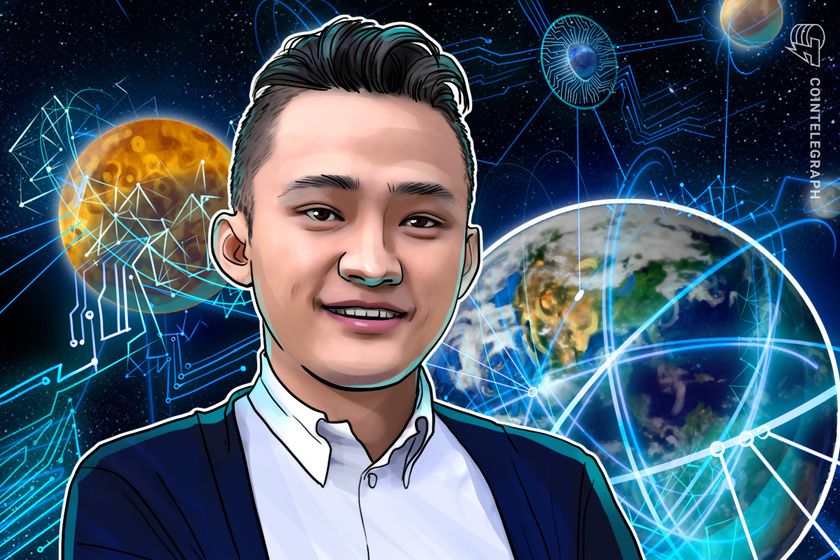 The Tron founder said it has been a long-time dream to travel to space and reflected on the fragility of the planet following his return. Justin Sun, founder of the layer-1 Tron blockchain network, returned safely from a commercial spaceflight on Saturday, alongside five other crew members aboard Blue Origin mission NS-34. The other crew members included the founder of venture capital firm Alpha Funds, J.D. Russell, entrepreneur Gökhan Erdem, real estate investor Arvi Bahal, meteorologist Deborah Martorell, and philanthropist and teacher Lionel Pitchford. Sun placed a $28 million bid for a seat aboard Blue Origin spaceflight NS-34 in 2021 and won the first reservation for the scheduled mission. Read more