Middle East | News
-
ukrinform.net - 14:45 Mar 08, 2026
President Volodymyr Zelensky said that Ukrainian experts would arrive in the Middle East as early as the following week. -
Dawn - 03:35 Mar 08, 2026
ISLAMABAD: As the conflict in the Middle East escalates, Pakistan’s Planning Commission has cautioned about possible economic impacts on the country, including increased energy costs, strain on remittance inflows, and potential interruptions to exports and financial stability. The ministry warned that instability in the region, especially around the strategic Strait of Hormuz, could drive up global oil prices and sharply increase Pakistan’s import costs, given the country’s heavy dependence on petroleum imports from the Middle East, according to the Ministry of Planning’s Monthly Development Update for March. Such developments could also fuel domestic inflation, raise production and freight costs for exporters, and place additional pressure on the exchange rate and fiscal position, according to the report released here on Saturday. At the same time, prolonged conflict could affect remittance inflows from Gulf countries, where millions of Pakistani workers are employed, and create uncertainty for Pakistan’s ex... -
ukrinform.net - 20:15 Mar 07, 2026
Equally effective protection of life must be ensured both in Europe and in the Middle East, President Volodymyr Zelensky said. -
ukrinform.net - 15:26 Mar 07, 2026
Ukrainian President Volodymyr Zelensky discussed the situation in Ukraine and the Middle East with French President Emmanuel Macron. -
ukrinform.net - 14:37 Mar 07, 2026
Escalation in the Middle East could lead to a shortage of Patriot systems and missiles for Ukraine, while rising energy prices will temporarily strengthen Russia's financial stability. -
Cointelegraph.com - 18:51 Mar 06, 2026
 In a Cointelegraph interview, Arthur Hayes explains why global markets may not be pricing in a longer war in the Middle East, and what that may mean for energy prices, liquidity and Bitcoin. As geopolitical tensions escalate and global markets face a new wave of uncertainty, one asset has been behaving in an unexpected way: Bitcoin. While the Middle East slides deeper into conflict and energy markets react to potential supply disruptions, the world’s largest cryptocurrency has held up relatively well compared to many traditional assets. For some observers, that resilience raises an important question: Could Bitcoin be signaling something about the macro environment that markets haven’t fully priced in? Read more
 -
Haaretz - 18:17 Mar 06, 2026
Sources say Russia has been providing Iran with locations of American military assets, including warships and aircraft, since the beginning of Iran's war with the U.S. and Israel. Iran has launched thousands of drones and hundreds of missiles at U.S. targets in the Middle East and Gulf -
ukrinform.net - 14:53 Mar 06, 2026
The escalation in the Middle East must not lead to a loss of focus on supporting Ukraine, as Russia's war remains the main security challenge for Europe. -
Dawn - 20:58 Mar 05, 2026
Pakistan expressed “serious concern” on Thursday on recent attacks targeting Azerbaijan and Turkiye, calling for restraint and emphasising the need for dialogue and diplomacy. The calls comes against the backdrop of an ongoing war between Iran and the US and Israel, which has expanded across the Middle East with Tehran targeting US bases and assets in other countries and Tel Aviv targeting Hezbollah in Lebanon. On Thursday, a drone struck an airport building in Azerbaijan’s exclave of Nakhichevan and exploded. Two people were injured in the incident, for which Azerbaijan held Iran responsible, but Iran has denied involvement in the incident and blames Israel. On Wednesday, Turkiye summoned the Iranian ambassador after a missile — apparently targeting a Cyprus base — landed in Turkish territory. Iran’s armed forces have also denied firing any missile towards Turkiye. Following the two incidents, the Foreign Office (FO) said in a statement that Pakistan expressed “serious concern” over the recent attacks target... -
ukrinform.net - 18:37 Mar 05, 2026
The United States has sent a request to Ukraine asking for specific assistance in defending against Shahed drones in the Middle East. -
Dawn - 15:07 Mar 05, 2026
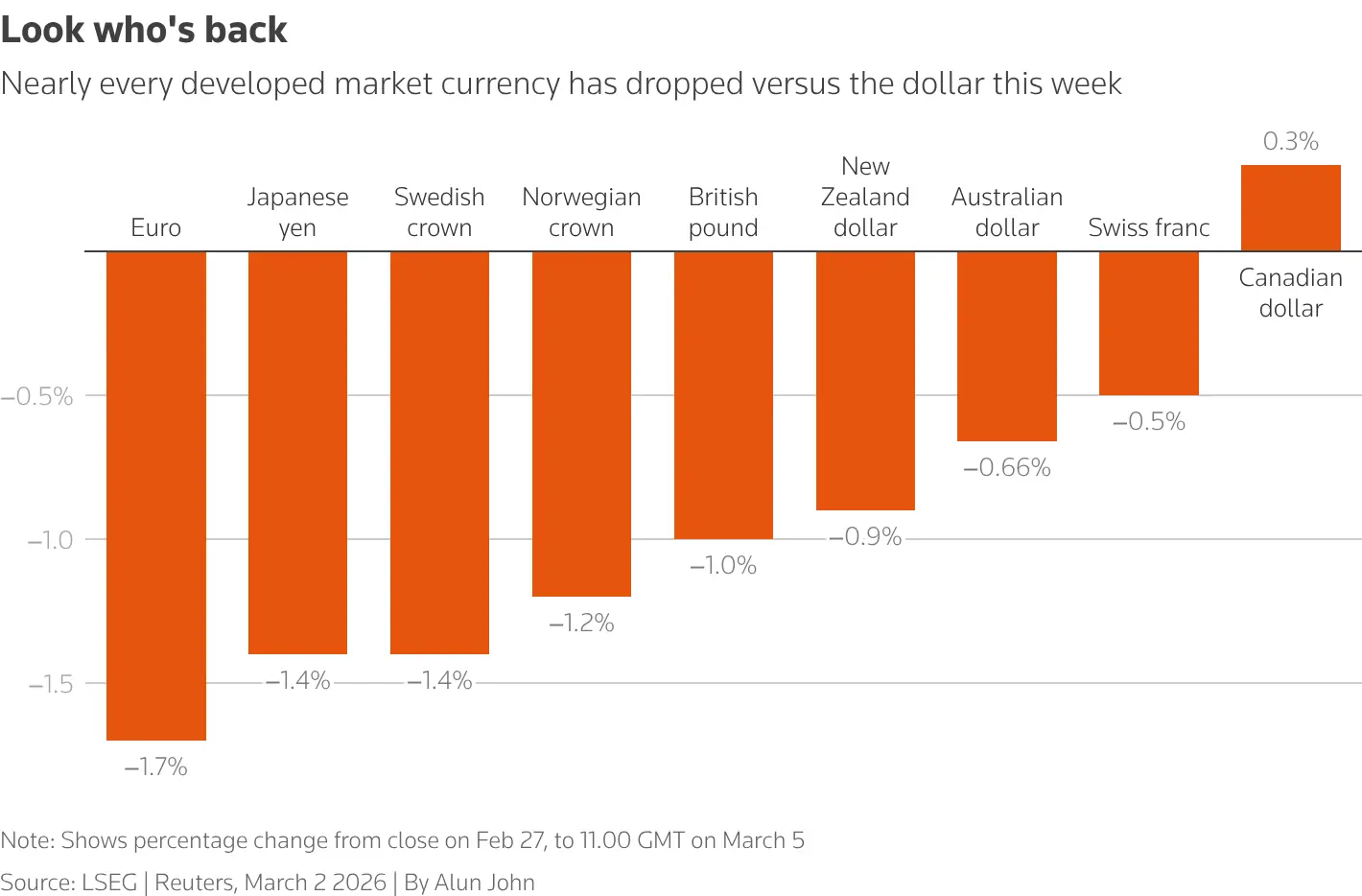 Turmoil in the Middle East has sent investors scrambling for safety once more, reigniting a debate over which assets truly offer protection in times of stress. The choice is complicated, as traditional refuges behave unpredictably. Gold has swung sharply, and the dollar — which has been out of favour in the past year — has bounced back. Here’s a look at how some of the favourites stack up: Greenback passes a test The dollar has arguably performed the best among safe havens this week. The dollar index, which tracks the US currency against six others, is up 1.5 per cent. The dollar has even gained against the Swiss franc and yen, which both typically outperform at times of market stress. That’s particularly notable as the dollar weakened when stocks fell following last April’s tariff turmoil, raising questions about its safe haven status. It’s short-term dollar cash that’s in demand, not other dollar assets, flow data shows. Of course, the US is a net energy exporter, so a crisis like this that sends benchmark ...
 -
The Nation - National - 14:57 Mar 05, 2026
Prime Minister Shehbaz Sharif held separate telephone discussions with Malaysian Prime Minister Anwar Ibrahim and Indonesian President Prabowo Subianto amid rising tensions in the Middle East following Israeli strikes on Iran and other Gulf nations. -
The Nation - National - 04:46 Mar 05, 2026
The ongoing war in the Middle East has intensified the regional aviation crisis, with more than 20,000 flights reportedly cancelled across eight countries over the past five days. -
ukrinform.net - 20:19 Mar 04, 2026
President Volodymyr Zelensky held a conversation with Sabah Khaled Al-Hamad Al-Mubarak Al-Sabah, during which they addressed security challenges in the Middle East. -
ukrinform.net - 18:41 Mar 04, 2026
Ukrainian President Volodymyr Zelensky has said that Ukraine is ready to help Middle East countries stabilize the situation and protect civilians in response to the threat posed by Iranian attack drones and missiles that are destabilizing the region and the global market. -
Dawn - 12:00 Mar 04, 2026
Gold prices climbed 2 per cent on Wednesday, rebounding from their lowest in more than a week reached in the previous session, as the dollar took a breather and mounting tensions in the Middle East drove investors toward safe havens. However, gold prices in Pakistan registered a significant drop of Rs10,000 per tola, settling at the rate of Rs 539,962 per tola. Spot gold gained 2.2pc to $5,198.58 per ounce by 10:17 GMT, after falling more than 4pc on Tuesday. U.S. gold futures for April delivery added 1.7pc to $5,211.20. The U.S. dollar fell 0.2pc, making greenback-priced gold more affordable for buyers using other currencies. “After the past few days of position unwinds and dollar strength, markets are back to a more typical macro risk-off stance, with silver higher too. A pause in the rise of the dollar and Treasury yields helps with their opportunity costs,” said Jamie Dutta, market analyst at Nemo.money. “Gold and silver’s safe-haven characteristics can shine again.” Spot silver advanced 5.3pc to $86.39 p... -
ukrinform.net - 19:45 Mar 03, 2026
Russian propaganda has launched a new wave of fake stories about Ukraine, exploiting developments in the Middle East to discredit Kyiv and undermine support from its allies. -
ukrinform.net - 18:21 Mar 03, 2026
Ukrainian President Volodymyr Zelensky has discussed the situation in the Middle East and the Gulf region with the Emir of Qatar, Sheikh Tamim bin Hamad Al Thani. -
Cointelegraph.com - 17:57 Mar 02, 2026
 Bitcoin short-term holder losses were minimal over the weekend, and the Monday rally to $70,000 suggests the heaviest selling is done. Will Bitcoin finally break the monthly resistance? Bitcoin (BTC) rallied to $70,000 on Monday as the shadow of war looms over the entire Middle East. Data from CryptoQuant shows short-term holder loss transfers to exchanges falling to a two-week low over the past 24 hours, and the slowing exchange flows stand in contrast to the rate of selling seen in early February. The short-term holder (STH) profit/loss (P&L) to exchanges metric tracks how much Bitcoin recent buyers send to exchanges at a profit or loss. These participants tend to amplify volatility during stress events. On March 1, the realized losses fell to 3,700 BTC even as geopolitical tensions between the United States and Iran escalated in the Middle East. Bitcoin dipped to $63,000 during that window, but exchange inflows from this cohort did not expand in response. Read more