China | Crypto
"China" in Crypto feed
-
Cryptonews.com - 22:30 Mar 03, 2026
War news may be dominating headlines, but Alibaba AI believes crypto’s mid-to-long-term prospects look better than ever. Market behavior suggests that investors may have already absorbed the impact of war-related risks earlier in the year, following selloffs triggered by former President Trump’s rhetoric around possible U.S. military escalation involving Greenland and Iran.As such, Alibaba AI […] The post China’s Alibaba AI Predicts the Price of XRP, Bitcoin and Ethereum by the End of 2026 appeared first on Cryptonews. -
Cryptonews.com - 22:30 Feb 27, 2026
DeepSeek AI predicts great things this year for HODLers of XRP, Bitcoin and Ethereum.Despite months of persistent downside pressure across the crypto market, DeepSeek has a notably optimistic stance on the market leaders, projecting that all three could reach fresh all-time highs within the next ten months.So, just how credible are DeepSeek’s predictions?XRP ($XRP): DeepSeek […] The post China’s DeepSeek AI Predicts the Price of XRP, Bitcoin and Ethereum appeared first on Cryptonews. -
Cryptonews.com - 22:30 Feb 19, 2026
Running a well-crafted prompt through Alibaba AI model KIMI can surface some eye-opening 2026 price scenarios for XRP, Shiba Inu, and Pepe.According to Alibaba’s outlook, all three digital assets could generate substantial returns by New Year, perhaps much sooner than investors expect.Below is a closer look at the projections and the logic behind them.XRP ($XRP): […] The post China’s Alibaba AI Predicts the Price of XRP, Shiba Inu and PEPE By the End of 2026 appeared first on Cryptonews. -
CryptoSlate - 14:00 Feb 18, 2026
An obscure Hong Kong firm has disclosed a $436 million position in BlackRock’s Bitcoin ETF, a revelation that is fueling speculation about Chinese capital flowing into crypto through offshore side doors. Laurore Ltd, a previously unknown entity, reported the stake in BlackRock Inc.’s iShares Bitcoin Trust (IBIT) in a filing with the US Securities and […] The post Is China using US Bitcoin ETFs as a backdoor? Mystery Hong Kong firm invested $436M in BlackRock’s IBIT appeared first on CryptoSlate. -
Cryptonews.com - 22:30 Feb 17, 2026
When asked a carefully structured prompt, DeepSeek hints at the possibility of high upside this year for current HODLers of XRP, Pepe, and Shiba Inu, a timeline that may catch unprepared investors off guard.Below is a breakdown of how current technical signals and broader ecosystem developments may support DeepSeek’s bullishness.XRP ($XRP): DeepSeek Believes Ripple’s Roadmap […] The post China’s DeepSeek AI Predicts the Price of XRP, PEPE and Shiba Inu By the End of 2026 appeared first on Cryptonews. -
CryptoSlate - 17:05 Feb 09, 2026
China’s gradual retreat from US government debt is evolving from a quiet background trend into an explicit risk-management signal, and Bitcoin traders are watching the market for the next domino. The immediate trigger for this renewed anxiety came on Feb. 9 when Bloomberg reported that Chinese regulators were urging commercial banks to limit their exposure […] The post Why Bitcoin faces a brutal liquidity trap because China’s $298B of US Treasuries are up for sale appeared first on CryptoSlate. -
Cointelegraph.com - 18:57 Feb 07, 2026
 The Bitcoin network's mining difficulty dropped by as much as 27% within a single adjustment period during China's 2021 crypto mining ban. Update (2-7-2026) This article has been updated to provide the latest projections for the next Bitcoin mining difficulty adjustment The Bitcoin network mining difficulty, a metric tracking the relative challenge of adding new blocks to the Bitcoin (BTC) ledger, fell by about 11.16% in the last 24 hours, the worst drop in a single adjustment period since China’s 2021 ban on crypto mining. Bitcoin mining difficulty is at 125.86 T and took effect at block 935,429, data from CoinWarz shows. The average block time is about 9.47 minutes, slightly under the 10-minute target. Read more
 -
Cointelegraph.com - 17:20 Feb 06, 2026
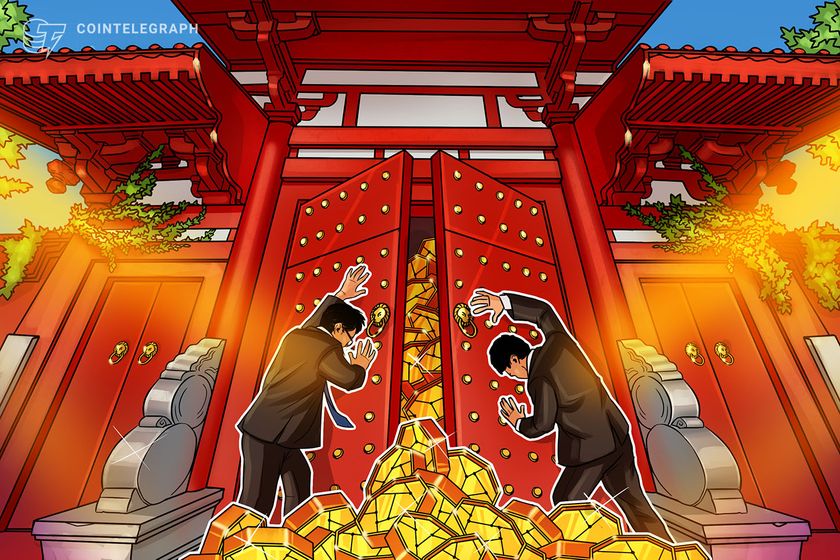 The latest announcement from the People's Bank of China follows months of flip-flopping on privately issued yuan-pegged stablecoins. The People’s Bank of China (PBOC), the country’s central bank, and seven Chinese regulatory agencies published a joint statement on Friday banning the unapproved issuance of Renminbi-pegged stablecoins and tokenized real-world assets (RWAs). The ban applies to both domestic and foreign stablecoin and tokenized RWA issuers, according to the statement, which was also signed by the Ministry of Industry and Information Technology and China’s Securities Regulatory Commission. A translation of the announcement said: Winston Ma, an adjunct professor at New York University (NYU) Law School and former Managing Director of CIC, China's sovereign wealth fund, told Cointelegraph that the ban extends to the onshore and offshore versions of China’s Renminbi, also called the yuan. “The Beijing crypto ban rule applies across all RMB-related markets, whether CNH or CNY,” he said. CNH is the of...
 -
CoinDesk - 16:10 Feb 06, 2026
The set of new rules reaffirm China’s hardline stance on crypto and impose restrictions on tokenized real-world assets and overseas issuance of yuan stablecoins. -
Cryptonews.com - 22:30 Feb 05, 2026
China's DeepSeek AI predicts upside cases for XRP, Solana and Bitcoin through 2026–2027, arguing that a longer bull market plus firmer US regulatory clarity could lift XRP toward $10, SOL toward $500, and BTC toward $250,000, even after steep pullbacks from prior highs. It also cites US ETF inflows. The post China’s DeepSeek AI Predicts the Price of XRP, Solana and Bitcoin By the End of 2026 appeared first on Cryptonews. -
CryptoSlate - 09:32 Feb 03, 2026
China seeks to make the renminbi a true reserve currency, but the numbers reveal a story in which Beijing's capital controls create conditions for Bitcoin and dollar stablecoins to thrive as workarounds rather than competitors. The International Monetary Fund's latest reserve data shows the renminbi holding just 1.93% of global foreign exchange reserves in the […] The post China targets global reserve currency status but capital controls push traders toward USDT and Bitcoin appeared first on CryptoSlate. -
Cryptonews.com - 22:30 Jan 23, 2026
DeepSeek AI Predicts XRP could reach $10 by end-2026, Cardano could reach $12 by early 2026, and Solana could reach $600 by 2027. The model has tied its targets to a longer bull market, clearer U.S. rules, and ETF launches, while noting that weaker macro conditions could pressure ADA. As 2026 nears. The post China’s DeepSeek AI Predicts the Price of XRP, Cardano and Solana By the End of 2026 appeared first on Cryptonews. -
Cointelegraph.com - 18:22 Jan 21, 2026
 The US president said he supported the GENIUS Act because it was "politically popular,” but added the main reason was in response to China. US President Donald Trump used part of his speech addressing the crowd at the World Economic Forum (WEF) on Wednesday to discuss the motivations behind his crypto policies, saying China’s regulatory landscape was a factor. In a Wednesday speech at the WEF’s annual meeting in Davos, Switzerland, Trump said he supported the signing of the payment stablecoin-focused legislation, the GENIUS Act, in July because it was “politically good” and “China wanted that market, too.” “[I]t is politically popular,” said Trump on crypto. “But it’s, much more importantly, we have to make it so that China doesn’t get the hold of it. And once they have that hold, we’re not going to be able to get it back.” Read more
 -
Cryptonews.com - 22:30 Jan 19, 2026
Alibaba AI has mapped out price paths for Bitcoin, XRP and Solana through 2027, tying upside to a longer bull run, friendlier U.S. policy and ETF inflows. It has put BTC near $170,000, XRP around $8 and SOL near $380, while cautioning that FOMO can amplify drawdowns amid tariff news and geopolitics. The post China’s Alibaba AI Predicts the Price of XRP, Solana and Bitcoin By the End of 2026 appeared first on Cryptonews. -
Cryptonews.com - 22:30 Jan 15, 2026
Alibaba’s mysterious new AI model, KIMI AI, a potential rival ChatGPT killer, predicts bold end-of-year forecasts for three major cryptocurrencies: XRP, Shiba Inu, and Bitcoin. According to the model, the return of a full-fledged bull market, particularly one backed by clear supportive U.S. regulation, could propel these assets to fresh all-time highs (ATHs) in the […] The post China’s Alibaba AI Predicts the Price of XRP, Shiba Inu and Bitcoin By the End of 2026 appeared first on Cryptonews. -
Cryptonews.com - 22:30 Jan 13, 2026
DeepSeek AI has outlined multi-year price projections for Bitcoin, XRP, and Cardano, examining how regulatory clarity, institutional flows, and macro conditions could influence valuations during a projected 2026 to 2027 crypto bull market. The post China’s DeepSeek AI Predicts the Price of XRP, Bitcoin and Cardano By the End of 2026 appeared first on Cryptonews. -
Cointelegraph.com - 13:52 Jan 08, 2026
 China’s move to pay interest on the digital yuan is colliding with the GENIUS Act’s ban on stablecoin yields, intensifying questions over whether US digital dollars can remain competitive. China’s move to let banks pay interest on digital yuan wallets from Jan. 1 is sharpening the debate in Washington over whether United States dollar stablecoins are being left structurally uncompetitive by the Guiding and Establishing National Innovation for US Stablecoins (GENIUS) Act’s ban on yields. The move allows China’s commercial banks to pay interest on balances held in e‑CNY wallets, with officials framing it as a way to better integrate the central bank digital currency (CBDC) into bank balance sheets. Coinbase CEO Brian Armstrong warned in an X post on Wednesday that the decision gives China a “competitive advantage” over US dollar stablecoins and has a “big impact on whether US stablecoins are competitive.” Read more
 -
Cryptonews.com - 21:42 Jan 07, 2026
Authorities in Cambodia have deported Chen Zhi, the alleged mastermind of a massive crypto scam linked to a record $15 billion Bitcoin seizure, to China following an arrest in Cambodia The post Crypto Scam Kingpin Behind $15B Bitcoin Seizure Deported to China — What Happens Next? appeared first on Cryptonews. -
Cointelegraph.com - 21:24 Jan 05, 2026
 “China’s Ethereum” co-founders clash on New Year’s Eve over Neo’s treasury, major Asian economies warm up to Bitcoin ETFs. Asia Express Neo co-founders Erik Zhang and Da Hongfei clashed on New Years Eve in a heated public exchange, accusing each other of mismanaging the blockchains treasury and misrepresenting years of internal governance decisions. Neo is a long-running smart contract network founded in 2014 that rose to prominence during the 2017 bull market, when it was widely dubbed Chinas Ethereum. The nickname reflected its early focus on smart contracts and regulatory-friendly design, similar in ambition to Ethereum but marketed as a domestic alternative for Chinas tech ecosystem. Zhang said he originally stepped away from Neo leadership after Da argued that joint oversight of the foundation was slowing the project. Read more
 -
Cointelegraph.com - 17:16 Jan 05, 2026
 Wu Blockchain reported the policy change listing Real-World Asset tokenization alongside stablecoins, ”air coins,” and crypto mining as illegal activities in China. Several of the largest financial industry associations in China have reportedly signaled that the country’s regulators could crack down on Real-World Asset (RWA) tokenization. According to a notice shared by Wu Blockchain on Monday, the Asset Management Association of China, National Internet Finance Association of China, the China Banking Association, the Securities Association of China, the China Futures Association, the China Association for Public Companies, and the China Payment Clearing Association will no longer consider RWAs as “new technology” subject to regulatory clarification but rather as a “risky” business model. The association listed RWAs, stablecoins, ”air coins,” a term for tokens lacking real value, and mining as illegal activities related to cryptocurrencies. Read more