Ethereum Foundation | Crypto
"Ethereum Foundation" in Crypto feed
-
Cointelegraph.com - 21:15 Oct 17, 2025
 Feist, who is one of the Ethereum Foundation's key researchers, said that Tempo and Ethereum share similar values and "complement" each other. Dankrad Feist, a longtime Ethereum developer and researcher at the Ethereum Foundation, announced Friday that he’s joining Tempo, a layer-1 blockchain for payments and stablecoins built by Stripe and Paradigm. Feist said he will remain as a “research adviser” at the Ethereum Foundation to provide input on scaling the layer-1 network, improving user experience (UX), and blobs, a feature of the Ethereum network that frees up blockspace by temporarily storing data. He added: I am looking forward to staying involved with the community and continuing to push Ethereum forward,” he said. Cointelegraph reached out to Feist but was unable to receive a response by the time of publication. Read more
 -
Cryptonews.com - 22:04 Oct 10, 2025
The Ethereum Foundation and Keyring Network have launched a legal-defense initiative for Tornado Cash developers Roman Storm and Alexey Pertsev, saying early zkVerified mainnet fees have been allocated as support while the cases have continued and debate over privacy and developer liability has intensified. The post Ethereum Foundation, Keyring Network Raise Funds For Tornado Cash Developers appeared first on Cryptonews. -
Cointelegraph.com - 21:22 Oct 03, 2025
 Ethereum Foundation sells 1,000 ETH via CoW Swap for stablecoins to support research, grants and DeFi funding as part of its treasury strategy. The Ethereum Foundation (EF) announced plans to convert 1,000 Ether (ETH) into stablecoins to finance research, grants and donations, aligning with its broader treasury strategy and involvement in funding decentralized finance (DeFi) initiatives. The sale, worth approximately $4.5 million at current prices, was executed via CoW Swap, a decentralized trading protocol that aggregates liquidity across multiple exchanges to offer users competitive prices without relying on a centralized intermediary. Neither the foundation’s announcement nor its treasury policy specified which stablecoins it would receive in exchange for the ETH. Read more
 -
Cointelegraph.com - 18:22 Sep 15, 2025
 The new team will be led by Ethereum Foundation research scientist Davide Crapis and will support projects that seek to create an ecosystem for humans and AI. The Ethereum Foundation announced a new AI-focused research team, aiming to blend the censorship-resistant power of blockchain with one of tech’s hottest fields. Davide Crapis, a research scientist with the Foundation, said Monday that the new team will focus on developing an AI economy on Ethereum and a decentralized AI stack for developers. “Ethereum makes AI more trustworthy, and AI makes Ethereum more useful,” Crapis said on X. “The more intelligent agents transact, the more they need a neutral base layer for value and reputation. Ethereum benefits by becoming that layer and AI benefits by escaping lock-in to a few centralized platforms.” Read more
 -
Cryptonews.com - 14:14 Sep 14, 2025
The Ethereum Foundation's Privacy & Scaling Explorations team rebranded as Privacy Stewards for Ethereum (PSE), unveiling an ambitious roadmap to make privacy the default rather than exception across Ethereum's technical stack through three core tracks including private writes, private reads, and private proving, following Vitalik Buterin's April advocacy for privacy as essential to Ethereum's survival as a global settlement infrastructure. The post Ethereum Foundation’s Privacy Team Rebrands as PSE, Unveils End-to-End Onchain Privacy Roadmap appeared first on Cryptonews. -
Cointelegraph.com - 16:49 Aug 29, 2025
 After awarding millions of dollars, the Ethereum Foundation is overhauling its Ecosystem Support Program, shifting from open applications to a curated model. After funding hundreds of projects with millions of dollars, the Ethereum Foundation is temporarily pausing the Ecosystem Support Program’s (ESP) open grant application process to refocus on a more proactive funding model that is better aligned with the ecosystem’s strategic needs. The transition comes as the foundation faces challenges reviewing the high volume of inbound applications, which it said has left “limited capacity to pursue new strategic opportunities.” In a Friday blog post, the Ethereum Foundation stressed that the ESP will continue funding new projects, but under a refined approach to grantmaking. More details are expected in the fourth quarter, including a curated methodology outlining specific ecosystem priorities. Read more
 -
Cointelegraph.com - 14:31 Aug 29, 2025
 Ethereum Foundation researchers said interoperability is the top near-term UX priority, with focus on intent-based architecture, speed and unifying standards. Ethereum Foundation researchers have highlighted that interoperability is the top near-term priority for Ethereum development. The researchers wrote in a Friday blog post that “we see interoperability, and related projects presented in this note, as the highest leverage opportunity” within the user experience domain in the next six to 12 months. The near-term strategy focuses on intent-based architecture and general message-passing. In other words, the focus is on allowing users to express outcomes (or “intents”) while the network handles the low-level transactions, and upgrading the crosschain “pipes” (message-passing infrastructure) so that those intents execute smoothly across layer-1 and rollups. The Ethereum Foundation states that it will optimize for specific metrics, including time-to-inclusion, confirmation/finality, layer-2 settlement, and sign...
 -
CryptoPotato - 18:36 Aug 15, 2025
Over $500M in ETH withdrawn or sold by whales, hackers, and the Ethereum Foundation as transfers and staking inflows surge. -
CryptoSlate - 23:30 Jul 15, 2025
SharpLink Gaming has officially become the largest corporate holder of Ethereum, surpassing even the Ethereum Foundation. On July 15, the company revealed it owns 280,706 ETH, valued at $867 million. The company’s impressive ETH holdings grew significantly between July 7 and July 13. During this period, SharpLink purchased 74,656 ETH for $213 million, with an […] The post Sharplink overtakes Ethereum Foundation to become largest ETH holder appeared first on CryptoSlate. -
Cointelegraph.com - 13:44 Jul 11, 2025
 The Ethereum Foundation sold 10,000 ETH to SharpLink Gaming at a steep discount just before Ether briefly surpassed $3,000. The Ethereum Foundation sold 10,000 Ether through an over-the-counter deal just before the cryptocurrency briefly regained the $3,000 mark. In a Friday X post, the Ethereum Foundation said it had finalized the terms of a 10,000 Ether (ETH) sale at an average price $2,572.37 via an over-the-counter transaction. At the time of writing, Ether traded nearly 16% higher, hovering just below $3,000. “Our OTC counterparty was Sharplink Gaming,” the foundation said. Read more
 -
CryptoSlate - 12:18 Jul 11, 2025
Ethereum has surged past the $3,000 mark for the first time since February, riding on the renewed momentum sweeping across the broader crypto market. According to CryptoSlate data, ETH’s price peaked at $3,033 during the last 24 hours amid a 9% increase. However, its value has slightly retraced to $2,991 as of press time. This […] The post Ethereum Foundation denies selling assets amid ETH’s climb past $3,000 appeared first on CryptoSlate. -
Cointelegraph.com - 11:46 Jul 11, 2025
 The Ethereum Foundation is preparing to bring zero-knowledge technology to Ethereum, with plans to launch a zkEVM on the layer-1 network within a year. Ethereum is preparing for a significant architectural upgrade that could see a zero-knowledge Ethereum Virtual Machine (zkEVM) integrated directly into its layer-1 blockchain within a year. In a post by Sophia Gold, a developer in the Ethereum Foundation’s (EF) protocol support team, the EF outlined a path toward replacing traditional block execution with zero-knowledge proofs (ZK-proofs). Instead of requiring every validator to re-run transaction blocks to verify them, the system will switch to validators only checking ZK-proofs, which are tiny cryptographic receipts that confirm everything was done correctly. Read more
 -
CryptoSlate - 20:45 Jun 13, 2025
Tornado Cash developers Roman Storm and Alexey Pertsev received renewed support from the crypto community on their respective trials for deploying the open-source code behind the mixer. The Ethereum Foundation on June 12 donated $500,000 to Tornado Cash developer Roman Storm’s legal defense. It said it will match another $750,000 from public contributors as the […] The post Tornado Cash support: Ethereum Foundation pledges $1M to Storm’s defense, entities boost Pertsev appeal appeared first on CryptoSlate. -
Cointelegraph.com - 17:49 Jun 11, 2025
 Péter Szilágyi, a former Ethereum Foundation employee and the lead Geth developer, said the organization repeatedly undermined his team. A lead developer of the Geth Ethereum client has accused the Ethereum Foundation (EF) of secretly creating and funding a second Geth development team. The Geth client is the software used by validators to execute Ethereum transactions. According to an X post by core developer Péter Szilágyi, the organization undermined the Geth development team in several ways, including encouraging the developers to work at other firms, proposing salary cuts and offering $5 million for the team to spin off into a private company. Szilágyi wrote in a Wednesday X post: He corrected the year further down the post chain, writing, “2024, whatev :).” Read more
 -
Cointelegraph.com - 22:24 Jun 10, 2025
 According to the Ethereum Foundation, “a significant burden of security” still falls on users of digital assets. The Ethereum Foundation has highlighted six security challenge areas for its ecosystem’s future in a Tuesday report, including issues with user experience and the social layer. The analysis, generated through inputs from Ethereum stakeholders like users and developers, notes that user experience, or UX, is one of the key security areas where Ethereum can enhance its position. “A significant burden of security falls on the user,” notes the report, adding that “UX security and safety was the top issue identified through feedback and consultation with the ecosystem.” Read more
 -
CryptoSlate - 21:15 Jun 10, 2025
The Ethereum Foundation has released the first report in its most comprehensive security initiative to date, which maps the critical risks Ethereum (ETH) must address to support trillions in global on-chain value. The first Trillion Dollar Security (1TS) report outlines what individuals, institutions, and governments require to entrust significantly larger sums to the network. The […] The post Ethereum Foundation releases first 1TS outlining roadmap to tackle security challenges appeared first on CryptoSlate. -
Cointelegraph.com - 01:09 Jun 05, 2025
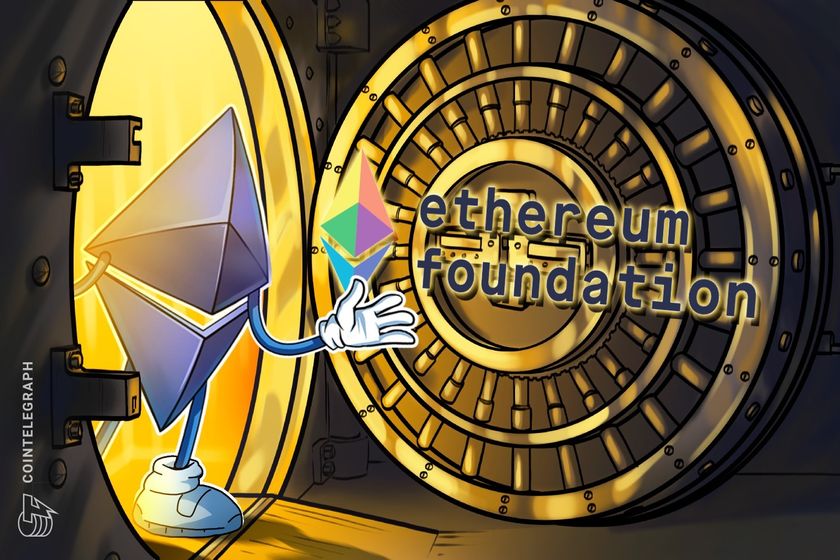 The Foundation backing the Ethereum blockchain has laid out a new treasury policy to ensure it allocates resources efficiently while supporting its DeFi ecosystem. The Ethereum Foundation is adopting a more structured and transparent treasury policy that ties operational costs and cash needs to its Ether reserves and sales to strengthen its financial position as it anticipates a pivotal 18 months ahead. Its annual operating cost — measured as a percentage of the EF’s treasury — and the number of years of runway will be reassessed regularly, factoring in market dynamics and community input to ensure the foundation’s short-term operations remain aligned with its long-term strategy, one of the foundation’s directors said on June 4. Hsiao-Wei Wang said the Ethereum Foundation currently only has 2.5 years before it runs out of cash, setting the stage for a crucial 18 months as it seeks to deploy resources more deliberately and provide more ecosystem support: Read more
 -
CryptoSlate - 22:00 Jun 04, 2025
Ethereum Foundation has released a sweeping update to its treasury management strategy, signaling a more mature, structured approach to capital allocation amid ETH’s growing global influence and rising institutional scrutiny. The new framework, published on June 4, outlines how the foundation will manage reserves, deploy capital in DeFi protocols, and assess privacy standards, while maintaining […] The post Ethereum Foundation unveils comprehensive treasury plan to balance capital and privacy commitments appeared first on CryptoSlate. -
CryptoSlate - 22:45 Jun 02, 2025
The Ethereum Foundation (EF) merged its protocol research and development units under a single banner, called Protocol, on June 2. The new initiative focuses resources on three technical priorities: scaling the base layer, expanding blob capacity for layer-2 networks, and enhancing the user experience. The three-track plan Protocol will steer code writers, researchers, and project […] The post Ethereum Foundation unites protocol teams to fast-track scaling, blobs and UX overhaul appeared first on CryptoSlate. -
Cointelegraph.com - 12:38 May 29, 2025
 Aave founder Stani Kulechov says the Ethereum Foundation is now both supplying and borrowing from Aave, completing what he calls “the full DeFi circle.” The Ethereum Foundation (EF) has borrowed $2 million in GHO, a decentralized stablecoin developed by Aave, in a move signaling deeper engagement with decentralized finance (DeFi) strategies. In a May 29 X post, Aave founder Stani Kulechov said the foundation borrowed $2 million in GHO tokens. “The EF is not only supplying ETH to Aave, but also borrowing from Aave,” Kulechov wrote, describing the development as “the full DeFi circle.” GHO is a decentralized, overcollateralized stablecoin native to the Aave Protocol. Unlike centralized stablecoins, GHO is governed by Aave’s decentralized autonomous organization (DAO), which oversees interest rates, collateral requirements and facilitator selection. Read more