Ethereum | Crypto
"Ethereum" in Crypto feed
-
CryptoSlate - 16:55 Dec 31, 2025
The Ethereum blockchain recorded its strongest operational year in history in 2025, processing record transaction volumes and securing the vast majority of the DeFi market. However, the crypto asset that powers the network failed to mirror that growth, posting double-digit losses for the year. According to CryptoSlate's data, ETH is trading down 10% year-to-date at […] The post Ethereum lost over $100 million in fees this year, and one corporate giant kept the profit appeared first on CryptoSlate. -
Cointelegraph.com - 13:32 Dec 31, 2025
 Ether trades sideways as spot ETF outflows, weak bullish leverage demand, and low Ethereum network fees cap recovery prospects going into 2026. Key takeaways: ETH remains capped below $3,000 as repeated breakout failures weaken trader confidence and suppress short-term momentum. A sustainable ETH rally will require stronger network activity and DApp demand to offset weak leverage and ETF flows. Read more
 -
Cointelegraph.com - 06:38 Dec 31, 2025
 Ethereum transactions were the most costly in May 2022 when fees were over $200 per transaction on average. They have been declining since. The Ethereum mainnet clocked 2.2 million transactions in a single day in a new record this week, while fees have fallen to just 17 cents on average. The layer-1 blockchain recorded its new transaction milestone on Tuesday, according to block explorer Etherscan. Transaction fees have also dropped considerably over time. The highest transaction fees on Ethereum were recorded in May 2022, when users had to spend over $200 per transaction. Read more
 -
Cointelegraph.com - 16:43 Dec 30, 2025
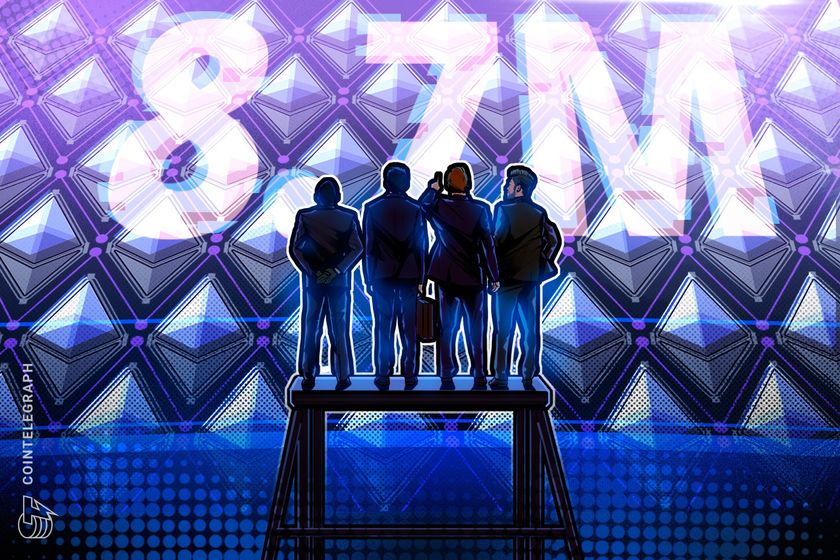 Onchain development activity on Ethereum has rebounded sharply, driven by tokenized assets, stablecoins and infrastructure, according to Token Terminal. Despite sluggish Ether price action, developers are increasingly choosing Ethereum as a settlement layer, with the fourth quarter shaping up to be a record period for the network. Data from Token Terminal shows that the number of new smart contracts created and published on the Ethereum blockchain reached an all-time high of 8.7 million in the fourth quarter. The milestone marked a sharp rebound from the previous two quarters, when contract deployment activity was significantly lower. Read more
 -
CryptoPotato - 09:31 Dec 30, 2025
Ethereum whales added millions of ETH in 2025 as retail sold, while developer activity hit record highs and key price levels remain in focus. -
CryptoSlate - 11:41 Dec 29, 2025
A single corporate treasury has effectively hijacked Ethereum’s validator mechanics, executing a billion-dollar maneuver that has flipped the network’s flow data from a steady exodus to a sudden traffic jam. For the first time in six months, the queue to stake ETH, locking up tokens to secure the blockchain in exchange for yield, significantly outstrips […] The post Ethereum’s record staking queue looks bullish, but one corporate giant is secretly distorting the real signal appeared first on CryptoSlate. -
CoinDesk - 15:00 Dec 28, 2025
Hegota will follow “Glamsterdam,” Ethereum’s next major upgrade, which is currently expected to roll out in the first half of 2026. -
CryptoSlate - 13:53 Dec 28, 2025
Ethereum’s 2026 roadmap centers on two tracks: expanding rollup data capacity through blobs while pushing base-layer execution higher through gas limit changes. Those gas limit changes depend on validators moving from re-executing blocks to verifying ZK execution proofs. The first track is already anchored by Fusaka, which shipped Dec. 3, 2025. Fusaka Fusaka sets up […] The post Ethereum’s 2026 roadmap includes this validator risk that’s bigger than you think appeared first on CryptoSlate. -
CryptoPotato - 07:52 Dec 28, 2025
2025 was a mixed year for Ethereum, defined by major network upgrades, expanding institutional adoption, and a widening gap between ecosystem growth and ether’s price performance. -
Cointelegraph.com - 10:24 Dec 27, 2025
 Ethereum treasury firm Bitmine has begun staking Ether after depositing nearly $219 million worth of ETH into Ethereum’s proof-of-stake system. Ethereum treasury firm Bitmine has begun staking its Ether holdings depositing nearly $219 million worth of ETH into Ethereum’s proof-of-stake (PoS) system. On Sunday, multiple wallets linked to Bitmine sent large Ether (ETH) transfers to a contract labeled “BatchDeposit,” onchain data from Arkham shows. The transfers totaled 74,880 ETH, a pattern typically associated with institutional staking setups that aggregate funds before validator creation. “The largest Ethereum treasury company Bitmine (BMNR) has finally started attempting to stake its held ETH to earn interest income,” EmberCN said in a post on X. Read more
 -
Cointelegraph.com - 23:46 Dec 26, 2025
 A surge in stablecoins, tokenized RWAs and growing sovereign wealth fund interest could drive a major increase in Ethereum’s TVL in 2026, Sharplink’s co-CEO said. Ethereum’s total value locked (TVL) may surge ten-fold in 2026 as adoption expands across multiple use cases and institutional investors, according to Sharplink’s co-CEO Joseph Chalom. Sharplink Gaming is the second-largest public Ethereum treasury company, holding 797,704 ETH (ETH), worth roughly $2.33 billion at the time of publication, according to Ethereum Treasuries data. “The stablecoin market will hit $500B by the end of next year,” Chalom predicted in an X post on Friday, as the total stablecoin market capitalization currently sits at around $308.46 billion. A move to $500 billion would represent an increase of about 62%. Read more
 -
Cointelegraph.com - 13:00 Dec 26, 2025
 The lowdown on how the switchover to ZK-proofs is expected to work this year as part of Ethereum’s plan to scale to 10,000 TPS. 2026 is a pivotal year for Ethereum. The first Ethereum validators will process tiny zero-knowledge (ZK) proofs instead of reexecuting transactions. This unlocks immediate scaling benefits for the layer 1 and sets it on the path toward 10,000 transactions per second (TPS). Researcher Justin Drake demonstrated that validating proofs on an old laptop is already possible at EthProofs Day at Devconnect in November. One in 10 validators are expected to make the switch to ZK before the end of the year. It’s a complete overhaul of the fundamental way the blockchain works: comparable in scale to the Merge in 2022, when Ethereum successfully switched from proof-of-work to proof-of-stake. Read more
 -
Cointelegraph.com - 03:53 Dec 26, 2025
 If Ether manages to reclaim its all-time high in 2026, it may just be a “bull trap,” says crypto analyst Ben Cowen. Ethereum is unlikely to hit new highs in the coming year, given the current conditions for Bitcoin, says crypto analyst Benjamin Cowen. “If Bitcoin truly is truly in a bear market, which is what it feels like, it would be kind of hard for Ethereum to go up there,” Cowen said on the Bankless podcast on Tuesday. It comes after veteran trader Peter Brandt predicted on Dec. 19 that Bitcoin could fall as low as $60,000 by the third quarter of 2026. Read more
 -
Cointelegraph.com - 13:00 Dec 25, 2025
 The coming year will see perfect parallel processing, big increases in the gas limit and number of data blobs, and 10% of Ethereum’s network switching to ZK. The coming year is set to be crucial for Ethereum scaling. In 2026, the Glamsterdam fork will bring perfect parallel processing to the chain and ratchet up the gas limit to 200 million, up from 60 million today. A significant number of validators will switch over from reexecuting transactions to verifying zero-knowledge (ZK) proofs instead. This sets the Ethereum layer 1 on a path to scale up to 10,000 transactions per second (TPS) and potentially beyond, though that target won’t be hit in 2026. Meanwhile, data blobs will increase (potentially up to 72 or more per block), enabling the layer 2s (L2s) to process hundreds of thousands of transactions per second. L2s are becoming easier to use as well; ZKsync’s recent Atlas upgrade allows funds to stay on mainnet but trade in the fast execution environment of chains in ZKsync’s Elastic Network. The planned E...
 -
Cointelegraph.com - 02:16 Dec 25, 2025
 Dragonfly’s Rob Hadick says “there’s a lot of room” in crypto for more than one blockchain as networks race to win market share of tokenized assets. Solana and Ethereum will both thrive in the tokenization race and neither blockchain will push the other out of the space, says Dragonfly general partner Rob Hadick. “They are both Facebook,” Hadick told CNBC’s “Squawk Box” on Wednesday, when asked which blockchain will gain market dominance like social media platform Facebook or fall behind like the once-popular MySpace. Hadick said that with growing interest in tokenization and increasing economic activity onchain, there’s room for multiple blockchains to coexist. Read more
 -
Cointelegraph.com - 09:34 Dec 24, 2025
 Trend Research’s 46,379 ETH purchase vaults the private company into the top tier of ETH treasuries, behind only SharpLink Gaming and BitMine Immersion Technologies. Trend Research purchased 46,379 Ether (ETH) on Wednesday to raise its holdings to about 580,000 ETH, making it larger than most public Ethereum treasuries tracked by CoinGecko. Only two listed companies, SharpLink Gaming and BitMine Immersion Technologies, currently report bigger ETH balances, with 859,853 ETH and 4,066,062 ETH, respectively. Trend Research is not a publicly listed company and therefore does not appear in most Ethereum treasury rankings. Still, it has drawn industry attention for its rapid ETH accumulation. Read more
 -
Cryptonews.com - 17:58 Dec 23, 2025
Ethereum has been described by William Mougayar as a public good akin to the Internet. His framework values captured fees, wide flow value across apps and markets, and trust surplus from lower verification costs and counterparty risk, as dependency on the settlement layer grows over years, globally. The post Ethereum Is Emerging as a Global Public Good – and That Changes How It Should Be Valued, Says William Mougayar appeared first on Cryptonews. -
CryptoSlate - 15:05 Dec 23, 2025
Ethereum (ETH) broke its 2021 all-time high in August, brushing $4,945 and a $600 billion market cap, while exchange balances hit record lows. Corporate treasuries and spot ETFs now control nearly 11% of the circulating supply. By every structural metric, ETH should feel like it's having a moment. It doesn't. No Bored Apes are selling […] The post Ethereum is vanishing from exchanges, and the massive wallets absorbing it prove you aren’t the target audience anymore appeared first on CryptoSlate. -
Decrypt - 14:01 Dec 23, 2025
This year, global power centers like Wall Street learned to love Ethereum—and Ethereum learned to love them back. -
Cointelegraph.com - 13:19 Dec 23, 2025
 Ethereum is increasingly powering tokenized money, faster settlement and regulated onchain infrastructure — even as institutions avoid naming it outright. Wall Street’s adoption of Ethereum is closely tied to its ability to automate settlement through smart contracts, reducing reliance on slow, manual reconciliation processes. Stablecoins and tokenized dollars now serve as a primary entry point for banks, allowing regulated US dollar transfers to move continuously on Ethereum-based rails. Financial institutions often avoid naming Ethereum directly, instead describing it as neutral blockchain infrastructure that supports compliant financial systems. Read more