Mica | Crypto
"Mica" in Crypto feed
-
Cointelegraph.com - 12:30 Jun 09, 2026
 One of MiCA's architects said he sees no need to regulate DeFi as the European Commission gathers feedback on the framework's future. The European Union should focus on a broader digital asset framework covering real-world assets and tokenization instead of regulating decentralized finance through a second version of the Markets in Crypto-Assets Regulation (MiCA), an adviser at the European Commission said. The European Commission launched a public consultation on MiCA in May, seeking feedback through Aug. 31. "I do not believe that [MiCA] is outdated now. That’s my personal opinion, but it does not matter. That’s why we have this consultation,” Peter Kerstens told Cointelegraph during a fireside chat at WAIB Summit Monaco 2026. Read more
 -
Cointelegraph.com - 16:01 Jun 03, 2026
 The ESMA says crypto companies without MiCA authorization must stop serving EU clients from July 1, even if their licence applications remain under review. The European Union’s Markets in Crypto Assets Regulation hits a hard deadline on July 1 when the transitional period ends and in-scope crypto asset service providers operating under national regimes must either hold a MiCA licence or stop serving EU clients. A spokesperson from the European Securities and Markets Authority (ESMA) told Cointelegraph that from that date, non-authorized entities “will not be allowed to operate within the EU” and should implement wind-down and client migration plans rather than rely on open-ended transitional status while awaiting a decision. The deadline could force some crypto firms to suspend EU operations while their applications remain under review, potentially affecting millions of users who continue to engage with platforms that are not yet authorized under MiCA. Read more
 -
Cointelegraph.com - 20:19 May 28, 2026
 The European Union's Markets in Crypto Assets regulations first took effect in 2024, but gave crypto service providers time to fully comply with the framework. The French Financial Markets Authority (AMF) warned that crypto companies operating in the country without a license have until June 30 to acquire the permits or exit the country. AMF President Marie-Anne Barbat-Layani told a press event on Thursday that crypto companies that fail to obtain a license by the deadline must have "orderly wind-down plans" to offload customers and end their operations, according to Reuters. Under the European Union’s Markets in Crypto Assets (MiCA) regulatory framework, crypto service providers are required to have licenses to operate, but can acquire a license in any of the 27 EU member states and “passport” the license to any of the other member nations. Read more
 -
Cointelegraph.com - 14:36 May 27, 2026
 The bank plans to launch digital asset custody, transfer and receipt services in 2026 for selected customer categories. Italian bank Banca Sella announced that it has completed its notification process with the Bank of Italy under the European Union’s Markets in Crypto-Assets (MiCA) regulation, allowing it to offer crypto-asset services. On Wednesday, the bank said it is the first bank in Italy authorized to offer crypto-asset services, adding that the approval will allow it to launch a solution focused on the custody, transfer and receipt of digital assets in 2026, aimed at “selected categories” of customers. Banca Sella is the commercial bank of Sella Group. According to Sella Group, it has almost 300 branches and more than 2,400 employees. Read more
 -
Cointelegraph.com - 14:16 May 20, 2026
 EU opens MiCA review as consultation probes stablecoin interest rules, DeFi risks and classification gaps ahead of July's crypto authorization deadline. The European Commission has opened a review of its landmark crypto regulation, signaling that the European Union is considering updates to its landmark digital asset framework just two years after it took effect. The commission on Wednesday launched a public consultation seeking feedback from the crypto industry and the wider public on whether the EU’s Markets in Crypto-Assets Regulation (MiCA) should be updated. The consultation will remain open until Aug. 31. The commission said crypto markets and the global regulatory environment have “continued to evolve” since MiCA took effect in 2024, prompting officials to assess whether the current framework remains “fit for purpose.” Read more
 -
Cointelegraph.com - 14:55 May 13, 2026
 Paybis has secured both a MiCA crypto licence and a PSD2 payment institution licence from Latvia’s central bank, becoming the first company in the country to hold both simultaneously. Cryptocurrency platform Paybis has received two licences from Latvia’s central bank, including one for crypto-asset services under the European Union’s Markets in Crypto-Assets Regulation (MiCA) and another for payment institution operations under Payment Services Directive 2 (PSD2). The licences were issued by the Supervision Committee of Latvijas Banka on May 12 to SIA Paybis Europe, the company’s EU entity, according to an announcement from the central bank. Paybis is the third company in Latvia to receive a MiCA CASP licence, the central bank said. The MiCA licence covers custody and administration of crypto assets on behalf of clients, exchange of crypto-assets for funds or other crypto assets, execution of orders, transfer services and crypto asset advisory, Latvijas Banka said. The central bank added that the PSD2 payment...
 -
Cointelegraph.com - 18:32 Apr 29, 2026
 KuCoin EU hires a new AML chief and deputies in Vienna weeks after Austria’s regulator banned the MiCA‑licensed exchange from taking on new business over compliance gaps. Update (April 29, 17:15 UTC): This article has been updated to include comments from KuCoin EU's AML officer Carmen Kleinhans and managing director Sabina Liu. KuCoin EU has appointed a new Anti-Money Laundering (AML) chief and expanded its compliance team in Vienna, weeks after Austrian regulators barred the exchange from taking on new business under Europe’s Markets in Crypto-Assets Regulation (MiCA) regime. The MiCA-licensed entity named Carmen Kleinhans as its Anti-Money Laundering Officer, alongside two deputy AML officers drawn from former Austrian regulators and bank compliance chiefs. According to a Wednesday release, the team will oversee AML, Counter-Terrorist Financing (CTF) and sanctions controls, as well as enterprise-wide risk management and regulatory engagement. Kleinhans told Cointelegraph that the focus is on embedding cont...
 -
Cointelegraph.com - 13:49 Apr 27, 2026
 A new Blockchain for Europe report says MiCA has made euro stablecoins safer but less competitive, and urges targeted reforms to reserves and remuneration. A new report released Monday from industry group Blockchain for Europe argues that the European Union’s flagship crypto laws, the Markets in Crypto-Assets Regulation (MiCA) framework, have produced euro-denominated stablecoins that are ultra-safe but commercially weak, leaving the bloc far behind US dollar-pegged tokens in digital payments and trading. The report cites DeFiLlama data that euro stablecoins account for less than 1% of global stablecoin volume despite the euro’s much larger role in global markets, and argues that MiCA has pushed them onto the “downward-sloping” part of a regulatory "Laffer" curve, where stricter rules reduce the activity they are meant to govern. Drafted by European Central Bank official Ulrich Bindseil and Blockchain for Europe’s Erwin Voloder, the report focuses on MiCA’s rules for euro electronic money tokens, or EMTs, whi...
 -
Cointelegraph.com - 13:28 Apr 22, 2026
 Smaller crypto companies across Europe face mounting compliance costs as MiCA moves from framework to enforcement, raising fears of market consolidation. The European Union’s Markets in Crypto Assets Regulation (MiCA) transition period is entering its final stretch, forcing smaller crypto firms across the EU to either secure authorization quickly or prepare to shut down regulated services. The transitional period ends across the bloc on July 1, after which any crypto asset service provider operating without a MiCA license must stop serving EU clients. Early movers like United Kingdom-based exchange CoinJar, which said it secured MiCA authorization in Ireland in 2025, call the regime a necessary maturation that rewards compliance-first players, but founders in markets like Poland warn thousands of virtual asset service providers (VASPs) could fall off a regulatory cliff as deadlines hit. Companies face a hard stop of July 1 for the longest 18-month grandfathering window, with some national regimes already clos...
 -
Cointelegraph.com - 10:43 Apr 15, 2026
 EU officials plan to reassess MiCA as companies test its limits, with industry feedback set to shape potential changes to the bloc’s crypto framework. A European Commission adviser said the European Union’s landmark MiCA crypto regime is likely to evolve as digital asset markets develop beyond the conditions the law was originally designed to address. Speaking at the Paris Blockchain Week (PBW) 2026, Peter Kerstens, an adviser on technological innovation, digital transformation and cybersecurity at the European Commission’s financial services department, said the Commission will review the Markets in Crypto-Assets Regulation (MiCA) and launch a public consultation to assess whether the rules are working for market participants and supporting business development. The remarks suggest EU policymakers are already thinking about how MiCA may need to evolve as the crypto market matures. Kerstens said he could not predict the future, but added that EU financial legislation typically evolves in stages, suggesting it...
 -
Cointelegraph.com - 14:05 Apr 10, 2026
 A Bank of France official called for tighter MiCA rules on non-euro stablecoins as lawmakers advance reporting requirements for self-custodial crypto wallets above 5,000 euros. French officials are pushing for tighter oversight of crypto from two directions, as a Bank of France official called for stricter limits on non-euro stablecoins under the European Union’s Markets in Crypto-Assets Regulation (MiCA), and lawmakers in Paris advanced a separate reporting requirement for some self-custody holdings. Denis Beau, First Deputy Governor of the Bank of France, delivered a speech at the EUROFI High Level Seminar in March, calling on the EU to restrict the use of stablecoins for payments, particularly those pegged to non-euro currencies. Published on the Bank for International Settlements (BIS) website on Thursday, he said the Bank of France has been “pressing for a strengthening” of MiCA in this regard. Read more
 -
Cointelegraph.com - 14:26 Apr 08, 2026
 MEXC appointed Vugar Usi as CEO and outlined plans to expand zero-fee trading and pursue MiCA licensing amid growing industry competition. MEXC appointed Vugar Usi as CEO on Wednesday, elevating the executive as the exchange steps up its push for global licensing, including under the European Union’s Markets in Crypto-Assets Regulation (MiCA) framework. MEXC said Usi joined the company as chief operating officer in late 2025 after previously serving in the same position at rival exchange Bitget. In his new role, Usi said MEXC plans to preserve its low-fee trading focus while expanding broader multi-asset access on the platform. Read more
 -
Cointelegraph.com - 13:36 Mar 27, 2026
 An ECB working paper found DeFi governance remains highly concentrated, complicating efforts to identify who should fall under MiCA oversight. The European Central Bank published a working paper on March 26, finding that governance in four major DeFi protocols was heavily concentrated. The staff paper looks at Aave, MakerDAO, Ampleforth and Uniswap, and finds that while governance tokens are held across tens of thousands of addresses, the top 100 holders control more than 80% of the supply in each protocol. Based on holdings snapshots from November 2022 and May 2023, the authors found that a large share of governance tokens could be linked either to the protocols themselves or to centralized and decentralized exchanges, with Binance the largest identified centralized exchange holder across the four protocols. Read more
 -
Cointelegraph.com - 14:20 Mar 18, 2026
 The UK has a unique opportunity to merge the best of the EU’s MiCA framework and the US GENIUS Act, Circle’s Dante Disparte told the House of Lords committee on Wednesday. Circle’s policy chief Dante Disparte told a United Kingdom House of Lords committee that the UK has a chance to build its crypto regime by combining the clarity of the European Union’s Markets in Crypto-Assets Regulation (MiCA) with elements of the new US stablecoin framework. “The model is clear: take the best of both and make it distinctly British,” Disparte said during a Wednesday meeting of the House of Lords Financial Services Regulation Committee. “From Europe, take clarity, definitions, licensing, governance and strong consumer protection from the US and the landmark Genius Act.” Disparte argued that the absence of a regulatory framework will keep stablecoin activity offshore, leaving UK users more exposed and jeopardizing London’s status as a global hub for financial innovation. The meeting was part of the House of Lords’ inquiry in...
 -
Cointelegraph.com - 11:58 Feb 17, 2026
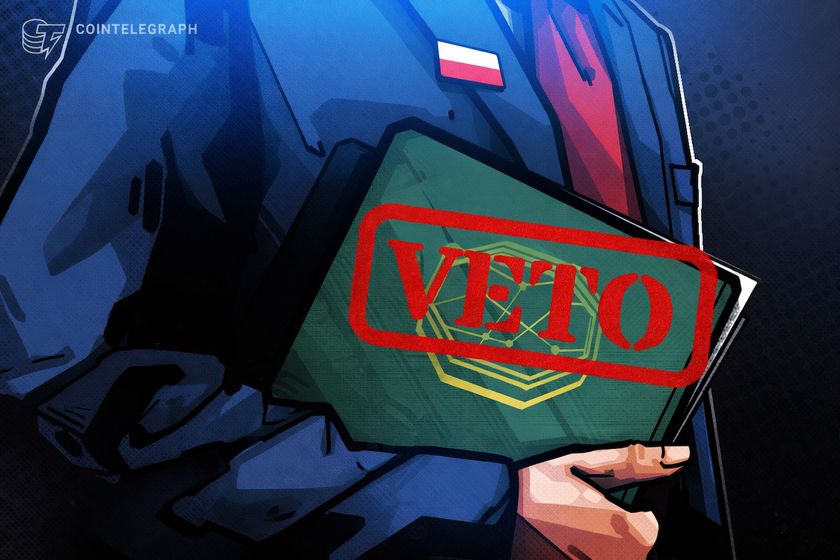 President Karol Nawrocki vetoed a second MiCA crypto bill, saying it was “practically identical” to a previous version, leaving local companies in limbo ahead of a summer MiCA deadline. Poland’s president vetoed a second bill meant to align the country’s crypto rules with the European Union’s Markets in Crypto-Assets Regulation framework, deepening uncertainty for local platforms as a key transition deadline approaches. President Karol Nawrocki declined to sign Bill 2064 last week, marking the second veto of proposed legislation to implement the EU’s Markets in Crypto-Assets Regulation (MiCA), the president’s office said Thursday. Nawrocki vetoed a similar measure in December and described Bill 2064 as “practically identical” to the original Bill 1424 vetoed previously. The veto followed an announcement by the Polish Financial Supervision Authority (KNF), warning that Poland has not designated a competent authority to supervise the crypto market, highlighting the MiCA transition deadline of July 1, 2026. Read...
 -
CryptoSlate - 11:30 Feb 03, 2026
Germany's ING Deutschland just made crypto exposure feel like buying an index fund, indicating the path Europe is taking in crypto adoption. Starting Feb. 2, the bank's 3.2 million brokerage customers can purchase crypto exchange-traded notes with zero order fees above €1,000 and set up automatic savings plans. According to the announcement, there are no […] The post Major German bank opens free crypto access as MiCA ends the legality debate and sparks a bank rush appeared first on CryptoSlate. -
Cointelegraph.com - 10:31 Jan 27, 2026
 Former London Stock Exchange Group executive Sabina Liu will lead KuCoin EU’s MiCA-era expansion from Vienna, as the exchange pivots toward a compliance-first European strategy. KuCoin has appointed former London Stock Exchange Group (LSEG) executive Sabina Liu to lead its European business, tasking her with steering the exchange’s Markets in Crypto Assets Regulation (MiCA) expansion from Vienna after securing a crypto asset service provider license in Austria. Liu, who will serve as managing director of KuCoin EU, previously ran KuCoin’s institutional business and also spent more than a decade at the LSEG working with global investment banks and cross-border trading clients, according to an announcement shared with Cointelegraph. Liu told Cointelegraph that securing a MiCA license was a “major milestone” that gave KuCoin a unified regulatory framework to serve a region with mature and diverse finance, increasing crypto use and “significant room” for further adoption across stablecoins, payments and wealth pr...
 -
Cointelegraph.com - 15:50 Jan 26, 2026
 As the US delays crypto laws and Europe enforces MiCA, markets face regulatory gaps, capital shifts and uneven compliance costs for global firms. Europe has moved from drafting to enforcing crypto rules under MiCA, giving companies clear timelines, licensing paths and compliance milestones across all EU member states. The US still relies on a multi-agency, enforcement-led framework, with major questions about token classification and market structure waiting on new federal legislation. MiCA’s single-license model allows crypto firms to operate across the EU after approval in one country, encouraging companies to base early expansion strategies in Europe. Read more
 -
CoinDesk - 12:14 Jan 23, 2026
The exchange confirmed it has applied for regulatory approval under the MiCA regime, part of a broader effort to regain footing in major markets. -
Cointelegraph.com - 09:05 Jan 23, 2026
 Binance applied for a MiCA license in Greece shortly after France flagged the exchange as still unlicensed under MiCA ahead of June compliance deadlines. Binance submitted an application for authorization under the European Union’s Markets in Crypto-Assets Regulation (MiCA) in Greece as regulators warn of looming compliance deadlines. A Binance spokesperson confirmed to Cointelegraph on Friday that the exchange had filed for a MiCA license in Greece and was working with the country’s financial regulator, the Hellenic Capital Market Commission (HCMC). “We welcome the opportunity to work closely with the HCMC as this new regulation takes shape in the EU and look forward to contributing to the long-term growth of the EU’s digital financial ecosystem,” the exchange’s representative said. Read more