Solana | Crypto
"Solana" in Crypto feed
-
CoinDesk - 16:49 Feb 12, 2026
Resilience built from the debris of 2022 is now shaping the Solana ecosystems future, leaders from Jupiter, Backpack, Kamino and DoubleZero argued at Consensus Hong Kong 2026. -
Cryptonews.com - 22:35 Feb 11, 2026
Market routs are often the best time to enter crypto.As Bitcoin ($BTC) fights to retake $70,000, many established digital assets are now trading at a substantial discount relative to recent highs.The long-term trend indicates global adoption is all but inevitable. In this context, signs indicate that XRP, Solana, and Dogecoin could be the best crypto […] The post Best Crypto to Buy Now February 11 – XRP, Solana, Dogecoin appeared first on Cryptonews. -
Cryptonews.com - 22:30 Feb 11, 2026
When you feed China’s strange new KIMI AI with a carefully engineered prompt, you can get the model to reveal some eye-catching price predictions for XRP, Dogecoin, and Solana this year.According to Alibaba’s projections, all three assets could print new all-time highs (ATHs) within the next eleven months.Below, we break down how these bullish forecasts […] The post Strange New Chinese AI ‘KIMI’ Predicts the Price of XRP, Dogecoin and Solana By the End of 2026 appeared first on Cryptonews. -
CryptoSlate - 21:25 Feb 11, 2026
The XRP Ledger (XRPL) has overtaken Solana on one closely watched metric over the past month, flipping it in real-world asset tokenization, excluding stablecoins. Data from RWA.xyz indicate that the Ledger has approximately $1.756 billion in total on-chain real-world asset value, excluding stablecoins, compared with approximately $1.682 billion for Solana. While this gap is not […] The post XRP Ledger just flipped Solana in RWA tokenization value and the holder count reveals why appeared first on CryptoSlate. -
Cryptonews.com - 22:35 Feb 10, 2026
The worst market dips are often the best days to buy crypto. With Bitcoin ($BTC) struggling to hold ground above $70,000, blue-chip cryptos are trading at a relative discount.Things are constantly moving towards global adoption, even if it doesn’t seem that way. In that light, certain news and chart signals suggest that XRP, Solana and […] The post Best Crypto to Buy Now February 10 – XRP, Solana, Dogecoin appeared first on Cryptonews. -
CryptoSlate - 17:35 Feb 10, 2026
Ripple has enabled staking for Ethereum and Solana within its institutional custody business, expanding beyond safekeeping to include asset servicing features that large investors increasingly consider standard. The new capability, delivered through a partnership with staking infrastructure provider Figment, enables Ripple Custody clients to offer staking on major proof-of-stake networks without setting up validator infrastructure. […] The post Ripple Custody just unlocked Ethereum and Solana staking, and institutions may finally get XRP yield without messy validator risk appeared first on CryptoSlate. -
Cointelegraph.com - 11:36 Feb 10, 2026
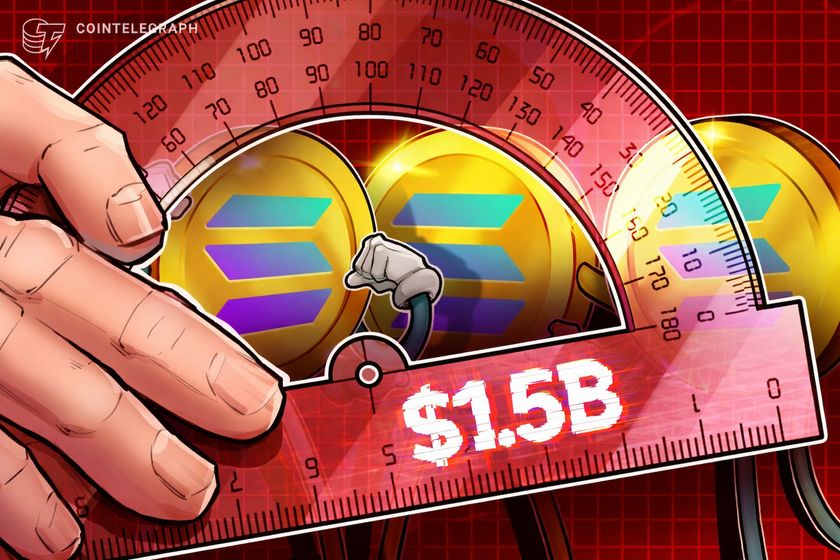 Public companies that amassed large Solana positions in 2025 have paused accumulation as equity markets reprice SOL-heavy balance sheets. Publicly listed companies that hold Solana as a treasury asset are sitting on more than $1.5 billion in unrealized losses, based on disclosed acquisition costs and current market prices tracked by CoinGecko. The losses are concentrated among a small group of United States-listed companies that collectively control over 12 million Solana (SOL) tokens, about 2% of the total supply. While losses remain unrealized, equity markets have already repriced the companies, with most trading well below the market value of their tokens. CoinGecko data shows that Forward Industries, Sharps Technology, DeFi Development Corp and Upexi account for over $1.4 billion in disclosed unrealized losses. The total is likely understated, as Solana Company has not fully disclosed its acquisition costs. Read more
 -
Cointelegraph.com - 15:14 Feb 09, 2026
 SOL’s price has validated a classic head-and-shoulders pattern on multiple time frames, with a price target of about $50. Solana’s SOL (SOL) has dropped 38% over the last 30 days, falling to a two-year low of $67 on Friday. Multiple analysts say that the downside is not over for the seventh-placed cryptocurrency, with downward targets extending as low as $30. Key takeaways: Solana’s head-and-shoulders pattern targets a SOL price of $50 or lower. Read more
 -
Cryptonews.com - 22:35 Feb 06, 2026
A broad technology-sector selloff continues to pressure digital assets, briefly dragging Bitcoin down to $60,000 in the early hours of the morning (UTC).Despite the downturn, sentiment around U.S. crypto regulation is likely around the corner. Lawmakers remain caught between competing interests from the banking and digital asset sectors, but the possible advancement of the CLARITY […] The post Best Crypto to Buy Now February 6 – XRP, Solana, Bitcoin appeared first on Cryptonews. -
Cryptonews.com - 22:35 Feb 06, 2026
A broad technology-sector selloff continues to pressure digital assets, briefly dragging Bitcoin down to $60,000 in the early hours of the morning (UTC).Despite the downturn, sentiment around U.S. crypto regulation is likely around the corner. Lawmakers remain caught between competing interests from the banking and digital asset sectors, but the possible advancement of the CLARITY […] The post Best Crypto to Buy Now February 6 – XRP, Solana, Bitcoin appeared first on Cryptonews. -
CryptoSlate - 12:36 Feb 06, 2026
The cryptocurrency market has entered a renewed phase of volatility, with major digital assets including XRP, TRX, and BNB experiencing notable price corrections alongside broader market weakness. The downturn reflects a combination of macroeconomic pressure, reduced speculative activity, and ongoing reassessment of long-term network fundamentals across leading blockchain ecosystems. As prices across multiple Layer 1 […] The post XRP, TRX, and BNB Slide Amid Broader Crypto Volatility as SONAMI Accelerates Layer 2 Development on Solana appeared first on CryptoSlate. -
Cryptonews.com - 22:30 Feb 05, 2026
China's DeepSeek AI predicts upside cases for XRP, Solana and Bitcoin through 2026–2027, arguing that a longer bull market plus firmer US regulatory clarity could lift XRP toward $10, SOL toward $500, and BTC toward $250,000, even after steep pullbacks from prior highs. It also cites US ETF inflows. The post China’s DeepSeek AI Predicts the Price of XRP, Solana and Bitcoin By the End of 2026 appeared first on Cryptonews. -
Cryptonews.com - 14:59 Feb 05, 2026
Uniform Labs’ Multiliquid and Metalayer have launched a Metalayer-backed Solana facility for instant stablecoin redemptions of tokenized RWAs. It buys assets at a discount to NAV to provide continuous liquidity, starting with issuers including VanEck, Janus Henderson and Fasanara. Kamino integration The post Uniform Labs’ Multiliquid and Metalayer Launch RWA Redemption Facility on Solana appeared first on Cryptonews. -
Cointelegraph.com - 14:00 Feb 05, 2026
 The new facility allows institutions to redeem tokenized real-world assets into stablecoins instantly, addressing a key liquidity bottleneck in onchain markets. Multiliquid and Metalayer Ventures have launched an institutional liquidity facility to provide instant redemptions for tokenized real-world assets (RWAs) on Solana. The facility allows holders of tokenized assets to convert positions into stablecoins instantly. The vehicle is raised and managed by Metalayer Ventures, with infrastructure and market support provided by Uniform Labs, the developer behind the Multiliquid protocol, according to an announcement shared with Cointelegraph. “Traditional finance has repo markets, prime brokerage and overnight lending facilities. Tokenized markets have had nothing comparable, until now,” said Will Beeson, founder and CEO at Uniform Labs. “This is the liquidity infrastructure that institutional RWA markets will require at scale.” Read more
 -
Cryptonews.com - 22:35 Feb 04, 2026
Best crypto to buy now February 4 has shifted as a broad selloff has pulled bitcoin toward $76,000. Even with the drawdown, US regulation momentum has built around the CLARITY Act. Focus has turned to XRP ETFs, oversold Solana, Hyperliquid’s rally and Bitcoin Hyper’s Layer-2 presale through Q2 2026. The post Best Crypto to Buy Now February 4 – XRP, Solana, Hyperliquid appeared first on Cryptonews. -
Cryptonews.com - 22:30 Feb 04, 2026
Google's Gemini AI predicts XRP, Ethereum and Solana could hit new highs in 2026-27 if a long bull cycle and clearer U.S. rules draw more institutional and ETF flows. Gemini cites oversold RSI readings for XRP and SOL and key resistance near $5,000 for ETH as traders watch for a break later in 2026 The post Google’s Gemini AI Predicts the Price of XRP, Ethereum and Solana By the End of 2026 appeared first on Cryptonews. -
CryptoPotato - 15:24 Feb 04, 2026
[PRESS RELEASE – George town, Cayman Islands, February 4th, 2026] Tramplin, a premium staking platform built on Solana, backed by iTreasury Ventures, today announced its public launch, introducing a proven real-world savings model rebuilt for crypto. Built on Solana’s native staking architecture, Tramplin features a premium bonds-inspired reward redistribution mechanism designed to give smaller SOL holders access […] -
Cryptonews.com - 22:50 Feb 03, 2026
Crypto price prediction today has turned cautious after BTC slipped under $78K for a yearly low, while XRP stays bearish with $2.9B open interest, SOL defends $100–$105 support, and PI drifts lower amid weak ecosystem activity and steady supply. February often rose after red January; risk-off stays. The post Crypto Price Prediction Today 3 February – XRP, Solana, Pi Coin appeared first on Cryptonews. -
Cryptonews.com - 22:30 Feb 03, 2026
We hacked Elon's Grok AI to predict has tested prompt engineering on Grok and has outlined 2026–27 price paths: XRP up to $8, Solana up to $500, and Bitcoin toward $250,000. It has cited ETF demand, post-halving supply limits, U.S. policy shifts and geopolitics plus Solana TVL gains and RWA use too. The post We Hacked Elon’s Grok AI to Predict the Price of XRP, Solana and Bitcoin By the End of 2026 appeared first on Cryptonews. -
CoinDesk - 15:59 Feb 03, 2026
Analyst Geoffrey Kendrick trimmed his 2026 SOL forecast to $250 from $310, but says stablecoin micropayments could drive a longer-term surge as Solana moves beyond memecoins.