Crypto
-
Cointelegraph.com - 20:00 Sep 09, 2025
 US macroeconomic conditions mirror the 1990s, when Federal Reserve interest rate cuts drove a 30% stock rebound, a backdrop that could now set the stage for Bitcoin price to go higher. Key takeaways: Potential Federal Reserve rate cuts into weak US jobs data could fuel Bitcoin’s next rally. BTC holds key support and eyes $129,000 after rebounding from its wedge pattern. Read more
 -
CryptoPotato - 19:55 Sep 09, 2025
Mow accused devs of mocking node operators an even DDoSing them, calling the culture "toxic" and urging humility and professionalism. -
Cointelegraph.com - 19:51 Sep 09, 2025
 Ethena joins Paxos, Frax, Agora, Native Markets and Sky in the race to issue Hyperliquid’s USDH, a mandate tied to $5 billion in liquidity. Ethena Labs became the sixth bidder for Hyperliquid’s USDH stablecoin, announcing its proposal in a Tuesday blog post. The competition will decide who controls billions in liquidity and revenue on one of decentralized finance’s (DeFi) fastest-growing derivatives exchanges. The team behind USDe and USDtb is proposing a version of USDH backed entirely by USDtb, a stablecoin tied to BlackRock’s BUIDL fund and soon to be issued through Anchorage Digital Bank. If selected, Ethena has pledged to return 95% of reserve revenue to the Hyperliquid community and implement safeguards through an elected validator “guardian network.” The protocol has also promised to cover the costs of migrating Hyperliquid’s markets from USDC to USDH and committed at least $75 million in ecosystem incentives, a figure it said could rise to $150 million. Read more
 -
Cryptonews.com - 19:43 Sep 09, 2025
WLFI price prediction scenarios face massive uncertainty after Eric Trump was removed from the World Liberty Financial board following Nasdaq compliance discussions, as Alt5 Sigma revised its original arrangement to comply with exchange listing requirements, triggering an immediate 7% decline to 52-hour lows around $0.20. The post WLFI Price Prediction: Eric Trump Removed From World Liberty Board Due to Nasdaq Rules – Can WLFI Recover? appeared first on Cryptonews. -
Cryptonews.com - 19:26 Sep 09, 2025
The SHIB burn rate spiked 1,682% in a single day – Shiba Inu price prediction now stands to challenge the leading meme coin. The post Shiba Inu Price Prediction: 1,682% Burn Surge Ignites Bullish Frenzy – Can SHIB Flip Dogecoin? appeared first on Cryptonews. -
Cryptonews.com - 19:23 Sep 09, 2025
OKX, a cryptocurrency platform, has partnered with Tether, the issuer of the world’s most widely used stablecoin USDT, to bring USDT0, onto X Layer, OKX’s Ethereum Layer 2 network, as well as the OKX Wallet and Exchange. The post OKX Teams Up With Tether to Bring USDT0 to X Layer, Wallet and Exchange appeared first on Cryptonews. -
CoinDesk - 19:20 Sep 09, 2025
The big gains for players like Bitfarms, Hut 8 and Cipher Mining came despite lame price action for bitcoin. -
CryptoSlate - 19:15 Sep 09, 2025
Gemini, the cryptocurrency exchange founded by Cameron and Tyler Winklevoss, has lined up Nasdaq as a strategic investor as it prepares to go public in New York this week, Reuters reported on Sept. 9, citing people briefed on the matter. According to the report, the share sale could raise up to $317 million, with Nasdaq […] The post Winklevoss twins’ Gemini gears up for public debut this week with Nasdaq backing appeared first on CryptoSlate. -
Cryptonews.com - 19:08 Sep 09, 2025
Cboe has unveiled futures for continuous Bitcoin and Ether on CFE beginning Nov. 10, 2025, pending approval. The 10-year cash-settled contracts have used daily funding to track spot. Cboe has scheduled education sessions as U.S. reviews of perpetual futures have progressed. The post Cboe Sets Nov. 10 Target for Cash-Settled Bitcoin, Ether Futures – Pending Approval appeared first on Cryptonews. -
Cryptonews.com - 18:54 Sep 09, 2025
ETH ETFs have logged $1.04B in net outflows over six sessions, taking AUM to $27.39B (5.28% of ETH’s market cap) as daily volume has reached $1.52B. Withdrawals have been led by BlackRock’s ETHA, partly offset by Fidelity’s FETH, while Bitcoin ETFs have continued to attract inflows. The post Alarming $1B Drain Hits Spot ETH ETFs in 6-Day Streak – Is a Deeper Crash Imminent? appeared first on Cryptonews. -
Decrypt - 18:45 Sep 09, 2025
Harvard's PDGrapher tool forecasts gene-drug pairings that restore diseased cells, marking a breakthrough in precision therapies and biotech innovation. -
Cryptonews.com - 18:39 Sep 09, 2025
Trust Wallet has worked with Ondo Finance to bring tokenized U.S. Stocks on Ethereum, and ETFs have been available in-app through a self-custodial flow. Trading has used the 1inch aggregator, and the tokens have mirrored underlying assets via smart contracts, without a brokerage account. The post Trust Wallet Brings Tokenized Stocks and ETFs On-chain for 200M Users – No Broker appeared first on Cryptonews. -
Decrypt - 18:33 Sep 09, 2025
A dozen pro-crypto Senate Democrats published a list of requested changes to a pending crypto market structure bill, and expressed eagerness to get bipartisan legislation passed. -
CryptoSlate - 18:31 Sep 09, 2025
Eric Trump was removed from ALT5 Sigma Corporation’s board of directors due to Nasdaq listing rule requirements, according to a filing disclosed on Sept. 9. The August filing stated that “to comply with Nasdaq’s listing rules,” the company restructured its board composition, but did not specify which particular rule triggered Eric Trump’s removal. Trump now […] The post Eric Trump removed from ALT5 Sigma board following Nasdaq rule compliance requirements appeared first on CryptoSlate. -
Decrypt - 18:25 Sep 09, 2025
New tools that simplify quantum complexity are reshaping physics research, drawing fresh investment, and fueling urgency around post-quantum cryptography. -
Cointelegraph.com - 18:20 Sep 09, 2025
 A cooling phase for Bitcoin under $113,000 could be laying the groundwork for a breakout toward $120,000. Key takeaways: Bitcoin lost the $113,000 level as leverage use cooled and speculative bets, creating room for upside volatility. A breakout above would $113,650 confirm an inverse head-and-shoulders pattern, potentially driving BTC toward $120,000. Read more
 -
CryptoPotato - 18:18 Sep 09, 2025
Ethereum is cementing its position as the industry leader for real-world asset tokenization as Wall Street onboards the asset. -
Cointelegraph.com - 17:57 Sep 09, 2025
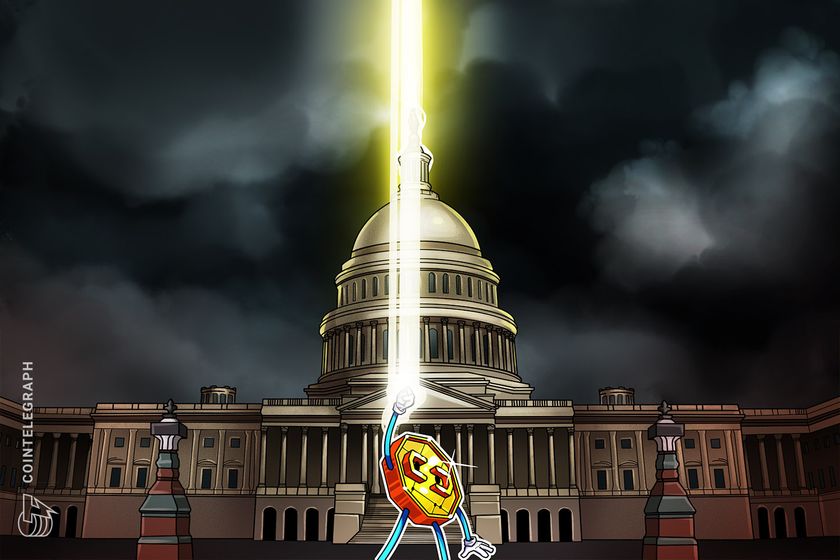 The group of 12 senators stressed the need for a bipartisan solution to market structure as Republicans on the banking committee plan to pass a bill this month. A group of Democratic US senators has released its own version of guidelines to influence legislation to establish a crypto market structure, focusing on taking time toward a “strong, bipartisan outcome.” In a Tuesday notice, 12 Democratic senators, several of whom are on the banking committee, unveiled a framework for market structure legislation in response to Republicans’ plans. Like the Republicans’ latest draft released on Sept. 5, the Democrats’ framework includes provisions for regulatory clarity and laying out rules by which the US Securities and Exchange Commission (SEC) and Commodity Futures Trading Commission (CFTC) could handle digital assets. Read more
 -
CryptoSlate - 17:47 Sep 09, 2025
Ethena Labs submitted a proposal on Sept. 9 to become the issuer of Hyperliquid’s native stablecoin USDH, joining an increasingly competitive race. The bid consists of backing USDH entirely by USDtb, a stablecoin backed by BlackRock’s BUIDL fund, with the support of Anchorage Digital. Ethena is committed to returning 95% of net revenue generated from […] The post Ethena enters USDH race supported by BlackRock BUIDL, Anchorage, Securitize appeared first on CryptoSlate.