Crypto
-
CryptoPotato - 13:51 Jan 22, 2026
Bitcoin trades near $89,800, holding key support as leverage rises and traders watch for potential Bank of Japan action to lift risk assets. -
Cointelegraph.com - 13:48 Jan 22, 2026
Using AI chatbots for legal advice matters may put attorney-client privilege at risk, and the chat logs could be used against you in court. -
Cointelegraph.com - 13:48 Jan 22, 2026
Using AI chatbots for legal advice matters may put attorney-client privilege at risk, and the chat logs could be used against you in court. -
Cointelegraph.com - 13:48 Jan 22, 2026
Using AI chatbots for legal advice matters may put attorney-client privilege at risk, and the chat logs could be used against you in court. -
Cointelegraph.com - 13:15 Jan 22, 2026
 Pantera Capital predicts a year of significant consolidation for corporate crypto treasuries, with a few large players dominating digital asset demand while smaller ones get bought up. Digital asset treasury (DAT) companies are likely to face consolidation in 2026, as the largest, best-capitalized players continue to accumulate Bitcoin and Ether while smaller companies struggle to keep pace, according to Pantera Capital. DATs are set for “brutal pruning” in 2026, with only a few dominant corporate treasuries left standing, predicted asset manager Pantera Capital in a Wednesday X post. “Everyone else gets acquired or left behind except for a longer-tail token winner going along for the ride.” So far this year, the pattern has been most visible in Bitcoin (BTC) and Ether (ETH) treasuries, where the most well-funded players have dominated acquisitions. Read more
 -
Decrypt - 13:01 Jan 22, 2026
Looking for a flashy new timepiece? GoMining's collab with Jacob & Co. pairs a Bitcoin-themed luxury watch with a share of mining profits. -
Decrypt - 13:01 Jan 22, 2026
The market cap of stablecoins topped $311 billion this week as traders sought shelter from crypto market volatility. -
Cointelegraph.com - 13:00 Jan 22, 2026
 Elliptic said the ruble-backed A7A5 token functioned as a bridge into USDT markets before sanctions and exchange controls curbed its growth. A ruble-backed stablecoin linked to sanctioned Russian financial networks processed more than $100 billion in onchain transactions in less than a year, according to a new report from blockchain analytics firm Elliptic. In a report published Thursday, Elliptic said the A7A5 stablecoin was designed to operate within a broader framework intended to reduce exposure to Western financial sanctions. The structure allowed Russian-linked businesses to move value through crypto markets while limiting the risk of asset freezes. Elliptic found that A7A5’s activity surged following its launch in early 2025, before slowing down in the second half of the year as sanctions and compliance actions taken by exchanges and token issuers started to restrict its usability. Read more
 -
CryptoPotato - 12:56 Jan 22, 2026
The bAXS overhaul introduces reputation-based selling fees, aiming to reduce sell pressure and retain value in-game. -
Cointelegraph.com - 12:50 Jan 22, 2026
 Bitcoin long-term holders of two years or more broke records during 2024 and 2025, says a new analysis of the latest bull market. Bitcoin (BTC) is seeing record selling from old hands, but the trend began far below current prices. Key points: Bitcoin long-term holders have beaten records with their sales over the past two years. Read more
 -
Decrypt - 12:46 Jan 22, 2026
Consumer research shows trust for crypto is shaped by control and access, with their habits now reaching policy moves on housing. -
CryptoSlate - 12:35 Jan 22, 2026
President Donald Trump's announcement that he would not impose tariffs scheduled for Feb. 1 triggered a sharp reversal in risk assets, with Bitcoin rebounding above $90,000 after testing $87,300 earlier in the session. The move erased most of a two-day selloff driven by trade-war fears tied to Trump's Greenland push, confirming Bitcoin's status as a […] The post Bitcoin prices are recovering as gold retreats because a surprise “framework deal” just killed the tariff threat appeared first on CryptoSlate. -
Cointelegraph.com - 12:30 Jan 22, 2026
 Bitcoin’s 20-year quantum timeline collapses. 25% of the Bitcoin supply sits in vulnerable addresses requiring urgent migration. Opinion by: Youssef El Maddarsi, chief business officer of Naoris Protocol Some Bitcoin (BTC) advocates argue that the network faces no meaningful quantum threat in the immediate future, pointing to emerging NIST-approved post-quantum standards and suggesting that Bitcoin can simply upgrade long before any cryptographically relevant quantum computer appears. This confidence relies on the risky assumption that the quantum threat begins only once a machine can break keys in real time. Adam Back argued that Bitcoin has at least 20-40 years to ready itself, but the quantum threat is already active today. Bitcoin cannot rely on a leisurely multi-decade upgrade path. Read more
 -
Cointelegraph.com - 12:27 Jan 22, 2026
 At the World Economic Forum, Circle CEO Jeremy Allaire rejected claims that stablecoin yields could spark bank runs, pointing to money market funds and broader shifts in finance. Jeremy Allaire, CEO of the publicly listed stablecoin issuer Circle, said interest payments on stablecoins do not pose a threat to banks. Speaking Thursday at the World Economic Forum in Davos, Allaire described concerns that stablecoin yields could cause bank runs as “totally absurd,” citing historical precedents and existing reward-based financial services already in use. “They help with stickiness, they help with customer traction,” Allaire said, adding that interest itself is not large enough to undermine monetary policy. Read more
 -
Cointelegraph.com - 11:51 Jan 22, 2026
 Despite Ether’s latest recovery to $3,000, data suggests that ETH price may see a deeper correction to $1,850 if key support levels don’t hold. Ether (ETH) has made modest gains over the last 24 hours, briefly reclaiming the $3,000 psychological level. However, decreased ETH demand, evidenced by heavy outflows from spot Ethereum exchange-traded funds (ETFs), and a weakening technical structure could see Ether drop to levels below $2,000 over the coming weeks. Key takeaways: Decreasing Ethereum demand and negative spot Ether ETF flows signal aggressive distribution. Read more
 -
Cointelegraph.com - 11:25 Jan 22, 2026
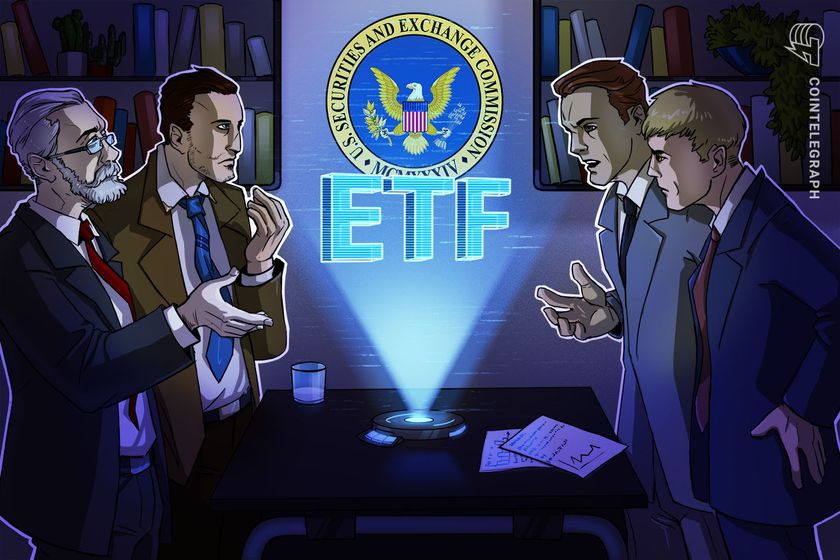 F/m Investments seeks SEC relief to record ownership of its $6 billion Treasury ETF on a permissioned blockchain as tokenization spreads on Wall Street. F/m Investments asked the United States Securities and Exchange Commission (SEC) to allow it to tokenize shares of its flagship Treasury exchange-traded fund (ETF). The $18 billion asset manager filed Wednesday for exemptive relief to let the F/m US Treasury 3 Month Bill ETF (TBIL) record ownership of its roughly $6 billion in shares on a permissioned blockchain, while remaining a standard 1940 Act exchange‑traded fund. In its press release, F/m describes the filing as the “first of its kind” from an ETF issuer seeking US regulatory relief specifically for tokenized shares of a registered investment company. Read more
 -
Cointelegraph.com - 11:14 Jan 22, 2026
 The fund targets institutional investors seeking returns beyond traditional long-only, “vanilla” Bitcoin exposure. The digital asset arm of Nomura is launching a new yield-focused Bitcoin investment product, as asset managers look to offer institutional investors returns beyond simple price exposure. Laser Digital is launching the Bitcoin Diversified Yield Fund (BDYF) to address a growing market demand for tokenized yield-driven funds over “vanilla long-only funds,” according to a Thursday announcement shared with Cointelegraph. Unlike traditional long-only Bitcoin (BTC) funds, the new product seeks to produce income by deploying diversified strategies intended to generate yield while maintaining exposure to Bitcoin, according to Laser Digital. Read more
 -
Decrypt - 11:05 Jan 22, 2026
The lawsuit alleges that Eightfold used hidden AI to score job seekers on a 0 to 5 scale without required disclosures or dispute rights. -
CryptoPotato - 10:55 Jan 22, 2026
XRP forms a falling wedge with bullish RSI divergence as price rebounds near $1.95; analysts watch for breakout above $2. -
CryptoSlate - 10:51 Jan 22, 2026
Senate Agriculture Chair John Boozman has now released updated crypto market structure text, posting a full bill PDF last night. The release locks in a near-term Senate Agriculture path to markup next week, but it also hardens a political split that could determine whether Senate Banking gets a negotiated bridge or a rival marker for […] The post The Senate crypto alliance just imploded, leaving these high-stakes developer protections in limbo appeared first on CryptoSlate.