Crypto
-
Decrypt - 12:32 Jan 06, 2026
Ethereum's daily transactions hit a record 2.02M driven by RWA tokenization, yet prediction markets show traders are more bullish on gold. -
Cointelegraph.com - 12:09 Jan 06, 2026
 Polymarket updated its documentation to show taker-only fees on short-term crypto markets, with proceeds redistributed to market makers as liquidity rebates. Prediction market platform Polymarket updated its documentation to show that 15-minute crypto up/down markets now carry taker fees, marking a departure from its long-standing zero-fee trading model. According to the newly updated “Trading Fees” and “Maker Rebates Program” sections of the site’s documentation, the prediction markets platform has enabled taker-only fees on 15-minute crypto markets to fund liquidity incentives for market makers. Fees collected from takers are redistributed daily in USDC (USDC) stablecoin to liquidity providers, rather than retained by the protocol. The change applies only to these short-duration crypto markets, while the vast majority of Polymarket’s markets remain without fees. Read more
 -
Cointelegraph.com - 12:00 Jan 06, 2026
 BitMEX is rolling out 24/7 Equity Perps that use crypto as collateral for exposure to major US stocks and indexes, as exchanges from Bitget to Kraken race to bring equities onchain. BitMEX is expanding beyond crypto-native markets with the launch of Equity Perps, a new line of perpetual swap contracts that provide 24/7, crypto‑collateralized exposure to major US stocks and indexes like Apple, Tesla, Nvidia, the S&P 500 and the Nasdaq, according to a press release shared with Cointelegraph. The product mirrors the role perpetual swaps played in reshaping crypto markets with non-expiring, funding‑rate‑based, highly leveraged exposure — now applied to equities that have traditionally been confined to limited market hours. The move comes as onchain access to equities is showing signs of traction. Bitget recently reported that cumulative spot trading volume for tokenized stocks on its platform had surpassed $1 billion, with roughly 95% of that volume generated in December alone, driven in part by surging demand fo...
 -
CryptoPotato - 11:57 Jan 06, 2026
[PRESS RELEASE – Hong Kong, China, January 6th, 2026] JINDOGE (JINDO), a Solana-based meme project, has been officially unveiled as a Web3 project expanded into an AI K-POP idol concept, inspired by the Korean Jindo dog—one of Korea’s native breeds. Moving beyond the traditional scope of meme coins, JINDOGE aims to establish itself as a […] -
CryptoSlate - 11:55 Jan 06, 2026
Ledger customers woke up on Jan. 5 to an email no one wants to see: their names and contact information had been exposed through a breach at Global-e, a third-party payment processor. The company clarified what hadn't been compromised: no payment cards, no passwords, and critically, no 24-word recovery phrases. The hardware remained untouched, the […] The post Ledger customer data breached including info that leads violent criminals to your door appeared first on CryptoSlate. -
CoinDesk - 11:55 Jan 06, 2026
The fund is betting on a liquidity wave driven by U.S. deficit spending and potential money printing by the Federal Reserve, which Hayes expects to support crypto prices. -
Cointelegraph.com - 11:45 Jan 06, 2026
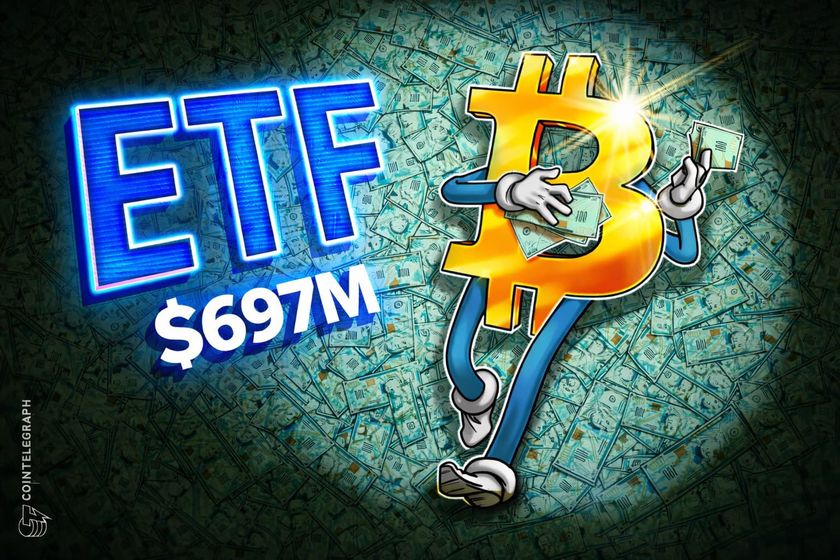 Spot Bitcoin ETFs have hauled in $1.1 billion in the first two trading days of 2026, with analysts pointing to a new year “clean-slate effect” driving digital asset demand. Spot Bitcoin exchange-traded funds (ETFs) have drawn strong inflows in 2026 as Matrixport analysts point to renewed investor appetite due to the new year’s “clean-slate effect.” US spot Bitcoin ETFs bagged $697 million worth of inflows during the second trading day of 2026 on Tuesday, bringing in over $1.1 billion in net positive inflows in the opening two days of the new year, according to Farside Investors data. The renewed inflows are a welcome sign for Bitcoin (BTC) holders, following two consecutive months of net outflows from spot Bitcoin ETFs. The funds saw $3.48 billion in outflows in November and $1.09 billion in December, according to Sosovalue data. Read more
 -
CoinDesk - 11:37 Jan 06, 2026
Wall Street heavyweight files for bitcoin trust amid rising institutional demand. -
CoinDesk - 11:34 Jan 06, 2026
Strong institutional demand returns as flows turn positive and bitcoin price recovers. -
Cointelegraph.com - 11:32 Jan 06, 2026
 Venezuela’s early crypto adoption and gold-to-Bitcoin conversion speculation raise questions about a $60 billion reserve, though analysts have found no proof. The US capture of Venezuelan President Nicolás Maduro has renewed questions over whether Venezuela holds an undisclosed Bitcoin reserve, which analysts say remains unproven. On Saturday, investigative journalist Bradley Hope outlined a theory that Venezuela may be holding a hidden Bitcoin (BTC) reserve worth up to $60 billion, claiming that its government has been converting gold into cryptocurrency over several years. “Sources describe a Swiss lawyer who controls wallet access,” Hope said in a co-authored report published by the investigative newsletter Whale Hunting, raising questions about the alleged involvement of Alex Saab, Venezuela’s minister of industry and national production, who has been sanctioned by the US. Read more
 -
Decrypt - 11:02 Jan 06, 2026
Sui and XRP notched double-digit rallies, leading overnight crypto market gains as Bitcoin held above $93,000. -
Cointelegraph.com - 10:52 Jan 06, 2026
 A migration flaw affecting older wallet setups can wipe local wallet files under specific conditions, prompting developers to pull recent releases. Bitcoin Core developers warned users on Monday of a wallet migration bug in versions 30.0 and 30.1 that can delete files and result in fund loss. The issue occurs under specific conditions and affects migrations from old Bitcoin Core wallets that were never renamed or upgraded. Lacie Zhang, market analyst at Bitget Wallet, told Cointelegraph that the bug is triggered when the software attempts to migrate an unnamed legacy “wallet.dat” file stored in a custom wallet directory, often defined using “-walletdir” setting, while pruning is enabled. Read more
 -
CryptoPotato - 10:48 Jan 06, 2026
Bubblemaps pushed back after analysts claimed a "99% match" linking a Maduro bet winner to politically connected wallets. -
CryptoPotato - 10:07 Jan 06, 2026
XRP rebounds 25% in 2 weeks, hitting $2.34 as ETF inflows rise and traders watch key resistance levels at $2.41 and $2.5. -
CryptoSlate - 09:29 Jan 06, 2026
Bitcoin (BTC) pierced $94,000 on Jan. 5, reaching its highest level since Dec. 10 and capping a rally that added nearly $100 billion to the total crypto market capitalization in 24 hours. The move came as spot Bitcoin ETFs recorded their strongest inflows in three months, derivatives positioning turned aggressively bullish, and macro conditions created […] The post Bitcoin breaks $94,000 for the first time in a month: Why is crypto up today? appeared first on CryptoSlate. -
Cointelegraph.com - 09:21 Jan 06, 2026
 The proposal highlights South Korea’s push to align crypto oversight with securities markets, raising stakes for exchanges and traders alike. South Korea’s financial authorities are reportedly weighing whether to allow regulators to preemptively freeze crypto accounts suspected of price manipulation. The Financial Services Commission (FSC) is reviewing the introduction of a payment suspension system that would block transactions before suspects launder potentially illicit gains, local outlet Newsis reported Tuesday. The measure would mirror tools already used in the country’s stock market, where authorities can freeze accounts suspected of manipulation before profits are cashed out. Read more