Crypto
-
Cryptonews.com - 15:10 Nov 27, 2025
Crypto giving has grown in 2025, with The Giving Block processing nearly $100 million for thousands of nonprofits, New York Cares reporting fresh support from digital asset donors, and Unchained’s Bitcoin Legacy Project funding developers and hubs through a new donor-advised fund. The post Crypto Donations Surge in 2025, Transforming Thanksgiving Philanthropy appeared first on Cryptonews. -
Cryptonews.com - 14:58 Nov 27, 2025
Solana Price Prediction has detailed institutional ETF interest, Upexi’s stock sale to expand its Solana treasury, key levels at $140, $144 and $156, and downside targets near $136 as traders also watch Bitcoin Hyper’s fundraising and yield. The post Solana Price Prediction: Nasdaq Firm Doubles Down After $200M Loss – What Do They Know About What’s Coming? appeared first on Cryptonews. -
Cointelegraph.com - 14:52 Nov 27, 2025
 Global inflation has slowed down, but in many countries, crypto is still providing an attractive and viable alternative to the local monetary system. Countries around the world are grappling with inflation, and in many places, investors and everyday savers are turning to crypto to protect their savings. The early 2020s saw a sharp uptick in global inflation rates amid government stimulus programs during the COVID-19 epidemic. Supply chain disruptions led to increased costs for businesses, and food and energy prices rose following Russia’s war in Ukraine. Central banks responded aggressively, hiking interest rates and easing pressure on supply chains. As a result, inflation rates have somewhat calmed in the last two years. Read more
 -
Cryptonews.com - 14:48 Nov 27, 2025
Bitcoin has rebounded more than 13% into Thanksgiving, reviving hopes that this year could break the holiday’s bearish pattern. The post History Says Thanksgiving Is Bearish for Bitcoin — Can This Year Be Different? appeared first on Cryptonews. -
Cryptonews.com - 14:46 Nov 27, 2025
The SEC is facing pushback from major exchanges including Nasdaq, Cboe, and CME over proposals that could allow crypto firms to offer tokenized stocks under relaxed regulatory conditions The post Major Exchanges “Alarmed” as SEC Eyes Tokenized Stock Exemptions — Here’s Why appeared first on Cryptonews. -
CryptoSlate - 14:45 Nov 27, 2025
Bitcoin’s hashrate is near record levels, yet miner revenue per unit of compute has fallen to record lows, pushing the network into a ‘high-security, low-profitability’ phase. While the network’s hashrate has pinned itself above the one-zettahash watermark, which is a record for aggregate computing power, the revenue underpinning that security has disintegrated to historic lows. […] The post How long can miners hold out as revenue hits record lows while Bitcoin’s security is at record highs? appeared first on CryptoSlate. -
Decrypt - 14:39 Nov 27, 2025
Investors can now trade Solana meme coin BONK as a regulated product on Switzerland's largest stock exchange. -
Cointelegraph.com - 14:33 Nov 27, 2025
 Houdini Swap launched Houdini Pay, a payment service that breaks onchain links between counterparties, offering surface-level privacy. Centralized instant exchange aggregator Houdini Swap has rolled out a private payment service allowing users to receive payments in their preferred asset without revealing their onchain address. According to an announcement shared with Cointelegraph, Houdini Pay allows users to generate shareable payment links with support for over 4,000 digital assets across multiple blockchains. The asset is converted to the receiver’s preferred asset, and routing the payment through the system breaks the onchain link between the sender and the receiver, preventing one from snooping on the other’s wallet. The fees incurred for using the service are those for using the Houdini Swap instant exchange aggregator on the back end and are covered by the sender. The recipient receives the full requested amount. Read more
 -
CryptoPotato - 14:24 Nov 27, 2025
[PRESS RELEASE – Zug, Switzerland, November 27th, 2025] Fanpla AG, a Swiss-based subsidiary of Fanpla Inc. (Japan), today announced the establishment of its new office in Zug, known globally as Crypto Valley. This move marks an important milestone toward building a sustainable and borderless entertainment economy powered by blockchain technology. The new entity will serve […] -
CryptoPotato - 14:24 Nov 27, 2025
Bitcoin has recently attracted a wave of buyers at a critical support area, driving a sharp rebound into a short-term supply range. Despite this recovery, the broader trend remains bearish, and the latest move should still be viewed as a temporary pullback unless the price can reclaim and consolidate above the $100K threshold. Technical Analysis […] -
CryptoPotato - 14:19 Nov 27, 2025
Is it worth paying for a crypto tax software to handle your filing this year? Let's find out if you really need to spend money. -
Cointelegraph.com - 14:16 Nov 27, 2025
 Lawyers say privacy laws and AML laws sometimes conflict and there’s no clear path to compliance for decentralized blockchain projects. Crypto was originally most closely associated with anonymity, but in 2025, the crypto ecosystem has changed. User privacy is diminishing, as new laws in different jurisdictions across the globe require Know Your Customer and ID checks for wallets or exchange accounts to combat money laundering. The increasing sophistication of blockchain analysis tools means that every transaction has a transparent trail that can be traced back to its source. As a result, onchain privacy has become a major theme. In October, the Ethereum Foundation announced the formation of its Privacy Cluster, a group of some 47 researchers, engineers and cryptographers who are working to make the base layer of Ethereum private. Read more
 -
Cointelegraph.com - 14:16 Nov 27, 2025
Lawyers say privacy laws and AML laws sometimes conflict and there’s no clear path to compliance for decentralized blockchain projects. Crypto was originally most closely associated with anonymity, but in 2025, the crypto ecosystem has changed. User privacy is diminishing, as new laws in different jurisdictions across the globe require Know Your Customer and ID checks for wallets or exchange accounts to combat money laundering. The increasing sophistication of blockchain analysis tools means that every transaction has a transparent trail that can be traced back to its source. As a result, onchain privacy has become a major theme. In October, the Ethereum Foundation announced the formation of its Privacy Cluster, a group of some 47 researchers, engineers and cryptographers who are working to make the base layer of Ethereum private. Read more -
Cointelegraph.com - 14:07 Nov 27, 2025
 A malicious Chrome extension called Crypto Copilot lets users trade Solana directly from X but secretly skims a small portion of the transaction. A malicious Google Chrome browser extension is letting users trade on Solana, while quietly skimming a fee from every swap into the creator’s wallet. According to a Tuesday report by cybersecurity company Socket, the Google Chrome extension allows users to trade on Solana (SOL) from their X social media feed. Unlike typical wallet-draining malware that tries to steal the entire balance, Crypto Copilot “injects an extra transfer into every Solana swap, siphoning a minimum of 0.0013 SOL or 0.05% of the trade,” Socket found. On the back end, Crypto Copilot uses the decentralized exchange Raydium to perform swaps for the user, but appends a second instruction that transfers SOL from the user to the attacker. The user interface only shows the swap details while wallet confirmation screens “summarize the transaction without surfacing individual instructions.” Read more
 -
Cointelegraph.com - 13:42 Nov 27, 2025
 CTDG Dev Hub’s upgrade pipeline turns raw ideas into tested code, formal proposals and transparent governance across networks. Blockchains do not stand still. Fee markets shift, validator sets evolve, and new modules arrive to handle everything from privacy to crosschain messaging. Behind each of those changes sits a simple starting point: an idea that someone cared enough to write down. Cointelegraph Decentralization Guardians (CTDG) was created to give those ideas a more reliable home. The initiative runs high-performance validators and participates in governance across networks such as Solana,, Injective, Chiliz, Polkadot, Coreum, Canton and Mantra, contributing to decentralization and security at the protocol layer. The CTDG Dev Hub, launched in collaboration with blockchain infrastructure provider Boosty Labs, extends the work to the development process itself. It serves as a public coordination space where contributors can submit, discuss and track upgrade proposals instead of relying on fragmented chat...
 -
Cointelegraph.com - 13:40 Nov 27, 2025
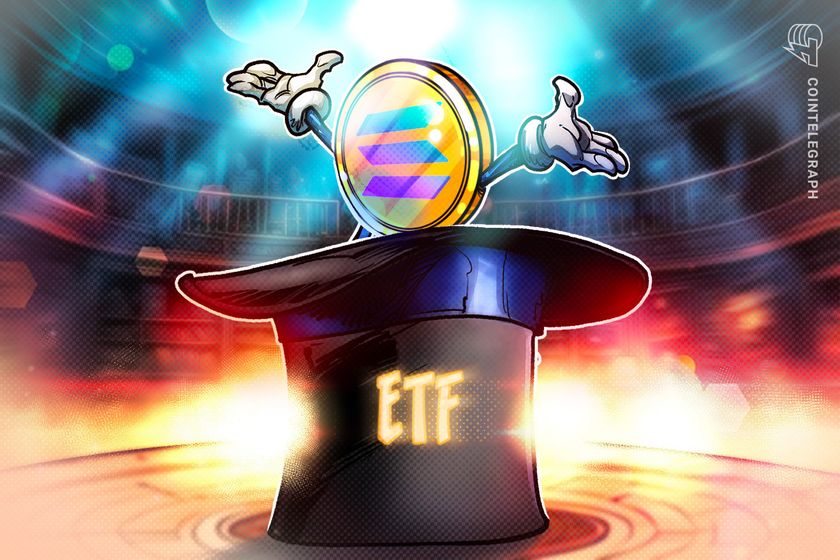 The reversal was driven by the 21Shares Solana ETF (TSOL), which saw over $34 million in withdrawals in a single day. US spot Solana exchange-traded funds (ETFs) broke their flawless inflow streak on Wednesday, recording $8.1 million in net outflows, their first day in the red since launch, according to ETF data provider SoSoValue. A single ETF product largely drove the pullback, the 21Shares Solana ETF (TSOL), which experienced over $34 million in outflows. The ETF has recorded cumulative net outflows of $26 million since launch and has net assets of $86 million. The rest of the SOL ETFs performed well, absorbing much of the outflows by TSOL. The Bitwise Solana Staking ETF (BSOL) continued to dominate with a $13.33 million single-day intake, lifting its cumulative inflows to $527.79 million Read more
 -
Cointelegraph.com - 13:34 Nov 27, 2025
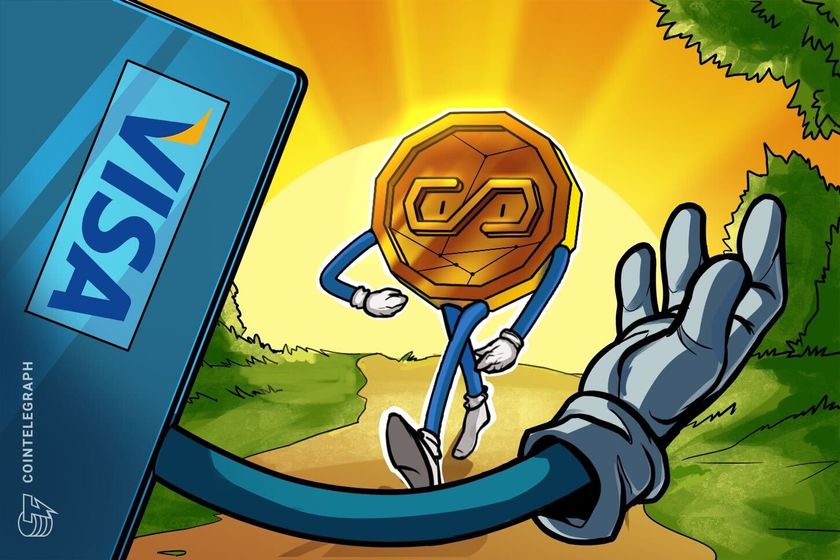 Visa has partnered with crypto infrastructure company Aquanow to expand stablecoin settlement across the CEMEA region, cutting cross-border costs and friction. Visa is expanding its use of stablecoins for settlement in Central and Eastern Europe, the Middle East and Africa (CEMEA) through a new partnership with crypto infrastructure company Aquanow. In an announcement Thursday, Visa said it partnered with Aquanow “to settle transactions using approved stablecoins such as USDC, reducing costs, operational friction, and settlement times.” The company said the move came amid strong demand from banks and payment companies for faster, cheaper cross-border payments. The move aims to leverage stablecoins to digitize the back end of money movement and to enable 24/7 settlement. Godfrey Sullivan, Visa’s head of product and solutions for the CEMEA region, said the integration will allow institutions in the region “to experience faster and simpler settlements.” Read more
 -
Cointelegraph.com - 13:16 Nov 27, 2025
 BlackRock Bitcoin ETF investors are back in profit, in a promising sign of a December market recovery from the cohort that drove much of Bitcoin’s rise to all-time highs in 2025. BlackRock’s spot Bitcoin exchange-traded fund (ETF) holders are back in profit after Bitcoin’s recovery above $90,000, an early sign that sentiment may be turning among one of the key investor groups driving the market this year. The holders of the largest spot Bitcoin (BTC) fund, BlackRock’s iShares Bitcoin Trust ETF (IBIT), bounced back to a cumulative profit of $3.2 billion on Wednesday, according to blockchain data platform Arkham. “BlackRock IBIT and ETHA holders went from being up almost a combined $40 billion at their PnL peak on 7th October, down to $630 million 4 days ago,” wrote Arkham in a Wednesday X post. “This means the average of all BlackRock ETF buys is at just about break-even.” Read more
 -
CryptoPotato - 13:14 Nov 27, 2025
Open Interest peaked in October, nearly five times higher than in November 2021, which is indicative of aggressive trader focus on fast profits.