Cointelegraph.com
Source:
https://cointelegraph.com
Found 10245 news
-
Cointelegraph.com - 21:54 Jan 04, 2026
 The sentiment among crypto investors has oscillated between "fear" and "extreme fear" since the market flash crash on October 10, 2025. The CoinMarketCap “Crypto Fear and Greed Index,” a metric tracking crypto investor sentiment, flipped to “neutral” on Sunday, for the first time since October, signaling that investor sentiment is improving. The Index is at 40, signaling that investors are no longer fearful, but they are not bullish on the crypto market either. The Index recorded its lowest sentiment reading of 2025 in November, when it hit a 10, indicating “extreme fear,” according to CoinMarketCap. Crypto investor sentiment plunged in October, sparked by a historic market crash that derailed the crypto market bull run. The price of Bitcoin (BTC) hit an all-time high above $125,000 days before the crash, eventually falling to about $80,000 — a 35% drop. Read more
 -
Cointelegraph.com - 20:34 Jan 04, 2026
 The altcoin market is set to rally, based on technical analysis showing altcoins trading above critical support levels formed in October. The altcoin market, which is valued at over $879 billion at the time of this writing, is poised for its next major leg up toward its previous all-time high of nearly $1.2 trillion, according to crypto trader and market analyst Michaël van de Poppe. The Total3 market cap, which tracks the total market capitalization of the entire crypto token ecosystem, excluding Bitcoin (BTC) and Ether (ETH), has maintained critical support around the $784 billion level, Van De Poppe said. The price of Total3 is also inching back toward the 365-day moving average, another critical support level, according to TradingView data. Read more
 -
Cointelegraph.com - 18:33 Jan 04, 2026
 The Japanese yen is commonly used by macroeconomic investors to carry out levered bets because of its artificially low interest rates. Metaplanet, a Bitcoin (BTC) treasury company, may have a financial edge over other digital asset treasury companies due to structural weakness in the Japanese yen (JPY), according to BTC analyst and crypto treasury company investor Adam Livingston. Japan’s debt-to-gross-domestic-product ratio is about 250%, Livingston said. This high debt level continues to weaken the yen, which must be printed to shore up deficits every year, contributing to an even higher debt level and an erosion of the yen’s value. Measured in US dollar terms, BTC has appreciated by about 1,159% since 2020, but BTC gained 1,704% over the same time period if measured against the Japanese yen, he said. Read more
 -
Cointelegraph.com - 16:40 Jan 04, 2026
 Bitcoin sought to maintain 2026 BTC price highs as the weekly close brought major volatility risks thanks to geopolitical uncertainty over Venezuela. Bitcoin (BTC) near year-to-date highs into Sunday’s weekly close as traders braced for liquidity grabs. Key points: Bitcoin enters classic fakeout territory as the weekly close coincides with the aftermath of the US-Venezuela news. Read more
 -
Cointelegraph.com - 13:00 Jan 04, 2026
 Crypto billionaires in California are threatening to leave the state, but are they ready to make good on their promise, or is an impending wealth exodus more of a paper tiger? Crypto billionaires are threatening to leave the state of California after a prominent trade union proposed a 5% assets tax on residents worth more than $1 billion. The Service Employees International Union-United Healthcare Workers West proposed the new tax back in November 2025. The trade union suggested that the new tax would bring in up to $100 billion from 200 state residents, more than making up for federal funding cuts to California’s state healthcare program. The measure will require 850,000 signatures before it can be put on the ballot for a popular vote in the 2026 elections in November. Prominent investors and billionaires based in California, such as PayPal co-founder Peter Thiel and Google co-founder Larry Page, have already threatened to leave. Others have argued that a billionaire exit could remove crucial sources of tax ...
 -
Cointelegraph.com - 12:54 Jan 04, 2026
 An analysis of “wrench attacks” shows physical assaults against crypto holders are increasing in number and severity, with Europe and Asia seeing the sharpest rise. Physical attacks targeting cryptocurrency holders are becoming more frequent and increasingly severe, according to a new analysis of so-called “wrench attacks.” In a Sunday post on X, Haseeb Qureshi, who analyzed a dataset maintained by Bitcoin (BTC) security advocate Jameson Lopp, revealed that the total number of reported wrench attacks has risen steadily over time, and the nature of those attacks has escalated. After categorizing incidents into five levels, ranging from minor assaults to fatal outcomes, the data suggests the average attack has become more violent in recent years. Read more
 -
Cointelegraph.com - 08:17 Jan 04, 2026
 Coinbase has halted peso-based USDC on- and off-ramps in Argentina less than a year after launch, citing a review of local operations while keeping crypto trading fully active. Crypto exchange Coinbase has paused its local fiat operations in Argentina less than a year after formally entering the market, scaling back peso-based services while keeping its crypto functionality. According to a report by Forbes Argentina, Coinbase informed users that it is temporarily stepping back from maintaining local services following a review of its operations. The company described the move as a “deliberate pause” aimed at reassessing its approach and returning with a more sustainable product offering. The change primarily affects fiat rails. From Jan. 31, 2026, users will no longer be able to buy or sell USDC (USDC) using Argentine pesos (ARS) or withdraw funds to local bank accounts. Coinbase told users they have a 30-day window to complete peso-based USDC transactions and withdrawals before the cutoff date. Read more
 -
Cointelegraph.com - 07:36 Jan 04, 2026
 The chances of Bitcoin’s price tumbling in the aftermath of the US military's attack on Venezuela are "relatively slim," according to a crypto analyst. Despite Bitcoin’s history of volatility during geopolitical tensions, its price is unlikely to fall in the coming days following the US strike on Venezuela, according to a crypto analyst. “I don't think we'll see a widespread correction based on the attack in Venezuela on Bitcoin,” MN Trading Capital founder Michael van de Poppe said in an X post on Saturday. The US strikes on Venezuela took place at around 6:00 a.m. UTC on Saturday and reportedly lasted for around 30 minutes. Van de Poppe anticipates the event will not directly affect Bitcoin’s (BTC) price because it was a “planned and coordinated attack” and one that has “already passed us.” Read more
 -
Cointelegraph.com - 07:09 Jan 04, 2026
 A $400,000 Polymarket wager tied to Maduro’s capture has prompted Ritchie Torres to propose legislation restricting insider trading on political prediction markets. US Representative Ritchie Torres is preparing to introduce legislation aimed at curbing insider trading on prediction markets, following scrutiny around a highly profitable wager tied to the reported sudden capture of Venezuelan President Nicolás Maduro. In a Sunday post on X, Punchbowl News founder Jake Sherman said Torres plans to introduce the Public Integrity in Financial Prediction Markets Act of 2026. The bill would prohibit federal elected officials, political appointees and executive branch employees from trading prediction market contracts linked to government policy or political outcomes when they have nonpublic information through their official duties. “The restriction applies to buying, selling, or exchanging prediction market contracts tied to government policy, government action, or political outcomes on platforms engaged in interst...
 -
Cointelegraph.com - 04:56 Jan 04, 2026
 Crypto exec Kain Warwick lost a $50,000 Ether price prediction bet, Coinbase reveals “everything exchange”: Hodler’s Digest An attacker has drained hundreds of crypto wallets on Ethereum Virtual Machine (EVM) chains, siphoning small sums from each victim in what onchain investigator ZachXBT described as a broad but low-value exploit. The losses appear limited on a per-wallet basis, with each victim losing less than $2,000, according to ZachXBT. The activity has affected wallets on several EVM-compatible networks, indicating a widespread incident rather than it being isolated to a single blockchain. A fraudulent email disguised as legitimate communication from Web3 wallet MetaMask could have been the vehicle for the attack, said cybersecurity researcher Vladimir S., who cited a clue left by another pseudonymous X user. Read more
 -
Cointelegraph.com - 03:59 Jan 04, 2026
 On the first trading day of 2026, US-based spot Bitcoin exchange-traded funds recorded their largest net inflow day in 35 trading days. US-based spot Bitcoin and Ether ETFs began 2026 on a strong note, posting a combined net inflow of around $646 million on the first trading day, despite mixed sentiment across the broader crypto market. On Friday, spot Bitcoin (BTC) ETFs saw net inflows of $471.3 million, while spot Ether (ETH) ETFs added $174.5 million, bringing total inflows across the two ETF types to $645.8 million, according to Farside data. US spot Bitcoin ETFs posted their largest net inflow in 35 trading days since Nov. 11, when the eleven US-based ETFs collectively saw $524 million in a single day. Read more
 -
Cointelegraph.com - 22:06 Jan 03, 2026
 Risk-on asset markets tend to react negatively to geopolitical shocks, macroeconomic turmoil, and other negative news events. The price of Bitcoin (BTC) remained firm at about $90,000, despite geopolitical tensions between the United States and Venezuela reaching a boiling point in the early hours of Saturday morning. Bitcoin briefly fell below $90,000 on Saturday before climbing back up above the $90,000 level, where it is trading at the time of this writing. “The US bombed a country and captured its leader, on a weekend no less, and yet Bitcoin has barely moved,” Nic Puckrin, market analyst and founder of the crypto media company Coin Bureau, said in an X post. Read more
 -
Cointelegraph.com - 20:37 Jan 03, 2026
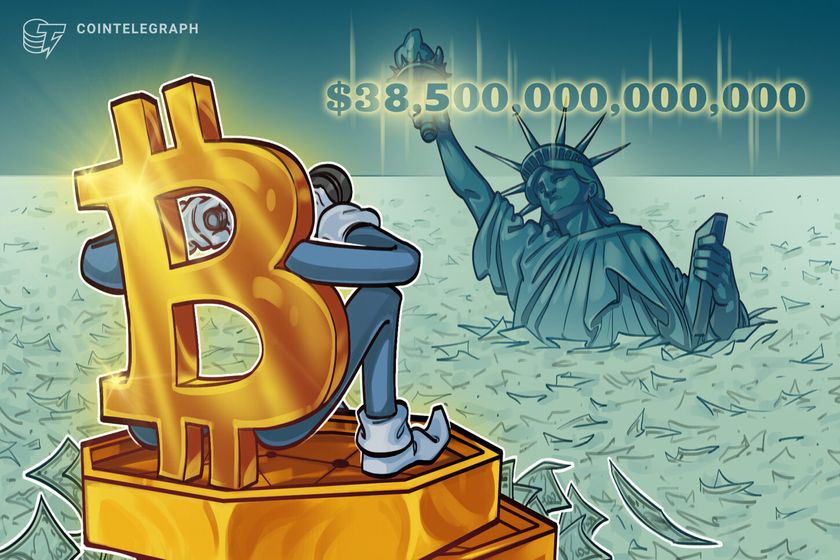 The first block was mined and added to the Bitcoin ledger on January 3, 2009, by pseudonymous cryptographer Satoshi Nakamoto. The United States National Debt surged past $38.5 trillion on Saturday, as Bitcoiners celebrated “Genesis Day,” the day the first block was mined on the Bitcoin network by pseudonymous Bitcoin (BTC) creator Satoshi Nakamoto. US government debt at the time of this writing is about $38,561,900,451,378, according to the US National Debt Clock. “Lie, cheat, steal, and print relentlessly. It’s the playbook of fiat currency, and it weakens the money until confidence in that currency ultimately fails,” market analyst James Lavish said in response to the rising debt. Read more
 -
Cointelegraph.com - 17:05 Jan 03, 2026
 The company continued to diversify into the AI and high-performance computing sectors in 2025, with major deals and credit expansions. The Hut 8 Bitcoin (BTC) mining company expanded its credit facility with crypto exchange company Coinbase to $200 million, building on momentum from 2025 and strong stock performance, setting it apart among players in the struggling mining industry. Hut 8 will use the funds for “general corporate purposes,” according to an amended filing with the United States Securities and Exchange Commission (SEC). The credit expansion follows Hut 8’s $7 billion agreement with AI cloud platform Fluidstack in December to deliver 245 megawatts (MW) of energy for an AI data center over a 15-year term. Read more
 -
Cointelegraph.com - 13:20 Jan 03, 2026
 Bitcoin hit a three-week high, but derivatives and spot ETF flows show traders remained cautious, signalling limited confidence in further upside for now. Key takeaways: Bitcoin rose above $90,000, yet options data show traders are not comfortable with downside risk exposure. Bitcoin spot ETF outflows and low leverage demand suggest investors remain cautious about near-term gains. Read more
 -
Cointelegraph.com - 12:11 Jan 03, 2026
 Wallet drainer phishing losses dropped sharply in 2025, but security researchers warn activity still rises with market rallies and new attack vectors continue to emerge. Crypto phishing attacks tied to wallet drainers dropped sharply in 2025, with total losses falling to $83.85 million, down 83% year over year from nearly $494 million in 2024. The number of victims also declined significantly to 106,000, a 68% drop from the previous year, Web3 security platform Scam Sniffer said in its new report analyzing signature-based phishing across Ethereum Virtual Machine (EVM) chains. Despite the steep fall, the report warned that phishing activity has not disappeared. Instead, losses closely followed market cycles, rising during periods of higher onchain activity and easing as markets cooled. The third quarter of 2025, which coincided with Ethereum (ETH)’s strongest rally of the year, recorded the highest phishing losses at $31 million, with August-September accounting for nearly 29% of annual losses. Read more
 -
Cointelegraph.com - 10:17 Jan 03, 2026
 Bitcoin halted a breakout to new 2026 highs near $91,000 as BTC price action dealt with "geopolitical tension" while TradFi markets were closed. Bitcoin (BTC) dropped below $90,000 on Saturday as crypto markets reacted to the US military action in Venezuela. Key points: Bitcoin attempts to hold recent gains as the US mounts an attack on Venezuela’s capital, Caracas. Read more
 -
Cointelegraph.com - 08:19 Jan 03, 2026
 Ethereum’s validator entry queue has climbed toward 1 million ETH, with an estimated wait time of nearly 17 days for new validators to become active. BitMine Immersion Technologies has added another 82,560 Ether, worth roughly $259 million, to Ethereum’s staking system, intensifying congestion in the network’s validator entry queue as institutional demand for yield continues to build. Data from Arkham shows that the Ether (ETH) treasury firm sent multiple large deposits to Ethereum’s BatchDeposit contract within the past few hours. With the new stake, BitMine’s total staked ETH has climbed to 544,064 Ether, valued at approximately $1.62 billion at current prices, according to onchain analyst Lookonchain. BitMine first started staking ETH on Dec. 26, transferring nearly $219 million worth of ETH to staking-related contracts on the Ethereum network. Read more
 -
Cointelegraph.com - 07:13 Jan 03, 2026
 The hacker behind the 2016 Bitfinex breach says he was freed early under Donald Trump’s First Step Act, just over a year after receiving a five-year sentence. Ilya Lichtenstein, the hacker behind one of the largest Bitcoin thefts on record, has been released from prison just over a year after receiving a five-year sentence, thanks to a criminal justice reform law signed during former President Donald Trump’s first term. “Thanks to President Trump's First Step Act, I have been released from prison early,” Lichtenstein said in a Friday post on X. “I remain committed to making a positive impact in cybersecurity as soon as I can,” he added. The First Step Act, passed in 2018, expanded eligibility for sentence reductions through earned time credits and other rehabilitation measures. Lichtenstein was sentenced in November 2024 after pleading guilty to a money laundering conspiracy tied to the 2016 hack of Bitfinex, in which nearly 120,000 Bitcoin (BTC) were stolen. Read more
 -
Cointelegraph.com - 06:03 Jan 03, 2026
 The crypto market may see FOMO enter the market if Bitcoin suddenly creeps toward the $92,000 price level, according to a crypto analyst. Sentiment among crypto market participants on social media has started the year strong, according to a Santiment analyst, who warned that further market upside depends on retail investors staying level-headed. “We need retail to continue to be a bit cautious, a bit pessimistic, a bit impatient,” Santiment analyst Brian Quinlivan said in a video published to YouTube on Saturday. Despite other crypto sentiment indicators showing fear among market participants, Quinlivan said Santiment’s social media data points the other way. Read more
10245 items