Cointelegraph.com
Source:
https://cointelegraph.com
Found 10245 news
-
Cointelegraph.com - 13:20 Sep 16, 2025
 Pudgy Penguins’ Pudgy Party racks up 500K downloads with a tournament planned for Q4, Pirate Nation is shutting down, and more: Web3 Gamer. Pudgy Penguins new battle royale game, Pudgy Party, has racked up half a million downloads within the first two weeks of launching, and gamers are praising how subtle and well-integrated the Web3 elements are. It has just the right am [amount] of Web3 and doesnt force you to buy tokens or NFTs from the start, gamer Spike said in an X post. Ive played 300+ Web3 games and its safe to say @PlayPudgyParty is nothing short of a masterpiece. Several blockchain and gaming firms have recently told Magazine that the key to onboarding a mass wave of gamers onto Web3 is to make blockchain itself invisible. Read more
 -
Cointelegraph.com - 13:20 Sep 16, 2025
Pudgy Penguins’ Pudgy Party racks up 500K downloads with a tournament planned for Q4, Pirate Nation is shutting down, and more: Web3 Gamer. Pudgy Penguins new battle royale game, Pudgy Party, has racked up half a million downloads within the first two weeks of launching, and gamers are praising how subtle and well-integrated the Web3 elements are. It has just the right am [amount] of Web3 and doesnt force you to buy tokens or NFTs from the start, gamer Spike said in an X post. Ive played 300+ Web3 games and its safe to say @PlayPudgyParty is nothing short of a masterpiece. Several blockchain and gaming firms have recently told Magazine that the key to onboarding a mass wave of gamers onto Web3 is to make blockchain itself invisible. Read more -
Cointelegraph.com - 13:20 Sep 16, 2025
Pudgy Penguins’ Pudgy Party racks up 500K downloads with a tournament planned for Q4, Pirate Nation is shutting down, and more: Web3 Gamer. Pudgy Penguins new battle royale game, Pudgy Party, has racked up half a million downloads within the first two weeks of launching, and gamers are praising how subtle and well-integrated the Web3 elements are. It has just the right am [amount] of Web3 and doesnt force you to buy tokens or NFTs from the start, gamer Spike said in an X post. Ive played 300+ Web3 games and its safe to say @PlayPudgyParty is nothing short of a masterpiece. Several blockchain and gaming firms have recently told Magazine that the key to onboarding a mass wave of gamers onto Web3 is to make blockchain itself invisible. Read more -
Cointelegraph.com - 13:20 Sep 16, 2025
Pudgy Penguins’ Pudgy Party racks up 500K downloads with a tournament planned for Q4, Pirate Nation is shutting down, and more: Web3 Gamer. Pudgy Penguins new battle royale game, Pudgy Party, has racked up half a million downloads within the first two weeks of launching, and gamers are praising how subtle and well-integrated the Web3 elements are. It has just the right am [amount] of Web3 and doesnt force you to buy tokens or NFTs from the start, gamer Spike said in an X post. Ive played 300+ Web3 games and its safe to say @PlayPudgyParty is nothing short of a masterpiece. Several blockchain and gaming firms have recently told Magazine that the key to onboarding a mass wave of gamers onto Web3 is to make blockchain itself invisible. Read more -
Cointelegraph.com - 13:11 Sep 16, 2025
 Saifedean Ammous warned Argentina’s high-yield bond strategy is unsustainable, calling it a “Ponzi” that could push investors toward Bitcoin as the peso crumbles. Economist and author of “The Bitcoin Standard,” Saifedean Ammous, warned that Argentina’s financial system is on the brink of collapse, calling President Javier Milei’s economic program a “debt and inflation Ponzi” propped up by unsustainable bond yields and money printing. In a post on X, Ammous argued that Argentina’s government has created a financial system where bond speculation is the only path to financial security. “The only concrete achievement of his administration so far is that it destroyed the currency and created a shitcoin casino,” he said. At the center of the crisis is what locals call “la bicicleta financiera,” a high-yield carry trade where investors buy short-term government bonds that offer interest rates exceeding the pace of peso devaluation. According to Ammous, this setup, which has become the country’s most lucrative indust...
 -
Cointelegraph.com - 13:00 Sep 16, 2025
 LimeWire has acquired the rights to the infamous Fyre Festival and plans to revive the brand through Web3 integrations with its LMWR token. LimeWire, a former file-sharing platform turned Web3 company, acquired the rights to the infamous Fyre Festival brand and plans to relaunch it with a crypto twist. In a Tuesday announcement, LimeWire said it had purchased the Fyre Festival’s trademark, logo, domain and social media accounts. Marcus Feistl, LimeWire’s chief operating officer, told Cointelegraph that the new iteration will include offline events, with LimeWire’s LMWR token powering access to products and services. The Fyre Festival became a symbol of failed hype in 2017, when a promised luxury music event in the Bahamas collapsed into chaos, leaving attendees stranded without proper food or accommodations. Its founder, Billy McFarland, was later convicted of fraud and sentenced to prison. LimeWire confirmed that McFarland is not involved in the new project. Read more
 -
Cointelegraph.com - 12:19 Sep 16, 2025
 Strategic Solana Reserve data showed that Solana treasuries have hit 17.11 million SOL tokens, worth over $4 billion at current prices. Solana-based corporate treasuries surged past $4 billion as companies have continued to accumulate the cryptocurrency, according to new data. Data from the reserve tracker, Strategic Solana Reserve, showed on Tuesday that Solana treasuries hit 17.11 million tokens, worth $4.03 billion at current prices. The reserves accounted for almost 3% of Solana’s (SOL) circulating supply of more than 600 million tokens. The largest participant was Forward Industries, which held more than 6.8 million SOL, worth $1.61 billion. Other firms such as Sharps Technology, DeFi Development Corp. and Upexi each held about 2 million SOL, with individual allocations exceeding $400 million. Read more
 -
Cointelegraph.com - 12:01 Sep 16, 2025
 While some legal experts see France’s threat as legally feasible, others argue that it’s only a warning for crypto firms looking for licensing loopholes in the EU. France’s warning that it may try to block cryptocurrency companies from operating in the country under licenses issued by other European Union member states — known as passporting — has raised questions about enforcement of the 27-nation bloc’s flagship crypto law. France’s securities regulator, the Autorité des Marchés Financiers (AMF), is considering a ban on crypto firms operating in France under licenses obtained in other member states, Reuters reported Monday. The move reportedly stems from the AMF’s concern that some crypto companies seek licenses in more lenient EU jurisdictions. The warning came less than a year after the EU’s Markets in Crypto-Assets Regulation (MiCA) took effect for crypto-asset service providers. MiCA was designed to create a harmonized framework across Europe and prevent the kind of regulatory arbitrage the AMF is flagg...
 -
Cointelegraph.com - 11:42 Sep 16, 2025
 Ether price eyed fresh highs as it held above a key trendline, with markets betting on a 96% chance of Fed cuts and further easing this year. Ethereum’s native token, Ether (ETH), has fallen 5.73% from its weekend high near $4,766, retreating as traders trim risk ahead of Wednesday’s Federal Reserve interest rate decision. The pullback reflects caution in the market, but the bigger question is whether the Fed’s potential dovish shift could reignite Ethereum’s rally and how far its next move might extend. Ether bulls are defending the 20-day exponential moving average (20-day EMA; the green wave) near $4,450, showing resilience as markets price in a 96.1% chance of a Fed rate cut this week, up from 85.4% a month ago, with two more reductions expected by year’s end. Read more
 -
Cointelegraph.com - 11:15 Sep 16, 2025
 Crypto Finance, part of the Deutsche Börse Group, launched AnchorNote to let institutions trade across venues without moving assets out of custody. Crypto Finance, a subsidiary of Deutsche Börse Group, launched a new off-exchange settlement solution to improve capital efficiency and trading flexibility for institutional crypto investors. The new product, Crypto Finance AnchorNote, allows institutions to trade on different platforms without moving their assets out of custody. It also helps them settle trades off-exchange and earn yields within a compliant, risk-controlled setup, according to a Tuesday announcement. “With Crypto Finance AnchorNote, we are closing a critical gap between custody and capital efficiency,” said Philipp Dettwiler, head of custody and settlement at Crypto Finance. The launch is initially focused on the Swiss market, with a broader European rollout expected in the near term. Read more
 -
Cointelegraph.com - 10:40 Sep 16, 2025
 Whale selling and a reduction in XRP ledger activity over the past two months increased the downside potential for XRP price to drop toward $2. Key takeaways: XRP’s failure to hold $3 points to a continued downside risk to $2.40-$2.00. Whales continue to sell XRP. Read more
 -
Cointelegraph.com - 09:07 Sep 16, 2025
 SC Ventures plans to launch a digital asset fund in 2026, with a focus on global digital asset investment opportunities. Update Sept. 16, 11:33 am UTC: This article has been updated to clarify that SC Ventures is launching a digital asset fund, not a crypto fund. Update Sept. 16, 1:38 pm UTC: This article has been updated to include comments from an SC Ventures representative. Standard Chartered’s venture arm is preparing to launch a $250 million digital asset investment fund in 2026, signaling growing institutional appetite for digital assets. Read more
 -
Cointelegraph.com - 00:21 Sep 16, 2025
 Strategy’s Michael Saylor and BitMine’s Tom Lee are among 18 industry leaders who will look at ways to pass the BITCOIN Act and enable budget-neutral ways to buy Bitcoin. US lawmakers are set to meet with 18 crypto industry executives, including Strategy chairman Michael Saylor, on Tuesday to discuss how Congress can move forward with President Donald Trump’s Strategic Bitcoin Reserve. Those in attendance will also include Fundstrat CEO Tom Lee, who is also the chairman of BitMine, as well as MARA CEO Fred Thiel, according to crypto advocacy group The Digital Chambers, which shared the full list with Cointelegraph on Monday. The industry executives are looking to build momentum behind the BITCOIN Act, a measure introduced by US Senator Cynthia Lummis in March that calls on the government to acquire one million Bitcoin (BTC) over five years. Read more
 -
Cointelegraph.com - 21:51 Sep 15, 2025
 Almost three years after the SEC filed a complaint involving allegations with the Gemini Earn product, the crypto company and regulator said they had reached a potential deal. The US Securities and Exchange Commission (SEC) and Gemini Trust Company filed a status update in court, letting a federal court know they had reached a “resolution in principle” to resolve a securities case stemming from a 2023 complaint. In a Monday filing in the US District Court for the Southern District of New York (SDNY), the SEC and Gemini Trust said that, “subject to review and approval” by the commission, the two parties requested that all litigation in the civil case be indefinitely stayed. The filing stated that both parties would file another status report if the case weren’t resolved by Dec. 15. Read more
 -
Cointelegraph.com - 21:26 Sep 15, 2025
 Standard Chartered warns of risks as Bitcoin, Ethereum and Solana treasury companies face valuation crunch. The boom in digital asset treasury (DAT) companies — fueled by the success of Strategy’s Bitcoin-buying — has shone a spotlight on cryptocurrencies such as Bitcoin, Ether and Solana. However, that spotlight has dimmed in recent weeks as the market net asset values (mNAVs) of many DATs collapsed, exposing smaller firms to growing risks, Standard Chartered warned Monday. In the world of DATs, mNAV measures the ratio of a company’s enterprise value to the value of its cryptocurrency holdings. An mNAV above 1 allows a firm to issue new shares and keep accumulating digital assets. Below that threshold, it becomes far harder — and less prudent — to expand holdings. Standard Chartered noted that several high-profile DATs have recently slipped below that critical level, effectively shutting off their ability to keep buying. Read more
 -
Cointelegraph.com - 21:08 Sep 15, 2025
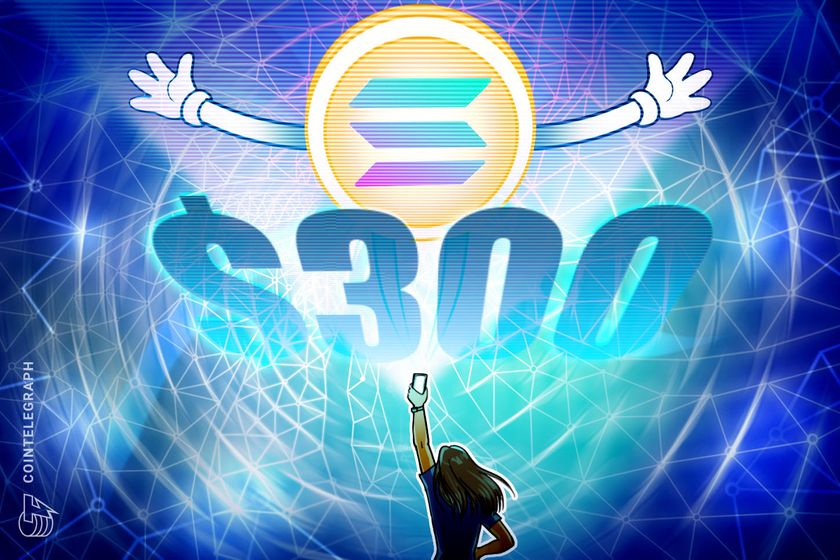 An uptick in Solana onchain activity, digital asset treasury allocation, and its expanding DeFi ecosystem could be the fuel that sends SOL to $300. Key takeaways: Corporate treasury investments are driving consistent demand and strengthening SOL’s price momentum. DEX dominance, fee growth, and interoperability upgrades reinforce Solana’s competitive blockchain position. Read more
 -
Cointelegraph.com - 20:45 Sep 15, 2025
 The Fellowship PAC, launched in August, said it had “over $100 million” from unnamed sources to support the White House’s digital asset strategy. A new political action committee (PAC) focused on backing “pro-innovation, pro-crypto candidates” in the United States has launched with $100 million. In a Monday X post, the Fellowship PAC said it had launched “with over $100 million” from unnamed sources as part of efforts to support the Trump administration’s digital asset strategy. The PAC said it aimed to support specific candidates for federal office and prevent an “exodus of talent and entrepreneurs” from crypto companies in the US by helping provide regulatory clarity. Read more
 -
Cointelegraph.com - 19:45 Sep 15, 2025
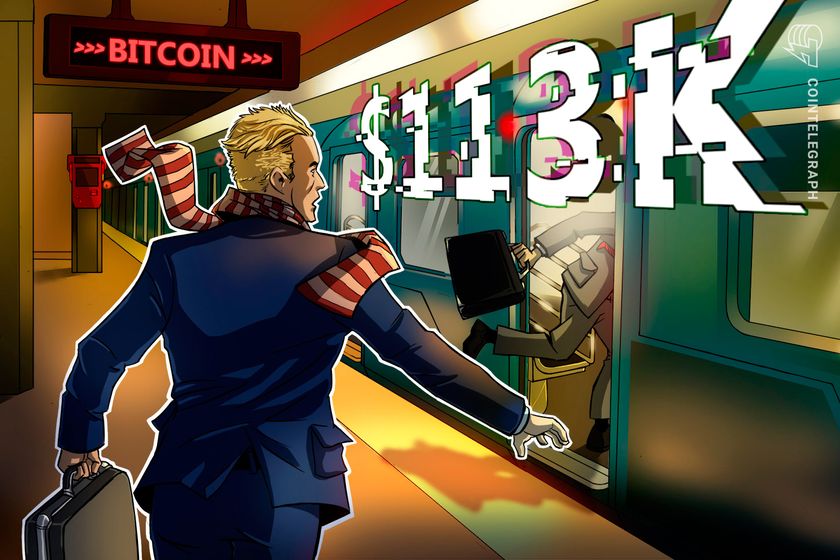 Bitcoin’s $113,000 zone emerges as a critical support with new investors absorbing whale supply, hinting at one of the last discounts before new highs. Key takeaways: Bitcoin could retest the $111,000–$113,000 zone, mirroring the breakout structure seen in Q2. The URPD metric shows 5.5% of BTC supply clustered between $110,000–$113,000. Read more
 -
Cointelegraph.com - 18:46 Sep 15, 2025
 The brokerage is seeking SEC approval for Robinhood Ventures Fund I, which would trade on the NYSE and expose retail investors to private companies. Brokerage firm Robinhood is planning a closed-end fund that would give retail investors access to its venture capital portfolio — a space traditionally reserved for institutions and high-net-worth individuals. The brokerage disclosed Monday that it has filed a Form N-2 with the US Securities and Exchange Commission (SEC) to register shares of the Robinhood Ventures Fund I (RVI), which will be managed by its new subsidiary, Robinhood Ventures DE. If approved, shares of RVI will be listed on the New York Stock Exchange, where they can be bought and sold through participating brokerage platforms. Read more
 -
Cointelegraph.com - 18:25 Sep 15, 2025
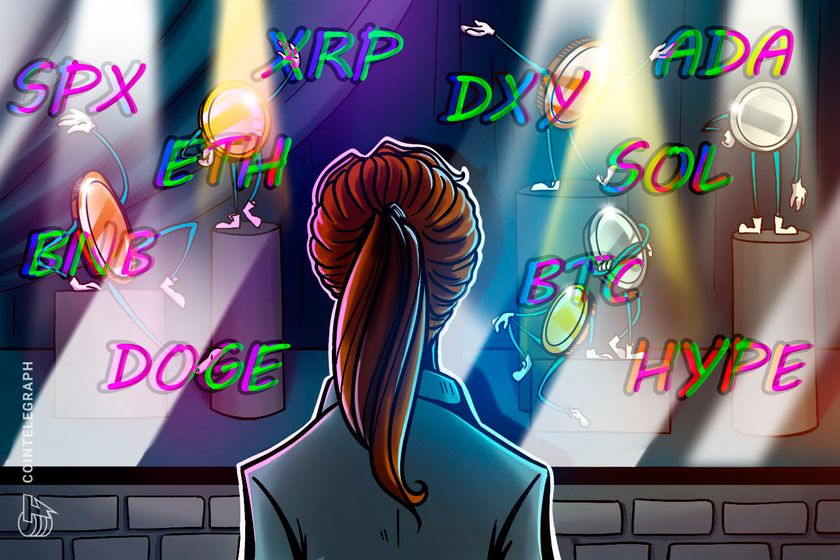 Bitcoin is facing solid resistance at $117,500, but the possibility of a rally to $124,474 remains high as long as the price remains above the moving averages. Key points: Bitcoin is facing significant resistance at $117,500, but the bulls remain on top as long as the price stays above $113,400. Several altcoins are showing signs of profit booking in the near term, but lower levels are likely to attract buyers. Read more
10245 items