Cointelegraph.com
Source:
https://cointelegraph.com
Found 10222 news
-
Cointelegraph.com - 13:33 Apr 06, 2026
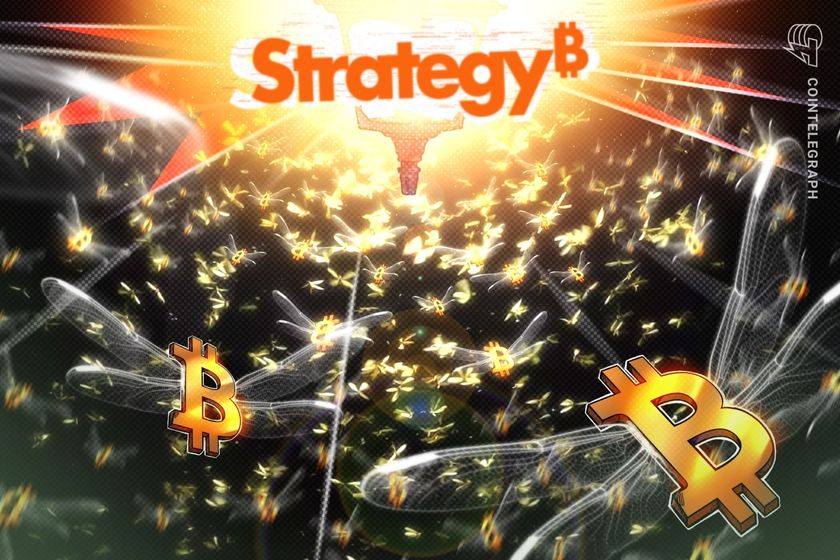 Strategy resumed Bitcoin purchases, acquiring 4,871 BTC for $329.9 million, while reporting a $14.46 billion unrealized loss and expanding its holdings. Michael Saylor’s Strategy, the world’s largest publicly listed holder of Bitcoin, resumed buying BTC last week after reporting no purchases in the final week of March. Strategy acquired 4,871 Bitcoin (BTC) for $329.9 million last week, according to an 8-K filing with the US Securities and Exchange Commission on Monday. The purchases were made at an average price of $67,718 per coin, below the company’s overall average acquisition price of $75,644. The new acquisitions bring Strategy’s holdings to 766,970 BTC, acquired for a total cost of around $58 billion. Read more
 -
Cointelegraph.com - 13:09 Apr 06, 2026
 A darknet threat actor is selling new fraud kit to trick KYC identity verification systems on financial platforms via AI-generated deepfakes and real-time voice altering. A threat actor known as “Jinkusu” is allegedly selling cybercrime tools designed to bypass Know Your Customer (KYC) checks at banks and crypto platforms. The tool uses deepfakes and voice manipulation to trick KYC verification systems on finance platforms, cybercrime tracker Dark Web Informer wrote in a Sunday X post. Cybersecurity company Vecert Analyzer added that Jinkusu uses AI for real-time face swaps via InsightFace for “fluid gesture transfers,” along with voice modulation to evade biometrics. Read more
 -
Cointelegraph.com - 13:00 Apr 06, 2026
 Institutional crypto flows through prime brokerages that enforce TradFi custody standards. Ripple's $1.25B Hidden Road acquisition signals a permanent infrastructure shift. Opinion by: Dominic Lohberger, chief product officer at Sygnum. Counterparty risk in crypto markets has always moved in cycles. Exchanges default or get hacked. Standards tighten for a while. Then, complacency quietly returns as losses are forgotten. What is happening this time is different. Read more
 -
Cointelegraph.com - 12:06 Apr 06, 2026
 Marc Andreessen says AI job loss fears are “all fake” and predicts a “massive jobs boom,” as fresh US data show increasing long-term unemployment and tech companies citing AI while cutting positions. Marc Andreessen said artificial intelligence will spark a “massive jobs boom,” dismissing fears of widespread job losses as “all fake” in a Sunday post on X. His optimism contrasts with a March US jobs report showing unemployment holding steady at 4.3%, while the number of people unemployed for 27 weeks or more rose by 322,000 over the past year. Andreesen shared a Business Insider report showing a sharp rise in tech job openings in 2026, with more than 67,000 software engineering roles, a twofold increase from 2023, and argued that employers had recovered from post-pandemic hiring corrections and the interest rate spike. Read more
 -
Cointelegraph.com - 12:03 Apr 06, 2026
 Samson Mow pushes back against calls to rush Bitcoin’s move to post-quantum cryptography, warning it could introduce new vulnerabilities. Rushed quantum fixes for Bitcoin could introduce new risks, Samson Mow warned in response to calls from Coinbase executives for faster action. Mow, a Bitcoin advocate and Jan3 founder, took to X on Saturday to address comments from Coinbase CEO Brian Armstrong and chief security officer Philip Martin, who urged the industry to begin preparing for quantum computing threats sooner rather than later. He said that while post-quantum (PQ) cryptography could secure Bitcoin (BTC) against future quantum computers, rushing implementation may create new vulnerabilities such as compatibility issues and reduced network efficiency due to larger signature sizes. Read more
 -
Cointelegraph.com - 10:42 Apr 06, 2026
 Perp DEX daily volume fell to $8.4 billion on April 4, its first sub-$10 billion level since September and the lowest since July, DefiLlama data shows. Onchain perpetual futures trading has cooled for five straight months since peaking in October 2025. Perp volume on decentralized exchanges (DEXs) fell to $699 billion in March 2026 from October’s $1.36 trillion, according to DefiLlama data. The decline has been steady across the period, with volumes slipping through November and December before losses extended through the first quarter of 2026. Read more
 -
Cointelegraph.com - 10:10 Apr 06, 2026
 China’s leading tax and financial authorities are urging banks to incorporate blockchain technology to bolster their credit facilities and data transparency. China’s tax and financial regulators on Monday urged banks and local authorities to use blockchain and privacy computing to upgrade the “bank-tax interaction” model and expand financing for small businesses. The State Administration of Taxation and National Financial Regulatory Administration said in a joint policy notice that banks and taxpayers should standardize data sharing and reduce information asymmetry between tax authorities, banks and enterprises. The report also urged banks to improve credit models, enhance credit approval efficiency and increase the supply of financing services to “honest, tax-paying enterprises.” Read more
 -
Cointelegraph.com - 09:43 Apr 06, 2026
 Bitcoin hinted at a long-term bullish trend change as BTC neared an MACD cross that last resulted in $25,000 gains over two months. Bitcoin (BTC) faces a fresh showdown this week as macro tensions contrast with a bullish BTC price trend reversal. A classic BTC price metric is above to flip bullish for the first time in nearly a year — last time, price gained $25,000 in two months. Short time frames see liquidations as “aggressive” traders pile in at $70,000. Read more
 -
Cointelegraph.com - 09:30 Apr 06, 2026
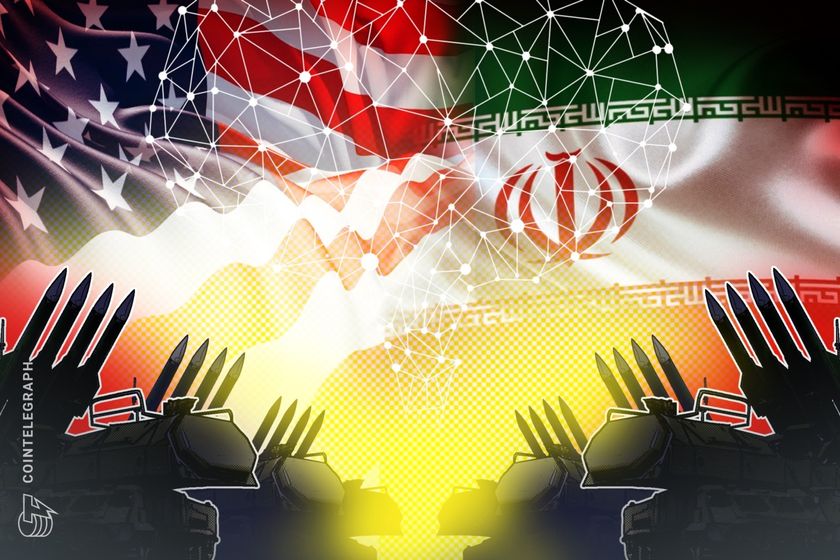 As Iran war odds swing on Polymarket and Kalshi, Sygnum’s Fabian Dori says prediction markets are fast becoming macro tools for crypto desks. Prediction markets rapidly repriced the odds of US escalation in the Iran conflict, offering a real-time signal of geopolitical risk for traders. Odds on platforms such as Polymarket and Kalshi shifted in real time as President Donald Trump paired new threats with signals of possible negotiations on Sunday, while Bitcoin (BTC) rose more than 3.5% on Monday. Crypto prediction markets are no longer a sideshow during periods of geopolitical tension, with professional desks increasingly using them to gauge macro risk, according to Sygnum Bank chief investment officer Fabian Dori. Read more
 -
Cointelegraph.com - 06:14 Apr 06, 2026
 In an experiment, a chatbot resorted to blackmail after it found an email about replacing it, while in another, it cheated to complete a task with a tight deadline. Artificial intelligence company Anthropic has revealed that during experiments, one of its Claude chatbot models could be pressured to deceive, cheat and resort to blackmail, behaviors it appears to have absorbed during training. Chatbots are typically trained on large data sets of textbooks, websites and articles and are later refined by human trainers who rate responses and guide the model. Anthropic’s interpretability team said in a report published Thursday that it examined the internal mechanisms of Claude Sonnet 4.5 and found the model had developed “human-like characteristics” in how it would react to certain situations. Read more
 -
Cointelegraph.com - 06:09 Apr 06, 2026
 Circle’s plan to make Arc quantum-resistant comes amid increasing fears that "Q-Day" may come sooner than anticipated. Stablecoin issuer Circle has released a post-quantum security roadmap for its layer-1 blockchain, Arc, aiming to implement solutions across all layers of the network’s tech stack. Circle said on Thursday that it is planning a phased implementation, starting with quantum-proof wallets and signatures when Arc launches on mainnet. This feature will be opt-in, the company noted, while adding that solutions at the validator level and surrounding infrastructure will be implemented later on. “Quantum resilience cannot live only in research papers, exploratory pilots, or distant roadmap slides. It has to show up in the infrastructure,” Circle said. Read more
 -
Cointelegraph.com - 06:04 Apr 06, 2026
 Security researcher Taylor Monahan listed at least 40 decentralized finance platforms she claims have been infiltrated by North Korean IT workers at some stage of their lives. North Korean IT workers have been embedding themselves in crypto companies and decentralized finance projects for at least seven years, according to a cybersecurity analyst. “Lots of DPRK IT workers built the protocols you know and love, all the way back to DeFi summer,” said MetaMask developer and security researcher Taylor Monahan on Sunday. Monahan claimed that over 40 DeFi platforms, some being well-known names, have had North Korean IT workers working on their protocols. Read more
 -
Cointelegraph.com - 04:25 Apr 06, 2026
 Bitchat launched in July last year and has been used during protests in Madagascar, Uganda, Nepal, Indonesia and Iran as authorities attempted to restrict usage of the internet. Bitchat, a decentralized peer-to-peer messaging app developed by Block CEO Jack Dorsey, has been removed from Apple’s App Store in China for allegedly violating its internet service regulations. In an X post on Sunday, Dorsey shared a screenshot from Apple’s app review team informing him that Bitchat had been removed from the App Store in February and that the TestFlight beta version would no longer be available in China at the request of the Cyberspace Administration of China (CAC). “Bitchat pulled from the China App Store,” he said. Read more
 -
Cointelegraph.com - 04:14 Apr 06, 2026
 Michael Saylor posted "back to work" on X on Sunday, signaling a potential Bitcoin purchase after the firm paused buying last week. Michael Saylor has hinted his Bitcoin treasury firm is back on track with its weekly Bitcoin purchases after taking a rare week off at the end of March. In an X post on Sunday, Saylor shared a screenshot from StrategyTracker with the caption "Back to Work.” He often posts the chart ahead of purchase announcements. The firm took a week off from buying BTC at the end of March, breaking its weekly buying streak for the first time this year. The firm's last purchase was reported on March 23, buying about $77 million worth of BTC at $74,326 per coin. Read more
 -
Cointelegraph.com - 04:06 Apr 06, 2026
 US President Donald Trump threatened Iran could be "living in Hell" if it doesn't open the Strait of Hormuz, though he also told reporters that a deal with Iran is getting close. Crypto markets bounced 2.5% as US President Donald Trump sent mixed signals over a potential deal with Iran to reopen the Strait of Hormuz, including reports of a possible ceasefire that could permanently end the war. In an expletive-laden post on the Truth Social platform on Sunday, Trump threatened that Iran would be “living in Hell” if the Strait of Hormuz is not reopened. However, he also acknowledged in a Fox News interview that Iran is “negotiating now” and expressed optimism about a “good chance” of a deal within 24 hours. Read more
 -
Cointelegraph.com - 03:06 Apr 06, 2026
 The Rwanda central bank's warning came after Bybit added the Rwandan franc to its list of assets that its peer-to-peer platform can use to trade for crypto. The National Bank of Rwanda (NBR) has warned the public that crypto payments and trades using the local currency remain illegal in the country after Bybit added support for the Rwandan franc for its peer-to-peer platform on Friday. “Crypto-assets are NOT authorized for payments, FRW conversion, or P2P trading involving FRW under the current framework,” the central bank posted to X on Sunday, urging citizens to avoid crypto due to “serious financial risks and no recourse in case of loss.” The central bank’s comments were in response to an X post from Bybit on Friday, stating that the Rwandan franc (FRW) can be used to buy and sell crypto through its Bybit P2P service. Read more
 -
Cointelegraph.com - 21:41 Apr 05, 2026
 The $280 million Drift Protocol attack was likely carried out by threat actors aligned with North Korea state-affiliated hackers. The hack of the Solana-based decentralized finance (DeFi) platform Drift Protocol could have been prevented if standard operational security procedures were followed by the Drift team, and may constitute “civil negligence,” according to attorney Ariel Givner. “In plain terms, civil negligence means they failed their basic duty to protect the money they were managing,” Givner said in response to the post-mortem update provided by the Drift team and how it handled Wednesday’s $280 million exploit. The Drift team failed to follow “basic” security procedures, including keeping signing keys on separate, “air-gapped” systems that are never used for developer work, and conducting due diligence on blockchain developers met through industry conferences. Read more
 -
Cointelegraph.com - 19:37 Apr 05, 2026
 The President of the United States continues to give contradictory signals of escalating the war and winding it down within a few weeks. The odds of the United States invading Iran this year surged to 63% on the Polymarket prediction platform on Sunday, following comments made by US President Donald Trump on social media. The odds of an invasion before 2027 are still down from the high of 68% on March 29, which occurred due to a US troop buildup and comments from the Trump administration that the US was considering capturing Kharg Island, a major Iranian oil shipping station. The Polymarket trading volume for a potential US invasion of Iran was about $3.74 million at the time of publication. Read more
 -
Cointelegraph.com - 17:17 Apr 05, 2026
 Demand for either currency strengthens both in a reinforcing relationship, contrary to popular sentiment, Sam Lyman told Cointelegraph. US dollar-pegged stablecoins and Bitcoin (BTC) share a “symbiotic” relationship, mutually benefitting from rising adoption, according to Sam Lyman, head of research at Bitcoin Policy Institute (BPI), a Washington DC-based digital asset advocacy organization. “Bitcoin is beneficial to the US system because the largest Bitcoin trading pair is BTC/USD,” or Tether’s USDt (USDT) stablecoin, which is backed by cash deposits and short-term US government debt, Lyman told Cointelegraph. He added: He said Bitcoin and dollar-pegged stablecoins share a similar relationship to the dollar and oil. Under the petrodollar system, which began in the early 1970s, international oil sales are priced in dollars, driving more demand for the currency. Read more
 -
Cointelegraph.com - 12:17 Apr 05, 2026
 The Rich Dad Poor Dad author continues to back Bitcoin, gold and silver as alternatives to traditional money. Rich Dad Poor Dad author Robert Kiyosaki has argued that the economic shifts set in motion more than five decades ago are now unfolding, advocating for Bitcoin and gold while warning against rising debt, inflation and retirement risks. In a Saturday post on X, Kiyosaki pointed to 1974 as a turning point that reshaped both money and retirement systems. He argued that the United States’ move toward a petrodollar framework, alongside policy changes affecting pensions, laid the foundation for today’s financial pressures. “The future created in 1974 has arrived,” Kiyosaki wrote, linking current inflation and geopolitical tensions around energy to the dollar’s evolution after the end of the gold standard era. He also mentioned the passage of the Employee Retirement Income Security Act, which introduced new rules for pension plans and coincided with a broader shift toward market-based retirement savings. Rea...
10222 items