Dawn
Source:
https://www.dawn.com
Found 10444 news
-
Dawn - 14:51 Jan 18, 2026
Iranian authorities have said they are considering “gradually” restoring internet access after imposing a communications shutdown 10 days ago, as nationwide protests in the country began to subside following a crackdown by security forces. Demonstrations sparked in late December by anger over economic hardship exploded into protests widely seen as the biggest challenge to the Iranian leadership in years. Iranian officials have said the demonstrations were peaceful before turning into “riots” and blamed foreign influence, namely from Iran’s foes, the United States and Israel. The rallies subsided after the crackdown carried out by security forces amid a communications blackout that started on January 8 as the protests grew in size and intensity. Government officials have said calm has been restored, with schools reopening on Sunday — Iran’s weekend falling on Thursday and Friday — after a week of closure. Late Saturday, the Tasnim news agency reported “the relevant authorities announced that internet access wo... -
Dawn - 10:18 Jan 18, 2026
The Netherlands’ foreign minister on Sunday said that US President Donald Trump’s threat to impose new tariffs on European allies until they agree to sell Greenland to the United States is “blackmail”. “It’s blackmail what he’s doing … and it’s not necessary. It doesn’t help the alliance (Nato) and it also doesn’t help Greenland,” David van Weel said in an interview on Dutch television. In a post on Truth Social on Saturday, Trump said additional 10 per cent import tariffs would take effect on February 1 on goods from Denmark, Norway, Sweden, France, Germany, the Netherlands, Finland and Great Britain countries that have agreed to contribute personnel to a Nato exercise on Greenland. Van Weel said the Greenland mission was intended to show the US Europe’s willingness to help defend Greenland, and he was opposed to Trump making a connection with diplomacy over the island and trade. Trump has insisted he will settle for nothing less than full ownership of Greenland, an autonomous territory of Denmark, which he ... -
Dawn - 09:02 Jan 18, 2026
Israeli Prime Minister Benjamin Netanyahu convened a meeting of his ruling coalition partners on Sunday after objecting to the composition of a Gaza advisory panel formed by the White House, according to an official and media reports. The White House announced this week the setting up of a “Gaza Executive Board,” which would operate under a broader so-called “Board of Peace” to be chaired by US President Donald Trump as part of his 20-point plan to end the war in Gaza. The executive board, described as having an advisory role, includes Turkish Foreign Minister Hakan Fidan and Qatari diplomat Ali Al-Thawadi, alongside other regional and international officials. Late on Saturday, Netanyahu’s office objected to the composition of the executive board. “The announcement regarding the composition of the Gaza Executive Board, which is subordinate to the Board of Peace, was not coordinated with Israel and runs contrary to its policy,” the office of Netanyahu said. “The prime minister has instructed the foreign affair... -
Dawn - 07:57 Jan 18, 2026
 This piece was originally published on July 1, 2024. At the far corner of the pediatric unit at Karachi Burns Center, a woman desperately tries to latch her daughter for feeding. The infant, covered in gauze, fails to hold on as her shrill cries fill the room, cutting through the white walls of the facility. Two-year-old Fariha Hassan bears the burns of a fire that ripped through her apartment in Kharadar last week. The story is not unheard of; a gas cylinder explosion that engulfed her family into flames. The incident, one of many reported across the metropolis every week, was preventable if only a handful of safety rules and regulations were followed. According to an analysis of five-year data compiled by the Karachi Metropolitan Corporation (KMC), at least six fires erupt in the city daily. The reasons behind these fires may vary from case to case, but the casualties and injuries that arise from them are easily preventible if only the authorities and citizens themselves take some basic precautions. Doctors...
 -
Dawn - 07:21 Jan 18, 2026
KARACHI: As many as 21 eateries on the famous Burns Road Food Street have been sealed by authorities for occupying footpaths and walkways. District South Deputy Commissioner Javed Nabi Khoso said that the restaurants and other food shops had been sealed because they had placed their furniture on the walkways. He said that the sealed outlets would be unsealed after payment of fines and undertaking by the restaurant owners to fully comply with the standard operating procedures (SOPs). Mr Nabi said that the commissioner had directed all deputy commissioners to take strict action against the “soft encroachments” that hindered the vehicular and pedestrian movement in any part of the city. He said that most of the shops and eateries were sealed in Arambagh sub-division where Burns Road Food Street was also located. The DC said that all shopkeepers would have to pay fines and submit written assurances of compliance with the SOPs. He said that some of the restaurants and shops sealed two days ago would be allowed to ... -
Dawn - 07:02 Jan 18, 2026
PESHAWAR: The federal government’s instructions to the Khyber Pakhtunkhwa government to stop issuing permits for hunting non-exportable trophies in the province is causing unrest in the provincial wildlife department and local communities, which insist the move has threatened the over $1 million permits already sold. The controversy over the hunting permits for markhor and grey gorals emerged when the wildlife department received minutes of a recent meeting with the climate change and environmental coordination ministry where minister Musadik Masood Malik was in the chair. “The chair directed that a legal opinion be obtained to clarify the matter and that a subsequent meeting be convened to finalise the non-exportable quota in line with relevant international conventions. Till that time, no quotas for non-exportable trophies will be allocated by any province,” reads minutes of the meeting available with Dawn. Sources in KP wildlife department told Dawn that the federal ministry of climate change and environme... -
Dawn - 06:02 Jan 18, 2026
LONDON: Taking paracetamol, known as Tylenol in the US, during pregnancy is safe, a group of European researchers have said, after compiling data in response to US President Donald Trumps claims of a link to autism last year. In a review published in the British journal The Lancet Obstetrics, Gynaecology & Womens Health on Saturday, the team said they had focused on amassing the best-quality evidence to address the claims. Paracetamol is safe to use in pregnancy, said lead author Asma Khalil, professor of obstetrics and maternal foetal medicine at City St Georges, University of London. The key message is reassurance: When used as recommended, the best available evidence does not support a causal link with autism, ADHD (attention-deficit/hyperactivity disorder) or intellectual disability. President Trump claimed last year the painkiller could be linked to autism in children if taken during pregnancy Khalil said she had been asked about the popular pain medication also known as acetaminophen by her patients aft... -
Dawn - 05:38 Jan 18, 2026
WHILE the US may want regime change in Iran, and Israel the collapse of the established order, internal strife and chaos, it appears that Tehran has stayed safe from US-led military strikes, for the time being at least, because any such action seems less imminent now than it did earlier this week. Speculation abounds about what made US President Donald Trump change his mind — from entreaties by Gulf friends, including Saudi Arabia, Qatar and Oman, to a seemingly bizarre New York Times report that claimed that the apartheid state’s Prime Minister Benjamin Netanyahu also asked the US leader not to launch military strikes for the time being. However, in Trump’s own words “nobody” made him change his mind and it was the staying of 800 hangings of protesters that Iran had supposedly planned that was the main reason he had called off the strikes and also because the protesters’ “killing has stopped”. Whatever led to the pause, temporary or permanent, it is a welcome development for the region, which seemed to be sl... -
Dawn - 05:29 Jan 18, 2026
IRAN’S clerical regime seems to have weathered yet another wave of internal resistance, exploited, as always, by its external rivals. But the human losses have left a deep new wound on the Iranian psyche. The immediate threat of a US-Israeli strike has also dispersed. Washington and Tel Aviv, backed by most Gulf capitals, recalibrated their stance after strategic assessments highlighted the danger of a wider regional war and the absence of any realistic plan for a post-regime change scenario. Inside Iran, resistance against the establishment still struggles to form a unified front or leadership. However, this does not mean the US, Israel or their allies have dropped the goal of political change in Tehran. Instead, they are adjusting their methods. Media reports indicate the regime will not collapse quickly due to a strong security apparatus, loyal institutions, and backing from a sizable segment of the population. Even so, external actors, along with internal resistance networks, are unlikely to allow the reg... -
Dawn - 05:23 Jan 18, 2026
LET us make no mistake. Donald Trump has not received the Nobel Peace Prize. He has simply acquired the medal. This is akin to holding a friend’s Oscar during a selfie and then captioning it ‘great night’. The distinction, however, has never really troubled the American president, who had campaigned for the honour for years. He had listed his achievements numerous times, compared himself favourably to past winners and expressed bafflement that the committee kept missing the point — him. That pursuit was not subtle. President Trump spoke of the Nobel as something he had earned but been unfairly denied, a prize that history had misplaced. The grievance lingered, resurfacing whenever foreign policy or legacy came up. What irony then, that María Corina Machado, the actual Nobel laureate, simply handed the medal to him. With the trophy now sitting on Mr Trump’s desk, destiny must feel restored. The custodians of the prize were quick to clarify matters. The Norwegian Nobel Institute reminded everyone that the Nobel... -
Dawn - 05:16 Jan 18, 2026
MORE than three months since the ceasefire in Gaza took effect, the second phase of President Donald Trump’s peace plan for the occupied Palestinian territory has been launched. Among the features of this phase is the announcement of the so-called Gaza ‘Board of Peace’, which the American leader will head. Other luminaries serving on this body include his son-in-law Jared Kushner, administration staffers Marco Rubio and Steve Witkoff and former British prime minister Tony Blair, among others. In Mr Trump’s own words, this “is the Greatest and Most Prestigious Board ever assembled”. Meanwhile, a serving American general has been named to head the International Stabilisation Force, which is supposed to oversee security and disarmament in Gaza, while Ali Shaath, an ex-Palestinian Authority official, is to head the Gaza governance committee. All the hyperbole notwithstanding, it remains to be seen whether these interim governing structures will succeed in addressing the still dire humanitarian situation in Gaza, ... -
Dawn - 03:47 Jan 18, 2026
• JAAC accuses govt of repeatedly violating agreement signed after deadly protests • Compensation promised to families of protest victims remains incomplete; FIRs against activists, civilians ‘not withdrawn’; travel restrictions continue to affect youth seeking jobs abroad MUZAFFARABAD: The Jammu and Kashmir Joint Awami Action Committee (JAAC) has accused the government of violating a landmark agreement signed in October last year and has urged Prime Minister Shehbaz Sharif to intervene, citing serious delays in implementation and expressing concern over the induction of a “controversial figure” into the Pakistan Muslim League-Nawaz (PML-N) ahead of the upcoming elections in Azad Jammu and Kashmir (AJK). In an open letter addressed to the prime minister on Saturday, the JAAC said the agreement was signed on October 3–4, 2025, following deadly protests in late September that claimed several lives. A high-powered delegation from Islamabad, dispatched on the premier’s directives, had visited Muzaffarabad and con... -
Dawn - 03:22 Jan 18, 2026
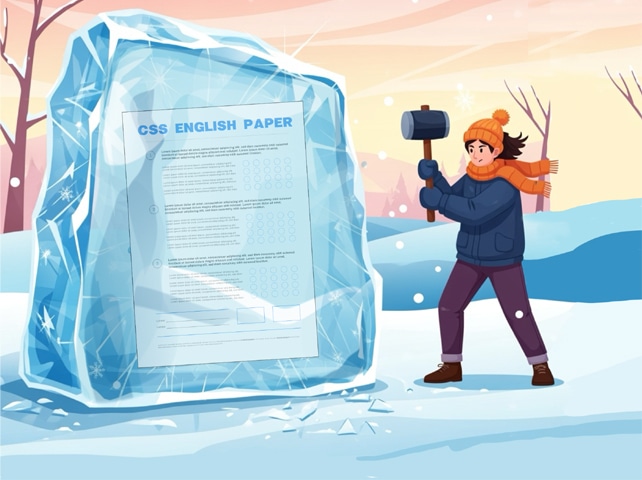 Illustration by Sarah Durrani In January 1997, I published an article, titled The CSS English Paper: A Scrutiny, in Dawn. The argument was simple: the English (Précis and Composition) paper of the Central Superior Services (CSS) examination tested neither authentic language proficiency nor the communicative skills required of a modern civil servant. Instead, it relied on archaic formats, ritualised exercises, and decontextualised language fragments, that distorted both teaching and learning. Nearly three decades later, the English paper of 2025 forces a sobering conclusion: nothing of substance has changed. This is no longer a matter of academic disagreement or pedagogical fashion. When a critique is placed in the public domain, grounded in language education and assessment principles, and then ignored for almost three decades, the question shifts. It is no longer “Is the criticism valid?”, but “What does such sustained inaction reveal about the institution itself?” ENGLISH AS SYMBOLIC CAPITAL The CSS English...
 -
Dawn - 03:10 Jan 18, 2026
 In the theatre of global politics, a ‘doctrine’ is more than just a policy paper. It is a nation’s strategic DNA. From the 1823 Monroe Doctrine, which fenced off the western hemisphere from European monarchs, to the 1947 Truman Doctrine that looked to aggressively ‘contain’ Soviet communism, these blueprints signal a country’s core values, and the consequences for those who cross them. In 1968, the Soviet Union introduced the Brezhnev Doctrine, asserting Moscow’s right to militarily intervene in socialist countries being threatened by capitalist/pro-US forces. Fast forward to the 21st century, and the blueprints have become increasingly aggressive. We’ve seen the Bush Doctrine’s ‘strike first, ask questions later’ approach (‘preemptive strikes’), and Russia’s Gerasimov Doctrine, which treats disinformation and cyberattacks as the new artillery. We see the Xi Jinping Doctrine seeking to enhance China’s glory through the sprawling veins of the Belt and Road Initiative, while Donald Trump’s recent ‘Donroe’ Doctr...
 -
Dawn - 03:07 Jan 18, 2026
GILGIT: Climate change impacts are becoming increasingly visible in Gilgit-Baltistan, where below-normal snowfall has left much of the region unusually dry this winter. Light snowfall was recorded in parts of Skardu, Kharmang, Shigar, Ghanche, Astore and Ghizer on Friday and Saturday. The Pakistan Meteorological Department (PMD) has forecast further rain and snowfall in several areas until Jan 23. Officials said Skardu received about two to three inches of snow on Saturday, while parts of Ghizer saw intermittent snowfall over the past two days. Light snow was also reported in Hunza, Nagar and other areas last week, but residents said most valleys remained dry, with mountains largely bare and rocky. Experts warn ‘snow drought’ could worsen flood risk downstream Muhammad Ali Alam, a resident of Skardu, said the region typically received heavy snowfall by mid-January. “The mountains should be snow-clad by now, but the first snow of the season in Skardu and adjoining areas only fell on Friday,” he told Dawn. He s... -
Dawn - 02:14 Jan 18, 2026
LAHORE: Pakistan’s rice exports recorded a strong rebound in December 2025, registering a 14 per cent month-on-month (MoM) increase compared to November, primarily driven by a more than 50pc surge in Basmati shipments. The impressive performance enabled Pakistan to overtake Vietnam and emerge as the world’s third-largest rice exporter, behind India and Thailand, during the month. According to trade data, Pakistan exported 489,000 tonnes of rice in December 2025, excluding shipments to Iran, compared to Vietnam’s 387,000 tonnes. This marks Pakistan’s best monthly rice export performance, underscoring renewed momentum in the sector. The UAE remained the top destination for Pakistani rice, importing 74,897 tonnes, including 16,850 tonnes of Basmati. China followed closely with 74,685 tonnes, while other major destinations included Tanzania (62,900 tonnes), Kenya (60,300 tonnes), Ivory Coast (41,700 tonnes), Guinea-Bissau (31,850 tonnes), Malaysia (23,930 tonnes), Madagascar (17,800 tonnes), Kazakhstan (17,050 to... -
Dawn - 02:12 Jan 18, 2026
KARACHI: Despite a 10 per cent year-on-year increase in revenue collection, the government borrowed net Rs1.192 trillion from scheduled banks in the first half of the current fiscal year against retirement of Rs1.255tr in the same period last year. The Federal Board of Revenue (FBR) collected Rs6.159 trillion during July-December FY26 against the target of Rs6.490tr, a shortfall of Rs331bn. However, it is 10pc higher compared to the year-ago figure of Rs5.618tr. The borrowing in 1HFY26 means the government spent much higher than the last year. This is also interesting to note that the State Bank reported a net profit of Rs2.5tr for FY25, which was transferred to the federal government. Despite this additional liquidity, the government is borrowing heavily from banks. Banks are comfortable to invest in the government papers as they get risk-free high yields which made the financial sector most stable financial sector. Last week the banks bids for the treasury bills auctions were Rs2.5tr reflecting the eagernes... -
Dawn - 02:06 Jan 18, 2026
ISLAMABAD: As many as 40 environmental samples from all four provinces and the federal capital were found positive during the month of December. According to an official of the polio laboratory located at the National Institute of Health (NIH), Islamabad, as many as 127 sewage samples from 87 districts were tested for the presence of poliovirus in December 2025. Of these, 87 samples tested negative, while 40 samples were found positive for poliovirus. “As many as 23 samples were collected from Balochistan, of which 21 were found negative and two were found positive. A total of 34 samples were collected from Khyber Pakhtunkhwa, of which 26 were negative and eight were found positive. From Punjab, 31 samples were collected, of which 25 were negative and six were positive. In Sindh, six samples were found negative and 23 were positive. In Islamabad, one out of five samples was found positive. However, five samples collected from Azad Jammu and Kashmir and Gilgit-Baltistan were found negative,” the official said.... -
Dawn - 20:01 Jan 17, 2026
A large fire erupted at the Gul Plaza shopping mall on Karachi’s MA Jinnah Road on Saturday night, killing at least three people, according to officials. Dr Sabir Memon, executive director of the Civil Hospital trauma centre, said three dead bodies had been brought to the facility. He said that all three were dead when they were brought to the hospital. South Deputy Inspector General Syed Asad Raza told Dawn that seven others were injured. Rescue 1122 spokesperson Hassaanul Haseeb Khan told Dawn that the fire erupted in shops located on the ground floor. However, he said there were people stuck on the upper portion of the high-rise building. “Six people have been injured and taken to the hospital,” he said. “Six fire tenders are busy controlling the fire; however, the situation is critical,” he said. Garden Sub-divisional Police Officer (SDPO) Mohsin Raza said in a statement that the fire appeared to have been caused by a short circuit at one of the shops, before spreading to the entire mall. He said that sev... -
Dawn - 17:34 Jan 17, 2026
US President Donald Trump’s so-called “Board of Peace” for post-war Gaza began to take shape on Saturday, with the leaders of Egypt, Turkiye, Argentina and Canada asked to join. The announcements from those leaders came after the US president named his Secretary of State Marco Rubio, former British prime minister Tony Blair, and senior negotiators Jared Kushner and Steve Witkoff to the panel. Trump had already declared himself the chair of the body, as he promotes a controversial vision of economic development in the Palestinian territory, which lies in rubble after two-plus years of relentless Israeli bombardment. The moves came after a Palestinian committee of technocrats meant to govern Gaza held its first meeting in Cairo which was attended by Kushner, Trump’s son-in-law who has partnered with Witkoff for months on the issue. In Canada, a senior aide to Prime Minister Mark Carney said he intended to accept Trump’s invitation, while in Turkiye, a spokesman for President Recep Tayyip Erdogan said he had bee...
10444 items