Dawn
Source:
https://www.dawn.com
Found 10418 news
-
Dawn - 02:02 Apr 02, 2026
ISLAMABAD: Federal Minister for Health Syed Mustafa Kamal said on Wednesday Pakistan will surpass Indonesia in population growth within the next five years. “Pakistan is currently the fifth most populous country in the world, and at the current growth rate, it is projected to surpass Indonesia in next five years. The rapidly increasing population has become a serious national challenge, placing immense pressure on healthcare, education, infrastructure, and employment sectors,” the minister said while chairing a meeting to review the growing population challenge and its implications for the country’s health system and national resources. He said the country’s population is increasing by around 6.2 million people annually, which exceeds the total population of some countries such as New Zealand. He noted that unchecked population growth was straining national infrastructure and undermining effective planning. “If we fail to control population growth, our vision for sustainable development will remain unach... -
Dawn - 02:01 Apr 02, 2026
• Over 30 districts face flood-like situation as severe weather persists • Lightning kills 12-year-old girl; flash floods damage infrastructure, cause widespread communication disruptions • Rescuers save 15 from stranded van; major highways cut off • Authorities ban travel; Met Office warns of severe flooding through April 3 QUETTA: A fresh spell of heavy, intermittent rain accompanied by strong winds, thunder and hail has pummelled more than 30 districts across Balochistan over the past 24 hours, triggering flash floods that have caused widespread disruption, infrastructure damage and at least one fatality. Widespread heavy rainfall was reported on Wednesday in Quetta, Khuzdar, Kalat, Surab, Lasbela, Hub, Kech, Gwadar, Qila Saifullah, Qila Abdullah, Zhob, Harnai, Loralai, Kohlu, Awaran, Kharan, Mastung, Sherani, Ziarat and other areas, creating flood-like conditions in many localities. Low-lying areas have been submerged, flash floods have damaged embankments, and residents are facing severe hardships... -
Dawn - 20:39 Apr 01, 2026
Iran President Masoud Pezeshkian has released an open letter, addressing the American people, calling on them to question the motives of the ongoing US-Israeli war on Iran. Below is the full text of his letter. “In the name of God, the Compassionate, the Merciful “To the people of the United States of America, and to all those who, amid a flood of distortions and manufactured narratives, continue to seek the truth and aspire to a better life: “Iran — by this very name, character, and identity — is one of the oldest continuous civilisations in human history. Despite its historical and geographical advantages at various times, Iran has never, in its modern history, chosen the path of aggression, expansion, colonialism, or domination. Even after enduring occupation, invasion, and sustained pressure from global powers — and despite possessing military superiority over many of its neighbours — Iran has never initiated a war. Yet it has resolutely and bravely repelled those who have attacked it. “The Iranian people... -
Dawn - 19:06 Apr 01, 2026
With President Donald Trump present, US Supreme Court justices signalled skepticism on Wednesday toward the legality of his directive to restrict birthright citizenship in the US, part of his hardline immigration approach that would upend the long-held understanding of a key constitutional provision. In his historic visit to the top US judicial body, Trump, wearing a red tie and dark suit, sat in the front row of the public gallery of the ornate courtroom after arriving by motorcade from the White House. The Republican president then left midway through the proceedings, not long after the Justice Department lawyer arguing for his administration completed his presentation. Most of the nine justices, conservatives and liberals alike, grilled the lawyer with questions about the legal validity of Trump’s executive order and its practical implications. The court has a 6-3 conservative majority. The justices heard more than two hours of arguments in the administration’s appeal of a lower court’s decision that block... -
Dawn - 18:46 Apr 01, 2026
ISLAMABAD: PPP Chairperson Bilawal Bhutto-Zardari, along with other leaders from his party, called on Jamiat Ulema-i-Islam (JUI-F) chief Maulana Fazlur Rehman at his residence in Islamabad on Wednesday, with statements by both parties saying that political matters were discussed during the meeting. Bilawal was accompanied by PPP leaders Raja Pervaiz Ashraf, Nayyar Bukhari and Chaudhry Yasin while JUI-F’s Asad Mehmood was also present on the occasion. A source privy to the matter told Dawn the meeting focused primarily on political matters and elections in Azad Jammu and Kashmir and Gilgit-Baltistan. Both sides agreed to continue consultations on the matter, the source added. The meeting took place three days after the AJK Election Commission announced on Sunday that the schedule for the upcoming Legislative Assembly elections was expected to be announced in May. Meanwhile, elections in GB are also expected to be held later this year after the GB chief election commissioner announced in December last year that... -
Dawn - 17:57 Apr 01, 2026
Officials from Pakistan, Afghanistan and China met on Wednesday in the Chinese city of Urumqi under the trilateral mechanism. Since Pakistan launched Operation Ghazab lil-Haq against terrorist hideouts in Afghanistan on February 26, diplomatic contact between the two sides had largely ceased. A senior official from the Ministry of Foreign Affairs (MoFA), who asked not to be named due to the sensitive nature of negotiations, told Dawn that the meeting was not a “mediation effort per se”. The meeting was focused on sharing perspectives on the latest escalation. No major outcomes were expected, though it was believed that China was pushing for confidence-building measures, such as reopening trade routes. Evolving regional situation and balancing security concerns with economic priorities were also a part of the discussion. Diplomatic sources said Pakistan’s agenda included reiterating its concerns over the presence of Tehreek-i-Taliban Pakistan (TTP) sanctuaries inside Afghanistan. Afghan Taliban representatives... -
Dawn - 17:35 Apr 01, 2026
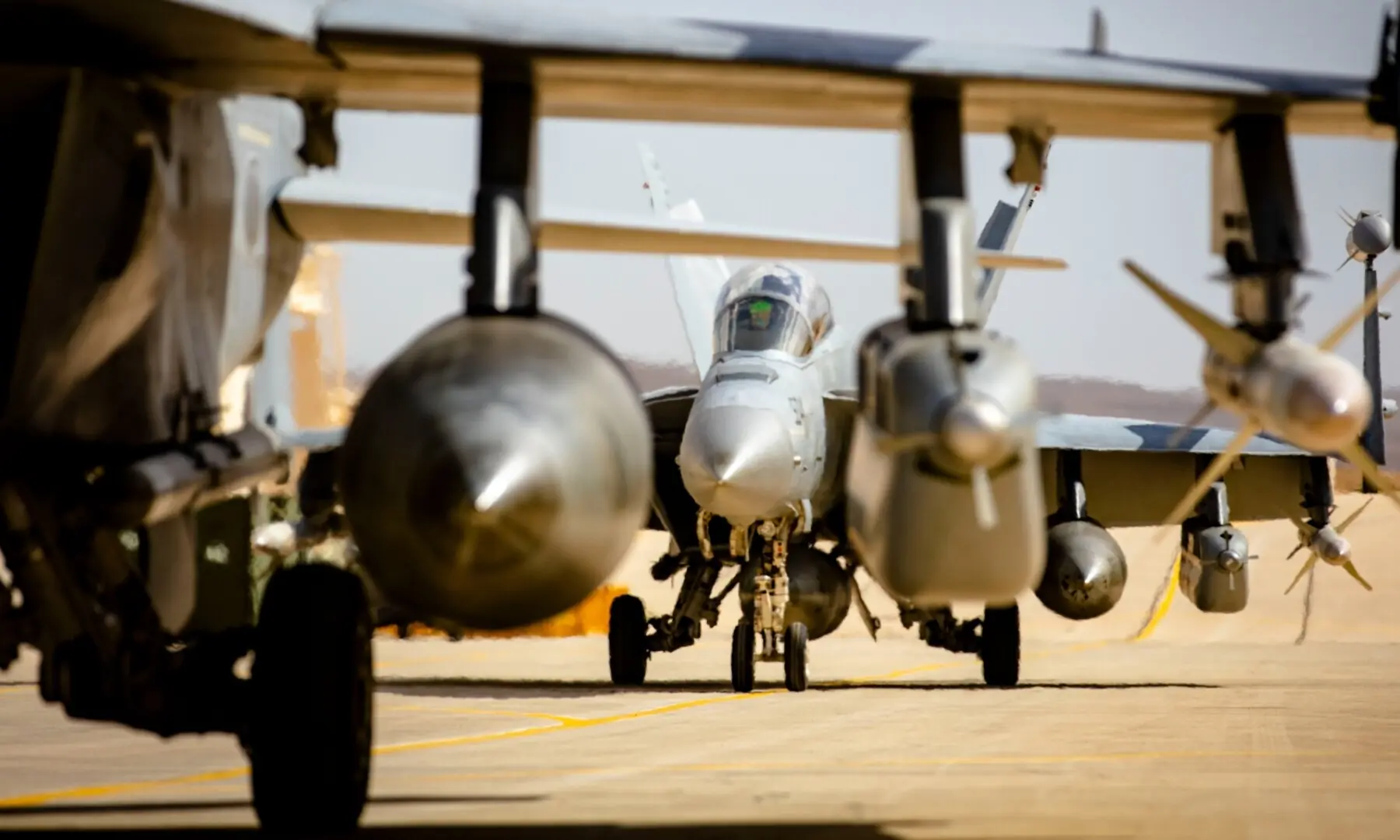 As the 33rd day of the US-Israel war against Iran drew to a close, all eyes were on US President Donald Trump’s speech later tonight, which diplomats and military analysts alike foresee as a defining moment that could set the next trajectory of the conflict, even as developments on the ground pointed less to de-escalation and more to an impending shift toward a higher risk escalation likely centred on control of critical maritime arteries. Speculation around the speech dominated the information space, with Trump’s public messaging about a possible “two-to-three-week” exit widely interpreted as tactical ambiguity rather than a genuine off-ramp; particularly in light of parallel military movements that suggested preparation for escalation, including the deployment of 18 A-10 Thunderbolt II aircraft which are designed for close air support of ground troops, heightened alert status for elements of a Marine Expeditionary Unit, and sustained heavy lift air traffic involving C-17 and C-5 transports, alongside the fo...
 -
Dawn - 17:34 Apr 01, 2026
ISLAMABAD: Telecom companies (telcos) and banks faced-off on Wednesday before a Senate panel meeting that focused on complaints by bank customers regarding being overcharged through regulatory or unauthorised messaging services. Representatives of the banks and telcos blamed each other for charging an extra fee — which collectively amounts to Rs26 billion — to bank customers during the meeting. This led the Senate Standing Committee on Finance, led by PPP Senator Saleem Mandviwalla, to dig deep into the matter and ask both sides, as well as the State Bank of Pakistan (SBP), to provide their transaction details and rates of service charges. The meeting also decided to seek the Pakistan Telecommunication Authority’s (PTA) assistance. Some senators were of the view that banks should not separately charge SMS fees, and that it should either be included in their service charges or rationalised. At the outset, Pakistan Banking Association (PBA) President Zafar Masud said there were two types of SMS charges, pertain... -
Dawn - 16:14 Apr 01, 2026
The Swiss government is considering dropping the agreed purchase of the Patriot air-defence system from the United States amid severe delivery delays, Defence Minister Martin Pfister said on Wednesday. “Cancellation is always an option in the event of a delay,” he told the ATS-Keystone news agency. Earlier on Wednesday, the defence ministry announced it would continue suspending payments for the system “until the United States has firmly announced new delivery dates and payment deadlines”. Switzerland, which is not in Nato, had ordered five Patriot systems in 2022, with delivery scheduled to begin this year and to be completed in 2028. But last July, the government said it had been informed by the US defence department that the deliveries to Switzerland would be delayed as Washington strived to provide more support for Ukraine. Switzerland first suspended its payments for the system last autumn. “We are still operating on the assumption that we will receive the delivery, but we don’t know when,” Pfister said,... -
Dawn - 15:46 Apr 01, 2026
The information ministry on Wednesday dismissed claims regarding the removal of the barbed wire along the Pak-Afghan border as “fabricated and devoid of facts”. In a post on X, the ministry’s fact-checking account denounced these “fake claims by the Afghan Taliban regime and Indian RAW’s (Indian intelligence agency Research and Analysis Wing) mouthpieces”. It said that the Pak-Afghan border, also called the Durand Line, was 2,640 kilometres long and guarded by Pakistan. “The Taliban regime works hand in glove with terrorists, smugglers and criminal mafia to infiltrate [it],” it said, adding that the complex dynamics of the border had already been explained multiple times by relevant security officials. The ministry’s post also referred to a November 2025 press conference by the Inter-Services Public Relations (ISPR) Director General (DG) Lt Gen Ahmed Sharif Chaudhry, during which he spoke about terrorist infiltration through the Pak-Afghan border and challenges being faced in this regard. He had also said tha... -
Dawn - 15:29 Apr 01, 2026
LAKKI MARWAT: Nine people, including four cops, were injured in an improvised explosive device (IED) explosion in the Serai Naurang town of Khyber Pakhtunkhwa’s Lakki Marwat district on Wednesday, according to police. District police spokesperson Qudratullah Khan told Dawn that the explosion occurred on the busy Bannu-DI Khan Road near a fruit and vegetable market. He said that according to initial information, the attackers targeted a police patrol party from the Shaheed Asmatullah Khan Khattak police station. The spokesperson said Head Constable Waheedullah and Constables Syed Anwar, Hadiullah and Ikramullah were injured in the explosion. He said that the van the police party had been patrolling in was also damaged in the explosion. Giving details about the exact nature and cause of the explosion, he said that terrorists had fitted an IED to a motorcycle to target the police van that was passing through the area. According to the police official, a total of nine people were injured. He identified the rest a... -
Dawn - 15:19 Apr 01, 2026
“Paper tiger”. “Cowards”. As US President Donald Trump grapples with the fallout of his war on Iran, much of his anger has been redirected onto another target: the Nato military alliance. Enraged by European allies who have refused to back his fight, rejected demands to help reopen the Strait of Hormuz, or denied access to US jets, Trump’s tone has grown increasingly menacing. “I was never swayed by Nato. I always knew they were a paper tiger,” Trump told British newspaper The Telegraph on Wednesday, suggesting he was strongly considering pulling the United States out. The ire from the president — who has also blasted Nato allies as “cowards” over Iran — is just the latest existential crisis to grip the 77-year-old alliance since his return to power last January. A few months ago, he rocked Nato’s foundations by threatening to seize the vast Arctic island of Greenland from fellow member Denmark — before abruptly backing off. That followed him repeatedly pulling the rug from under Ukraine in the war against Ru... -
Dawn - 14:37 Apr 01, 2026
LAHORE: Punjab Education Minister Rana Sikandar Hayat on Wednesday announced that all public and private schools across the province would remain closed on Fridays, with classes taking place four days a week. According to a notification by the Punjab School Education Department shared by Hayat on X, “Pursuant to approval of the competent authority, it is hereby notified that all public and private schools across Punjab shall remain off on Friday till further orders.” However, the notification didn’t mention the reason behind this decision. It also notified the opening and closing hours of public schools. Under the new schedule, schools with a single shift will operate from Monday to Thursday from 8am to 1:30pm. Meanwhile, schools with double shifts will have the morning session from 8:00am to 12:30pm, and the afternoon session from 1:00pm to 5:30pm. Speaking to Dawn, Punjab School Education Department Secretary Muddassir Riaz Malik also confirmed that educational institutions would remain closed on Friday. Me... -
Dawn - 13:54 Apr 01, 2026
The State Bank of Pakistan (SBP) on Wednesday launched a new framework for teenagers’ accounts, enabling them to independently own and operate bank accounts and digital wallets. According to a statement issued by the SBP, the move will build a financially savvy young generation. “By providing a convenient entry into the formal financial system at an early age, the SBP aims to foster meaningful participation of teenagers in the economy,” the statement said. It added that the initiative addressed a critical gap in the country’s financial landscape. “While overall account ownership of the adult population has risen to 67 per cent, teenagers have largely been confined to joint or parent-controlled accounts, limiting their practical financial engagement and learning,” the SBP said. The central bank said that with around 26 million citizens between the ages of 13 and 18, the framework was an effort for “nurturing a generation that is financially literate, digitally adept, and capable of driving future growth”. Key ... -
Dawn - 13:40 Apr 01, 2026
Pakistan and Norway on Wednesday signed the former’s first-ever carbon market deal under the Paris Agreement, according to an official press release. According to the press release, “Pakistan and Norway on Wednesday signed the country’s first landmark bilateral agreement under Article 6.2 of the Paris Agreement, opening the door to international carbon trading, climate finance and major investment in clean energy and climate-smart agriculture.” To tackle climate change and its negative impacts, world leaders at the UN Climate Change Conference (COP21) signed the Paris Agreement on December 12, 2015, according to the United Nations. The agreement included commitments from all countries to reduce their emissions and work together to adapt to the impacts of climate change, and called on countries to strengthen their commitments over time. The press release issued on Wednesday said that a memorandum of understanding (MoU) signed in Islamabad under the auspices of the Ministry of Climate Change and Environmental C... -
Dawn - 13:28 Apr 01, 2026
WASHINGTON: US President Donald Trump is set to address his nation at 9pm EST on Wednesday (6:00am on Thursday in Pakistan) to provide what the White House has described as “an important update on Iran,” fuelling speculation that he may declare an end to the five-week conflict — with or without a negotiated settlement. US media outlets, reporting the announcement, noted that Trump has brushed aside the need for a formal agreement to end hostilities. Speaking to reporters at the White House on Tuesday, he said US forces would likely leave Iran in “two or three weeks.” “We leave because there’s no reason for us to do this,” Trump said. “We’ll be leaving very soon.” In remarks that appeared to redefine the war’s objectives, he suggested that a negotiated settlement was no longer essential. “Iran doesn’t have to make a deal. It’s a new regime. They are much more accessible,” he said, adding that if the war has prevented Iran from developing a nuclear weapon, “then we’ll leave whether we have a deal or not.“ Domes... -
Dawn - 12:58 Apr 01, 2026
Palestinian shops and public institutions were closed across the occupied West Bank on Wednesday in protest of an Israeli law passed earlier this week permitting the execution of Palestinians convicted of deadly terror attacks. In the Palestinian territory’s main cities of Hebron, Ramallah, and Nablus, most stores were closed with their shutters down at midday, AFP journalists reported. Palestinian Authority president Mahmud Abbas’ Fatah party had called for a general strike the previous day. In Ramallah, the seat of the Palestinian Authority north of Jerusalem, entire shopping centres were closed as well as the city’s main market. People gathered to march against the law backed by Israel’s far-right National Security Minister Itamar Ben Gvir. “It’s a crazy law to be passed, it’s insane,” said Mohammed Gussein, a 24-year-old student at Al-Quds University, which like all Palestinian universities, was on strike. “It’s completely out of touch with humanity, and completely racist,” he told AFP. Riman, a 53-year-o... -
Dawn - 12:50 Apr 01, 2026
A delegation from the International Finance Corporation (IFC) called on Finance Minister Muhammad Aurangzeb and discussed its “growing portfolio in Pakistan, which now exceeds $2 billion annually and approximately $2.7bn committed this year”, according to the finance ministry. IFC is the private sector arm of the World Bank Group. According to the ministry, the IFC delegation comprised IFC Divisional Director for Pakistan, Afghanistan and Central Asia Simon Andrews, World Bank Country Director for Pakistan Bolormaa Amgaabazar and IFC Country Manager Naz Khan. Key areas of engagement included financial sector support through risk-sharing and guarantee facilities to promote trade and small and medium-sized enterprises (SME) financing; expansion of local currency financing to mitigate foreign exchange risks; and upcoming initiatives such as a diversified payment rights facility and a green bond issuance with a leading local bank, the ministry said. “Discussions focused on further scaling private sector investmen... -
Dawn - 12:20 Apr 01, 2026
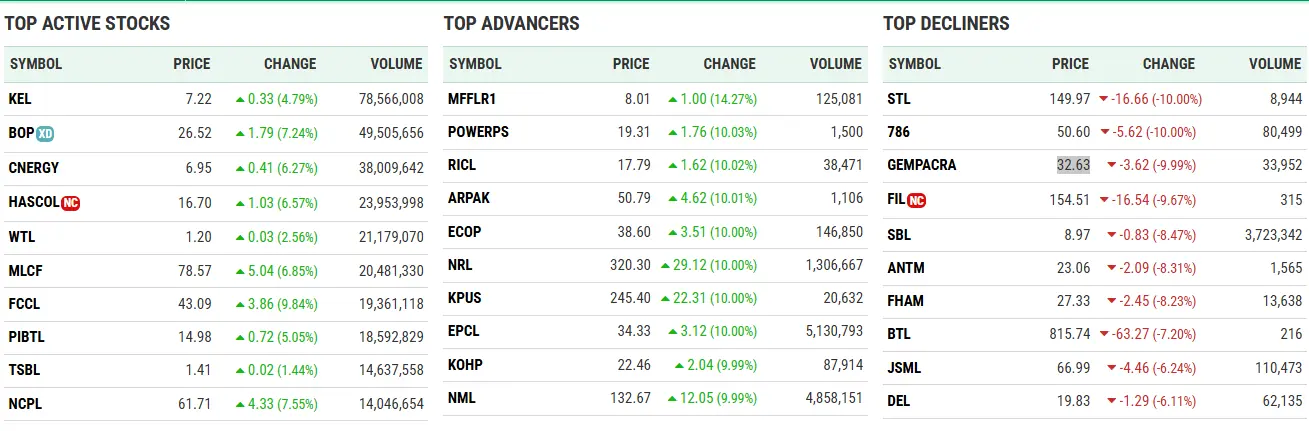 The Pakistan Stock Exchange’s (PSX) benchmark KSE-100 index continued its bullish momentum on Wednesday, surging by over 6,700 points as investors appeared hopeful of de-escalation in the Middle East. The KSE-100 index climbed by 6,768.25 points, or 4.55 per cent, to close at 155,511.56 from the previous close of 148,743.31. The market fluctuated between an intraday low of 151,262.76 points at opening and surged by 8,603.86 points to reach an intraday high of 157,347.17 at 1:13pm. AKD Securities Ltd said the KSE-100 was eyeing recovery on “rising hopes of Middle East de-escalation”. “KSE-100 index is expected to rebound after recording its worst monthly performance in March 26 in the past six years, as the likelihood of de-escalation in the Middle East conflict increases,” it noted. Arif Habib Ltd highlighted China and Pakistan’s joint call for an immediate ceasefire in the Iran war, noting that “additional news flow has also been positive with regards to de-escalation”. “Further positive news flow will drive...
 -
Dawn - 11:58 Apr 01, 2026
Prime Minister Shehbaz Sharif said on Wednesday that many countries were facing difficulties in maintaining the balance between demand and supply of essential commodities due to the global situation, but Pakistan was addressing the challenging situation “successfully and effectively,” the Prime Minister Office (PMO) said. According to a statement by the PMO, the prime minister made these remarks during a review meeting which was held to devise a comprehensive strategy to prevent the country from the financial and economic impacts arising from the regional conflict. PM Shehbaz commended the effective and timely measures taken by institutions to prevent any emergency situation regarding the demand and supply of essential goods. He appreciated the steps taken by relevant ministries and institutions through mutual coordination to address the financial and economic challenges and directed them to further enhance their cooperation. “After meeting domestic needs of food and essential items, progress is being made on...
10418 items