China | Pakistan
"China" in Pakistan feed
-
The Nation - National - 10:42 Apr 01, 2026
Pakistan and Afghanistan’s Taliban-led administration have resumed talks in China, which is mediating between the two sides in an effort to secure a durable ceasefire after weeks of heightened tensions, officials said on Wednesday. -
The Nation - National - 19:00 Mar 31, 2026
BEIJING: Deputy PM and Foreign Minister, Senator Mohammad Ishaq Dar, is received by Foreign Minister of China, Wang Yi at the Diaoytai State Guest House. -
Dawn - 16:11 Mar 31, 2026
Pakistan and China on Tuesday issued a five-point initiative for restoring peace and stability in the Gulf and the Middle East amid the US-Israeli war on Iran, in which they called on the immediate cessation of hostilities and starting peace talks as soon as possible. The development came as Deputy Prime Minister and Foreign Minister Ishaq Dar undertook a one-day visit to Beijing at the invitation of China’s Foreign Minister Wang Yi, for “in-depth discussions on regional developments”, according to the Foreign Office (FO). In a statement released after the meeting, the FO said the two reviewed the situation in the Gulf and Middle East region and put forward five points. Both countries called for the “immediate cessation of hostilities and utmost efforts to prevent the conflict from spreading”. Humanitarian assistance must be allowed to all war-affected areas, the statement said. The two countries also called for starting peace talks as soon as possible. “Sovereignty, territorial integrity, national independen... -
The Nation - National - 08:15 Mar 31, 2026
Deputy Prime Minister and Foreign Minister Senator Ishaq Dar on Tuesday departed here for China to pay a day-long visit, at the invitation of Chinese Foreign Minister Wang Yi. -
Dawn - 09:31 Mar 30, 2026
Deputy Prime Minister and Foreign Minister Senator Ishaq Dar will embark on an official visit to China on March 31 at the invitation of Chinese Foreign Minister Wang Yi, according to a statement issued by the Foreign Office (FO) on Monday. The FO said that Pakistan and China enjoy an all-weather strategic cooperative partnership, characterised by “close coordination and regular consultations” on regional development and international issues. “In this context, the upcoming visit will provide an opportunity for both sides to hold in-depth discussions on regional developments, as well as bilateral and global issues of mutual interest,” said the FO statement. It added that “FM Dar’s decision to undertake the visit, despite medical advice to rest following a hairline shoulder fracture sustained yesterday, reflects the importance Pakistan attaches to its relationship with China”. Earlier on Friday, Dar held a telephone call with Wang Yi, during which they exchanged views on the evolving regional situation and broad... -
The Nation - National - 14:26 Mar 27, 2026
Pakistan and China have reaffirmed their shared commitment to promoting peace and stability in the Middle East, calling for urgent diplomatic measures to de-escalate ongoing regional conflicts. -
Dawn - 12:54 Mar 27, 2026
Initiating peace talks in the war on Iran “is no easy task,” but it would be “conducive to restoring normal navigation through the Strait of Hormuz,” Chinese Foreign Minister Wang Yi said during a call with Deputy Prime Minister and Foreign Minister Ishaq Dar on Friday. The two “agreed to jointly promote a ceasefire and cessation of hostilities and the resumption of peace talks, to ensure the safety of non-military targets and waterways,” according to a summary of the call released by the Chinese ministry. China supports Pakistan’s role as a mediator, Wang told Dar. Meanwhile, in a social media post on X, Dar said the two “reaffirmed the need to restore peace and stability in the Middle East and the wider region”. “We agreed to support all efforts aimed at ensuring an immediate end to hostilities, resumption of peace talks, protection of non-combatants, security of shipping lanes, and adherence to the United Nations Charter,” he said. “FM Wang Yi conveyed China’s appreciation and support to Pakistan for its o... -
Dawn - 11:29 Mar 27, 2026
China’s foreign ministry accused the media of publishing “false information” on Friday following a report that said the country’s top semiconductor firm has sent chipmaking tools to Iran. The report, which cited information from two unidentified senior officials in US President Donald Trump’s administration, said contract chipmaker SMIC “began sending the tools to Iran roughly a year ago”. A US official was quoted in the report as saying they had “no reason to believe that any of this has stopped”. China is a key partner of Iran but has not announced military assistance to Tehran in the war triggered by US-Israeli strikes on February 28, repeatedly calling for a ceasefire. The chipmaker, Semiconductor Manufacturing International Corporation (SMIC), did not respond to an AFP request for comment on Friday. Asked about the report at a regular news conference in Beijing, foreign ministry spokesman Lin Jian said he was “not familiar with the situation”. “What I can tell you is that recently, some media have been k... -
The Nation - National - 19:00 Mar 26, 2026
ISLAMABAD - Prime Minister Shehbaz Sharif on Thursday appreciating China’s steadfast economic support, reaffirmed Pakistan’s commitment to advancing CPEC 2. -
Dawn - 06:33 Mar 26, 2026
United States President Donald Trump will meet Chinese President Xi Jinping in May during his first visit to China in eight years, a closely watched trip postponed due to the ongoing Iran war. Trump’s effort to reschedule the trip reflected the Republican president’s eagerness to project confidence in a challenging Middle East war and simultaneously to manage a tense relationship between the world’s biggest economies. Initially slated to travel next week, Trump will now visit Beijing on May 14 and 15, he said in a Truth Social post on Wednesday. Trump added that he would host Xi for a reciprocal visit in Washington later this year. “Our Representatives are finalising preparations for these Historic Visits,” Trump said. “I look very much forward to spending time with President Xi in what will be, I am sure, a Monumental Event.” China’s embassy said it had no information to provide on the announcement of the visit. Beijing normally does not detail Xi’s schedule more than a few days in advance. The long-schedule... -
Dawn - 10:18 Mar 25, 2026
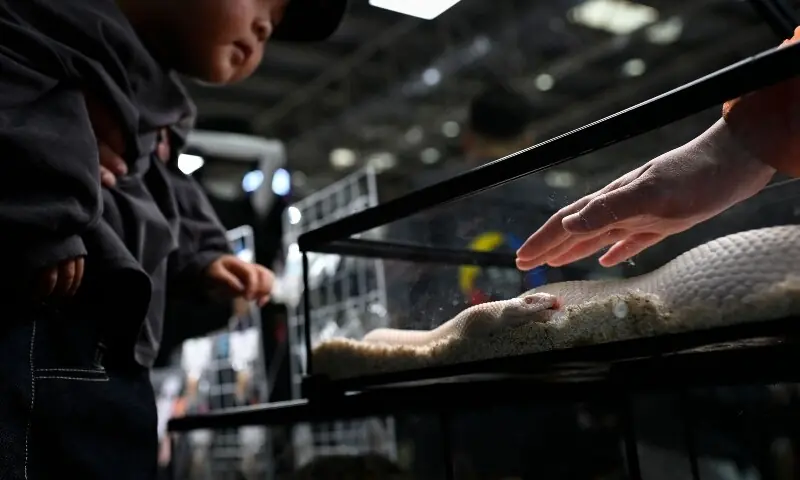 Pet lovers eagerly gathered around a container to snap photos of meerkats at a Beijing animal fair, each selling for $320, while nearby, a raccoon nervously paced in a cage only slightly bigger than itself. Throngs of people from across China packed into the cavernous exhibition halls for the annual pet fair, where exotic animals are a more common sight than cats or dogs. The exotic pet industry is experiencing rapid growth with a market nearing 10 billion yuan ($1.45 billion), Chinese state media have said. Approximately 17.07 million people in China have exotic pets, Xinhua reported last year, and animal rights groups have raised concerns about welfare standards. Unconventional pets are particularly popular among young people, with videos on how to raise them widely shared on social media platforms. A boy looks at a snake at a pet fair in Beijing on March 19, 2026. —AFP/File An 18-year-old putting down a deposit for a meerkat told AFP he was confident it would be easier to raise the animal than his previous...
 -
Dawn - 11:01 Mar 23, 2026
Chinese President Xi Jinping on Monday sent a congratulatory message to President Asif Ali Zardari on the occasion of Pakistan Day, saying he is ready to work with the president to build an even closer Sino-Pak community with a shared future in the new era. President Xi highlighted the start of China’s 15th Five-Year Plan this year, as well as the 75th anniversary of diplomatic ties between China and Pakistan. He expressed hope that both sides would carry forward their traditional friendship, enhance strategic communication and alignment of development strategies, and move forward together on their respective paths to modernisation. He lauded the Pakistani government on steadfastly safeguarding national sovereignty, independence, territorial integrity and national dignity, overcoming various risks and challenges, and advancing national development, as well as making contributions to regional peace, stability, development and prosperity. As a close friend, China is sincerely pleased with Pakistan’s development... -
Dawn - 12:56 Mar 22, 2026
Chinese Premier Li Qiang pledged on Sunday to further open the country’s economy to foreign firms and pursue more balanced trade with its global partners, after a year marked by trade friction and tariff wars with the United States and European Union in particular. China will import more high-quality foreign goods and work with all parties to promote optimised and balanced trade development and expand the global trade pie, Li told the China Development Forum in Beijing, according to state media. The annual two-day forum, which concludes on Monday, allows Beijing to lay out its economic vision and investment opportunities to foreign business leaders, Chinese officials, economists and academics. It comes after the world’s second-biggest economy reported a record $1.2 trillion trade surplus for 2025. Challenges for Beijing are aplenty, including deflecting concerns from an increasing number of global capitals about China’s trade practices and overcapacity, as well as its overreliance on key Chinese products. Whi... -
Dawn - 13:08 Mar 17, 2026
China said on Tuesday it will provide humanitarian assistance to Middle Eastern countries, including Iran and Lebanon, targeted in US and Israeli strikes in the conflict now in its third week. China’s foreign ministry spokesman Lin Jian said the war had caused “grave humanitarian catastrophes” in Iran and other Middle Eastern nations. “China has decided to provide emergency humanitarian assistance to Iran, Jordan, Lebanon and Iraq. It is hoped this will help alleviate the humanitarian plight faced by the local populations,” Lin told a press conference, without providing further details. “China will continue to make every effort to promote peace and stop the war … and to prevent further spreading of the humanitarian crisis,” he added. China has sought to mediate in the war, with its special envoy to the Middle East, Zhai Jun, urging de-escalation when he recently met Saudi Arabia’s foreign minister for talks. China’s top diplomat, Wang Yi, has also said that the war “should never have happened” and called for ... -
The Nation - National - 14:53 Mar 16, 2026
The Foreign Office of Pakistan has reiterated that Pakistan and China maintain a strong and trusted partnership, dismissing speculation surrounding recent diplomatic interactions between the two countries. -
Dawn - 10:55 Mar 14, 2026
Chinese Foreign Minister Wang Yi told his Afghan counterpart Amir Khan Muttaqi in a phone call that disputes between Afghanistan and Pakistan should be resolved through dialogue and consultation, not force, the foreign ministry said in a statement published on Friday. Wang urged both sides to remain calm and exercise restraint, hold face-to-face talks as soon as possible, seek an immediate ceasefire and address differences through dialogue, according to the statement. The further use of force would only complicate the situation and intensify tensions, Wang said. “China is willing to continue to make active efforts to help achieve reconciliation and detente between Afghanistan and Pakistan,” said Chinese Ambassador to India Xu Feihong on X, sharing the call’s details. The ministry’s statement came after Pakistan on Friday targeted terror camps and associated infrastructure in Afghanistan. Wang and Muttaqi also exchanged views on the situation in Iran, the statement said. Wang told Muttaqi, according to the sta... -
Dawn - 11:56 Mar 11, 2026
China warned the United States on Wednesday that the excessive use of artificial intelligence (AI) in its military could plunge the world into a Terminator like dystopian future. US President Donald Trump’s administration has sought the unconditional use of AI startups in the military. The Pentagon has confirmed Elon Musk’s Grok system is cleared for use in a classified setting, and blacklisted Anthropic after it refused to allow its Claude AI model to be used for mass surveillance and autonomous lethal warfare. “Such choices as the unrestricted application of AI by the military, using AI as a tool to violate the sovereignty of other nations, allowing AI to excessively affect war decisions, and giving algorithms the power to determine life and death, not only erode ethical restraints and accountability in wars, but also risk technological runaway,” a spokesman for China’s defence ministry, Jiang Bin, said on Wednesday. “A dystopia depicted in the American film The Terminator could one day come true,” he said.... -
Dawn - 12:35 Mar 05, 2026
UK police on Thursday said they had released three people arrested on suspicion of spying for China, including the husband of a lawmaker from Prime Minister Keir Starmer’s ruling Labour Party. The trio, aged 39, 43 and 68, were arrested on Wednesday by counter-terrorism officers in London and Wales on suspicion of assisting a foreign intelligence service. All three had “subsequently been released on bail to a date in May”, London’s Metropolitan Police said in a statement. Chinese espionage is a politically sensitive subject in Britain and the case could become awkward for Starmer, who visited Beijing recently, aiming to reset relations with the Asian giant. The media reported that the husband of Labour lawmaker Joani Reid was among the three. Reid said on Wednesday that she had never “seen anything to make me suspect my husband has broken any law”. Her husband, David Taylor, 39, is listed as a “lobbyist” on her list of registered interests. According to his LinkedIn page, he works for Asia House, a think tank... -
The Nation - National - 17:51 Feb 27, 2026
Prime Minister Shehbaz Sharif held a meeting in Islamabad with Jiang Zaidong, during which China reiterated its unwavering support for Pakistan’s sovereignty, territorial integrity, and economic advancement. -
Dawn - 06:38 Feb 21, 2026
US President Donald Trump will travel to China from March 31 to April 2 for a highly anticipated meeting between the leaders of the world’s two biggest economies, a trip announced as the Supreme Court overturned Trump’s sweeping tariffs on imported goods. A White House official confirmed the trip on Friday, just before the highest US court dealt Trump a stinging defeat by striking down many of the tariffs he has used in a global trade war, including some against rival China. Trump’s talks with Chinese President Xi Jinping on an extended visit to Beijing had been expected to revolve around extending a trade truce that kept both countries from further hiking tariffs. Ruling raises questions for US-China relations But the Supreme Court’s reversal created new questions for tense US-China relations that had recently stabilised after Trump trimmed tariffs on Chinese goods, in exchange for measures from Beijing, including cracking down on the illicit fentanyl trade and pausing export restrictions on critical mineral...