Israel | Pakistan
"Israel" in Pakistan feed
-
Dawn - 17:19 Oct 23, 2025
President Donald Trump said Israel would lose its crucial backing from the United States if it annexes the occupied West Bank, in a Time magazine interview published on Thursday. Trump’s comments, which Time said were made by telephone on October 15, were published as both Vice President JD Vance and Secretary of State Marco Rubio warned against any annexation. “It won’t happen. It won’t happen because I gave my word to the Arab countries. And you can’t do that now. We’ve had great Arab support,” Trump said when asked what the consequences would be for Israel if it did so. “Israel would lose all of its support from the United States if that happened.” Trump also told Time that he believed Saudi Arabia would join the Abraham Accords, which normalise relations between Israel and Arab states, by the end of the year. “Yes, I do. I do,” he said when asked if he thought Riyadh would join in that timeframe. “See they had a problem. They had a Gaza problem and they had an Iran problem. Now they don’t have those two p... -
Dawn - 07:50 Oct 23, 2025
The Foreign Office on Thursday condemned Tel Aviv’s attempt to “extend its so-called ‘sovereignty’” over parts of the Occupied West Bank a day after a bill applying Israeli law to the occupied West Bank won preliminary approval from the Knesset. Israeli lawmakers voted on Wednesday to advance two bills on annexing the occupied West Bank, barely a week after US President Donald Trump pushed through a deal aimed at ending Israel’s two-year military offensive in the Gaza Strip. In a statement released today, the FO said, “Pakistan strongly condemns Israel’s attempt to extend its so-called ‘sovereignty’ over parts of the occupied West Bank, including illegal Israeli settlements, through a draft law introduced in the legislature of the occupying power.” The FO said that these actions constituted a “flagrant violation” of international law, relevant United Nations Security Council resolutions, and the inalienable rights of the Palestinian people. “Such provocative and unlawful measures undermine ongoing efforts to ... -
Dawn - 16:38 Oct 22, 2025
The United Nations’ top legal body, the International Court of Justice (ICJ), on Wednesday said Israel has an obligation to ensure the basic needs of the civilian population in Gaza are met. The panel of 11 judges added that Israel is forced to support the relief efforts provided by the United Nations in the Gaza strip and its entities, including the UN Relief and Works Agency for Palestine Refugees in the Near East (UNRWA). Israel has not substantiated its claims that a significant number of UNRWA’s employees are members of Hamas, the judges said. The ICJ said that Israel was obliged to ease the passage of aid into Gaza, stressing it had to provide Palestinians with “basic needs” essential to survival. The wide-ranging ICJ ruling came as aid groups are scrambling to scale up much-needed humanitarian assistance into Gaza, seizing upon a fragile ceasefire agreed earlier this month. The ICJ’s “Advisory Opinion” is not legally binding but the court believes it carries “great legal weight and moral authority”. Is... -
Dawn - 12:53 Oct 22, 2025
Pakistan on Wednesday condemned Israel’s renewed hostilities in Gaza, following a US-backed ceasefire agreement, calling on the international community to take “urgent and effective” measures against the violation. Israeli forces have killed at least 87 Palestinians, among them civilians, since the ceasefire began, according to the Gaza Health Ministry, and two Israeli soldiers were killed by Palestinian freedom fighters in southern Gaza over the weekend, Reuters reported. On Sunday, more than 100 air strikes were reported in Rafah and Khan Younis in the south, Jabalia in the north, and other parts of central Gaza. While Israel accuses Hamas of initiating the hostilities with an attack on its forces in Rafah, the group has denied any knowledge or connection to the incident. “Pakistan strongly condemns the renewed attacks by the Israeli occupying forces in Gaza, resulting in the loss of numerous civilian lives,” said a statement released by the Foreign Office (FO) today. It noted that Israeli actions “run cont... -
Dawn - 11:06 Oct 12, 2025
Erling Haaland scored a hat-trick to pass 50 international goals in record time as Norway cruised to a 5-0 thrashing of Israel on Saturday, edging closer to qualifying for a first World Cup finals since 1998. Before the match in Oslo, hundreds of people attended a pro-Palestinian demonstration, chanting “Free Palestine” to protest against Israel’s “genocide” in Gaza, AFP journalists reported. Norwegian police dispersed a gathering of pro-Palestinian activists with tear gas and made several arrests. Inside the Ullevaal Stadium, several dozen Israeli fans waved their country’s flag and a banner reading “Let the Ball Talk!”. Norway now lead Group I with 18 points, six more than second-placed Italy, who beat Estonia 3-1 in Tallinn to stay on track for qualification. The comfortable win in Oslo leaves Norway firmly in control of the group as they seek a place at next year’s finals in the United States, Canada and Mexico. After a meek performance, Israel take on Italy in Udine on Tuesday knowing they must win to ke... -
Dawn - 17:30 Oct 09, 2025
Hamas and Israel signed an agreement on Thursday to cease fire and free Israeli captives in exchange for Palestinian prisoners, in the first phase of United States President Donald Trump’s initiative to end the conflict in Gaza. Officials on both sides confirmed they had signed the deal following indirect talks in the Egyptian beach resort of Sharm el-Sheikh. The deal’s announcement had been greeted with celebrations among Palestinians and Israelis alike. The deal includes the release of captives and prisoners as well as a surge of aid into Gaza after more than two years of genocide after Tel Aviv started bombing the Palestinian enclave following Hamas’s October 2023 attack on Israel. Israeli Prime Minister Benjamin Netanyahu’s office said the ceasefire would take effect once the agreement is ratified by his government, which would convene after a security cabinet meeting today. An Israeli government spokeswoman, confirming the deal had been signed, said the ceasefire would go into force within 24 hours of th... -
Dawn - 09:23 Oct 09, 2025
Italy are struggling to qualify automatically for next year’s World Cup finals and the pressure on the team is exacerbated by the tension surrounding next Tuesday’s qualifier with Israel in Udine. Italy was the scene of some of Europe’s biggest pro-Palestinian protests last weekend, as Israeli forces continue their offensive in Gaza. Hundreds of thousands of people gathered across Italy in anger at Israel’s actions, and calls for the country to be barred from international sport have grown louder. The protests were in response to Israel’s military operation in Gaza, which was sparked by the attack by Hamas fighters on October 7, 2023, on Israeli communities near the Gaza Strip. During Friday’s massive strike action in support of the Palestinians, demonstrators went to the Italian national team’s training centre in Florence to demand the match against Israel be called off. As of Tuesday only around 4,000 tickets had been sold for the game in Udine, a small city in Italy’s far north-east, which was picked speci... -
Dawn - 19:11 Oct 07, 2025
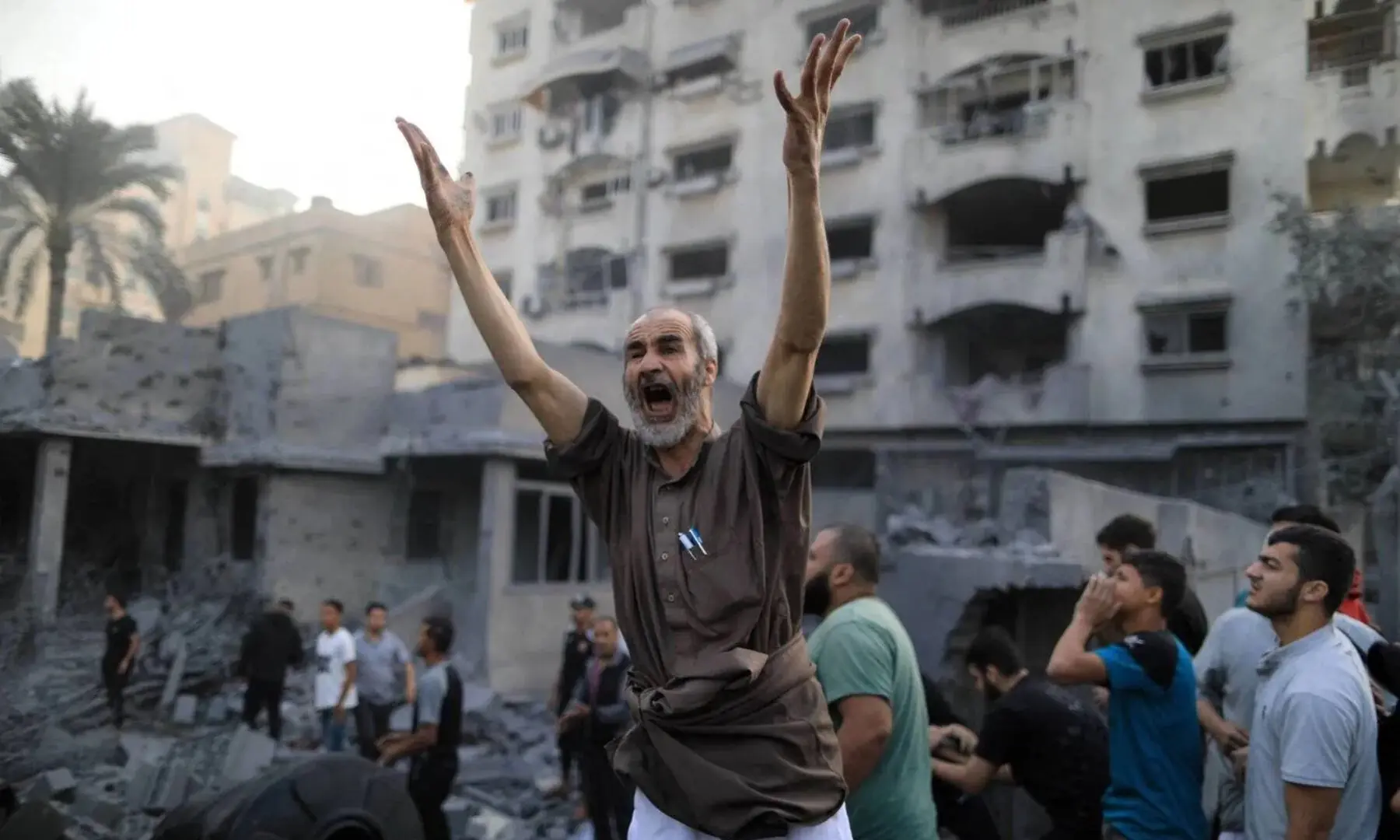 Israel has been facing damning criticism from across the globe over its relentless bombardment in Gaza over the past two years, with Amnesty International, Human Rights Watch and a United Nations inquiry already declaring its actions in the enclave as a “genocide”. Israel imposed a total blockade on the Palestinian enclave on March 2 after ceasefire talks broke down. In late July, it began allowing a small trickle of aid to resume, following warnings of a wave of starvation. But the aid was too little and too late to reverse the damage already done; the UN officially declared a famine in Gaza City in August. As today marks another year of the world witnessing piled up bodies in shrouds, spilt blood, shredded body parts, hungry cries for food and buildings reduced to rubble in Gaza, we take a look at some pictures that are an incriminating statement of Israel’s multiple war crimes in the enclave. A Palestinian shouts following an Israeli strike, in Khan Younis in the southern Gaza Strip on Oct 14, 2023, as fig...
 -
The Nation - National - 05:39 Oct 04, 2025
ISLAMABAD - Jamiat Ulema-i-Islam chief Maulana Fazlur Rehman on Friday rejected the Middle East peace plan presented by former US president Donald Trump, terming it pro-Israel and unacceptable. -
Dawn - 21:49 Oct 03, 2025
 US President Donald Trump said early Saturday Israel must stop bombing Gaza immediately and that he believes Hamas is ready for peace after an earlier statement by the Palestinian resistance group. Hamas said it would agree to some of the terms in Trump’s plan to end the Gaza war, including releasing hostages, but avoided addressing more vexing issues like disarmament and said it would seek further negotiations. Soon after, Trump posted Hamas’ response to his Truth Social account. Trump had earlier not specified whether the terms would be subject to negotiation, as Hamas is seeking. Notably, the resistance group did not say if it would agree to disarm and demilitarise Gaza — something Israel and the US want but Hamas has rejected before. It also did not agree to an Israeli withdrawal in stages, as opposed to the immediate, full withdrawal the group demands. A senior Hamas official told Al Jazeera that the group would not disarm before Israel’s occupation of the besieged enclave ends, comments that underscored...
 -
The Nation - National - 10:30 Oct 03, 2025
Pakistan Peoples Party (PPP) Chairman Bilawal Bhutto Zardari on Friday strongly condemned Israel’s detention of former Jamaat-e-Islami (JI) Senator Mushtaq Ahmed Khan and other activists aboard the Global Samoud Flotilla, demanding their immediate release. -
Dawn - 16:11 Oct 02, 2025
 Pakistan and several other countries on Thursday condemned Israel’s “dastardly attack” on the Global Sumud Flotilla (GSF) after its forces intercepted the flotilla heading to break Israel’s siege of Gaza and deliver aid. Hours after Tel Aviv’s move drew global condemnation, the Israeli foreign ministry posted on X that all on board the flotilla were safe would be “deported to Europe”. The statement said: “The Hamas-Sumud provocation is over. None of the Hamas-Sumud provocation yachts has succeeded in its attempt to enter an active combat zone or breach the lawful naval blockade. “All the passengers are safe and in good health. They are making their way safely to Israel, from where they will be deported to Europe.” It added that one last vessel of “this provocation remains at a distance. If it approaches, its attempt to enter an active combat zone and breach the blockade will also be prevented”. Earlier, the flotilla said that Israeli forces began intercepting the flotilla’s latest bid to reach Gaza late last ...
 -
Dawn - 15:13 Sep 27, 2025
 The Houthi rebels, who control swathes of Yemen, have used an array of sophisticated weapons — including ballistic missiles and “kamikaze” drones — in attacks on international shipping in the Red Sea in protest against Israel’s ongoing military onslaught in the Gaza Strip. Attacks on cargo ships and fuel tankers began in November 2023, when Houthi hijacked the Galaxy Leader cargo vessel as it was passing through the southern Red Sea. They redirected it toward Hodeidah port in Yemen and seized the crew. Since then, at least 43 more ships have been attacked in the area, with four seafarers killed and two vessels sunk. The Houthi attacks have disrupted international commerce, forcing international shipping to take the long route around South Africa to avoid being struck. Around 12 per cent of shipping passes through the Red Sea and the increase in delivery costs is stoking fears it could trigger a fresh bout of global inflation. Recent developments between Tel Aviv and Sanaa include the killing of the Houthi gov...
 -
Dawn - 03:11 Sep 21, 2025
JERUSALEM: Israel’s military kept up its assault on Gaza City and the wider Gaza Strip on Saturday, dismantling underground shafts and booby-trapped structures in attacks that left 87 Palestinians dead, 70 of them in Gaza City. The civil defence agency said 11 were killed when warplanes struck the Dughmush family in the city’s Al-Sabra neighbourhood. The assault came as 10 countries including Australia, Belgium, Britain and Canada are scheduled to formally recognise an independent Palestinian state on Monday, ahead of the annual gathering at the UN General Assembly. Israel’s intensified military demolition campaign targeting high-rise buildings in Gaza City began this week alongside a ground assault. Its forces, which control Gaza City’s eastern suburbs, have in recent days been pounding the Sheikh Radwan and Tel Al Hawa areas from where they would be positioned to advance on central and western parts of the city, where most of the population is sheltering. Hamas warns lives of Israeli prisoners are in danger... -
Dawn - 06:46 Sep 20, 2025
WASHINGTON: The Trump administration is seeking congressional approval to sell Israel $6.4 billion in support equipment and weapons, including attack helicopters and troop carriers. The Wall Street Journal reported the potential helicopter and vehicle sales on Friday. The White House did not immediately respond to a request for comment. The news of the proposed sale came days before world leaders were set to gather in New York for the annual United Nations General Assembly next week, while the UN Security Council is also due to hold a high-level meeting on Gaza. The planned package includes a deal worth $3.8bn for 30 AH-64 Apache attack helicopters and $1.9bn for 3,250 infantry assault vehicles for the Israeli army. Another $750 million worth of support parts for armoured personnel carriers and power supplies are also working its way through the sale process. The Republican president’s full-throated support for Israel’s military contrasts with growing wariness about Israel’s assault on Gaza among Democrats. O... -
Dawn - 18:07 Sep 16, 2025
Pakistan warned of “dangerous escalation” as the United Nations and a long line of countries on Tuesday denounced Israel’s attack on Qatar last week, demanding “accountability”. Israel’s strikes on the Qatari capital on September 9 targeted Hamas leaders gathered to discuss a new US ceasefire proposal for Gaza. Five Hamas members and a Qatari security officer were killed. That strike “was a shocking breach of international law”, UN rights chief Volker Turk said during an urgent debate at the UN Human Rights Council about the strike. Denouncing the attack as “an assault on regional peace and stability”, he urged “accountability for unlawful killings”. His words were echoed by Qatar and dozens of country representatives who took the floor during the three-hour debate. Qatari International Cooperation Minister Maryam bint Ali bin Nasser Al-Misnad slammed Israel’s “treacherous attack” and demanded that the international community “take practical steps to hold the aggressors accountable and prevent their impunity”... -
Dawn - 08:17 Sep 16, 2025
Pakistan has “very large” and “effective” armed forces that have proven their capabilities in conventional warfare, Foreign Minister Ishaq Dar said during an interview to Al Jazeera when asked about the possible position Islamabad would take in case a united body in the Middle East was formed to stop Israeli aggression. The interview, recorded ahead of an Arab-Islamic summit on Israel’s recent strikes in Qatar and published late on Monday night, saw Dar in conversation with Al Jazeera’s Osama Bin Javed. who asked the foreign minister if the formation of a united body in the Middle East, away from the United Nations structure, to intervene in Gaza was an option on the table. To that, Dar began his response by mentioning that “vis a vis UN Security Council, a mechanism could be chalked out”. “For example, they have [imposed] very serious sanctions on countries that don’t listen to them. And that is a very severe economic dent or pain they can cause to any country.” He then went on to say that there had been tal... -
Dawn - 19:54 Sep 15, 2025
Arab and Muslim leaders called for a review of ties with Israel after emergency talks in Doha on Monday following last week’s deadly strike on Hamas members in the Qatari capital. The Arab League and Organisation of Islamic Cooperation (OIC) joint session, which brought together nearly 60 countries, sought to take firm action after Israel’s attack on Qatar-hosted Hamas officials as they discussed a Gaza ceasefire proposal. It was co-sponsored by Pakistan. A joint statement from the summit urged “all states to take all possible legal and effective measures to prevent Israel from continuing its actions against the Palestinian people”, including “reviewing diplomatic and economic relations with it, and initiating legal proceedings against it”. Qatar’s fellow Gulf nations, the United Arab Emirates and Bahrain, along with Egypt, Jordan and Morocco, were among those present that recognise Israel. The leaders of the UAE, Bahrain and Morocco, which signed the Abraham Accords recognising Israel five years ago to the d... -
Dawn - 16:32 Sep 14, 2025
 Deputy Prime Minister and Foreign Minister Ishaq Dar on Monday called for urgent steps against Israel to “safeguard the global order”, in the wake of Tel Aviv’s strike on Qatar earlier this week. Israel targeted Hamas leaders on Tuesday in strikes on the Qatari capital, killing five Hamas members and a Qatari security officer. The attack drew widespread international condemnation, including from Gulf monarchies allied with the United States, Israel’s main backer. Attending a ministerial meeting in the Qatari capital, Dar delivered a speech where he highlighted that the frequency of meetings to discuss Israel’s activities in the region underlines “how Israel has become a persistent irritant and a danger to world peace and security”, according to the Foreign Office (FO). Deputy PM Ishaq Dar is welcomed in Doha by Qatari officials ahead of a ministerial meeting of the Arab-Islamic summit, on September 14. — screengrab via X/ForeignOfficePk “Pakistan condemns, in the strongest possible terms, the illegal and unpr...