Strait | Pakistan
"Strait" in Pakistan feed
-
Dawn - 17:54 May 18, 2026
Iran’s top security body announced on Monday the formation of a new body to manage the Strait of Hormuz, which Tehran has effectively closed and wants to charge ships to traverse. On its official X account, the Supreme National Security Council shared a post for the Persian Gulf Strait Authority (PGSA) saying it would provide “real-time updates on the #Hormuz_Strait operations and latest developments”. The account of the Revolutionary Guards’ navy shared the same post. It was not immediately clear what the new body would do but earlier this month Iranian English-speaking broadcaster Press TV said it constituted a “system to exercise sovereignty over the Strait of Hormuz” and that ships passing through the strait were sent “regulations” from the email info@pgsa.ir. Iran has largely blocked shipping through the vital strait since the outbreak of war with the United States and Israel on February 28. A fragile ceasefire has been in place since April 8. Iran’s grip over the waterway has rattled global markets and ... -
Dawn - 08:31 May 06, 2026
United States President Donald Trump said on Tuesday he would briefly pause an operation to help escort ships through the Strait of Hormuz, citing “great progress” toward a comprehensive agreement with Iran. Hours earlier, US Secretary of State Marco Rubio had outlined the effort that began on Monday to escort stranded tankers out of the Gulf. The strait has been virtually shut since the conflict began, blocking some 20 per cent of world oil supplies and igniting a global energy crisis. “Based on the request of Pakistan and other Countries, the tremendous Military Success that we have had during the Campaign against the Country of Iran and, additionally, the fact that Great Progress has been made toward a Complete and Final Agreement with Representatives of Iran, we have mutually agreed that, while the Blockade will remain in full force and effect, Project Freedom (The Movement of Ships through the Strait of Hormuz) will be paused for a short period of time to see whether or not the Agreement can be finalized... -
Dawn - 13:03 Apr 25, 2026
ISLAMABAD: State-run Pakistan LNG Limited (PLL) has approved a revised bid of $18.4 per million British thermal units (mmBtu) from TotalEnergies for delivery between April 27 and 30, while rejecting all other bids, it emerged on Saturday. TotalEnergies had initially bid $18.88 per mmBtu but later revised its offer downward to $18.4 following negotiations. After internal consultations, the authorities rejected all other bids for the first half of May, anticipating the reopening of the Strait of Hormuz. On Friday, PLL had received four bids at $17.997 to $18.88 per mmBtu for delivery between April 27 and May 8. A total of four bids were received from three bidders, and three were declared the lowest. Vitol Bahrain’s bid of $18.54 per mmBtu was declared the lowest for the May 1–7 delivery window, while OQ Trading was the lowest bidder at $17.997 per mmBtu for the May 8–14 period. However, both bids were rejected. PLL had on Thursday floated urgent tenders for the import of three LNG cargoes for delivery between ... -
Dawn - 17:17 Apr 24, 2026
ISLAMABAD: Police have arrested a citizen for allegedly mocking and likening the Tarnol Railway crossing to the Strait of Hormuz. The Strait of Hormuz, a crucial shipping route, has been virtually paralysed by the Middle East war. The first information report (FIR), a copy of which is available with Dawn, has been registered on the complaint of Sub-inspector Shahid Asghar on the state’s behalf. The FIR was registered under Section 188 (disobedience to order duly promulgated by a public servant), Section 341 (punishment for wrongful restrains) and Section 511 (punishment for attempting to commit offences punishable with imprisonment for life or for a shorter term) of the Pakistan Penal Code (PPC). According to the complaint, a man identified as Khurram was accused of sharing a post on social media, saying, “Tarnol Railway Crossing is no less than the Strait of Hormuz. If it is closed, all our problems will be resolved”. It said that the citizen was taken into custody and his phone was also checked, wherein evi... -
Dawn - 17:03 Apr 18, 2026
New Delhi on Saturday summoned Iran’s ambassador to convey the country’s “deep concern” after two Indian-flagged vessels were shot at near the Strait of Hormuz, India’s foreign ministry said. In a statement, India’s Ministry of External Affairs (MEA) said Iran’s Ambassador to India Dr Mohammad Fathali was summoned “for a meeting with [the] foreign secretary this evening”. During the meeting, the foreign secretary “conveyed India’s deep concern at the shooting incident earlier today involving two Indian-flagged ships in the Strait of Hormuz”, the MEA said. “He noted the importance that India attached to the safety of merchant shipping and mariners and recalled that Iran had earlier facilitated the safe passage of several ships bound for India.” Reiterating his concern at “this serious incident of firing on merchant ships”, the foreign secretary urged the ambassador to convey India’s views to the authorities in Iran and “resume at the earliest the process of facilitating India-bound ships across the strait”. Th... -
Dawn - 14:20 Apr 18, 2026
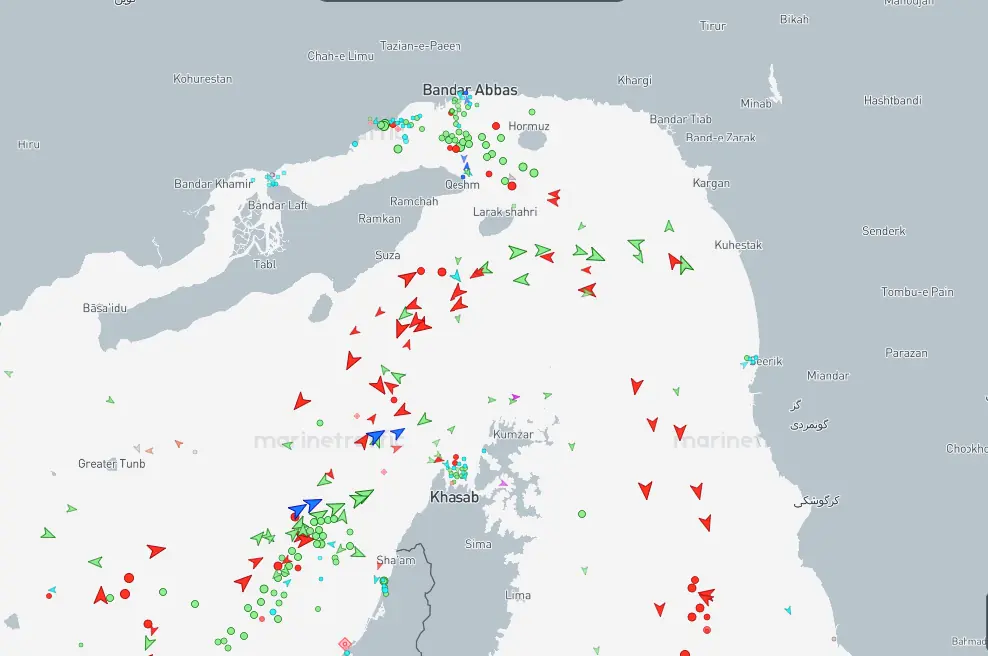 A handful of oil and gas tankers crossed the Strait of Hormuz on Saturday during a brief reopening, tracking data showed, but others retreated and two were reportedly attacked as Iran closed the route again. The toing and froing over the strait cast doubt on US President Donald Trump’s optimism the day before, that a peace deal to end the US-Israeli war with Iran was “very close”. Iran reversed its pledge to reopen the strait to commercial traffic during a ceasefire in the war to protest an ongoing US counter-blockade of the route, a crucial passage for commodity shipments. During the reopening, at least eight oil and gas tankers crossed the strait early on Saturday after the Iranian announcement on Friday afternoon, data from tracking firm Kpler indicated. However, tracking platform MarineTraffic showed several other crude oil tankers approached the strait but then turned back near Iran’s Larak Island, a checkpoint for vessels seeking to exit the Gulf under Iranian forces’ blockade of the passage. Screengrab...
 -
Dawn - 15:45 Apr 17, 2026
Iranian Foreign Minister Abbas Araqchi said on Friday that the Strait of Hormuz, vital for the global trade in oil and other commodities, was open following a ceasefire accord agreed in Lebanon. Araqchi said in a post on X that the Strait was open for all commercial vessels for the “remaining period of ceasefire”. It was not immediately clear whether he was speaking of the 10-day truce agreed by Lebanon and Israel that went into effect at midnight or an earlier two-week truce between Iran and the United States that began on April 8. He said the passage of ships would need to be along the route that Iran’s Ports and Maritime Organisation had announced. US President Donald Trump welcomed Iran’s announcement. “THANK YOU!” he wrote on his Truth Social platform, before going on a posting spree. In a separate post, he said that the US military blockade of ships sailing through the Strait to Iranian ports — announced after talks with Iran last weekend in Islamabad ended without a breakthrough — remained in place. “T... -
The Nation - National - 14:03 Apr 17, 2026
A Pakistani-flagged oil tanker, MT Shalamar, has successfully completed a rare transit through the Strait of Hormuz with a crude oil cargo amid ongoing maritime tensions and restrictions in the region, according to international shipping data. -
The Nation - National - 06:56 Apr 17, 2026
Pakistan has called for the immediate restoration of normal shipping through the Strait of Hormuz, warning at the United Nations that ongoing disruptions are affecting global trade, energy supplies and vulnerable populations. -
Dawn - 22:47 Apr 13, 2026
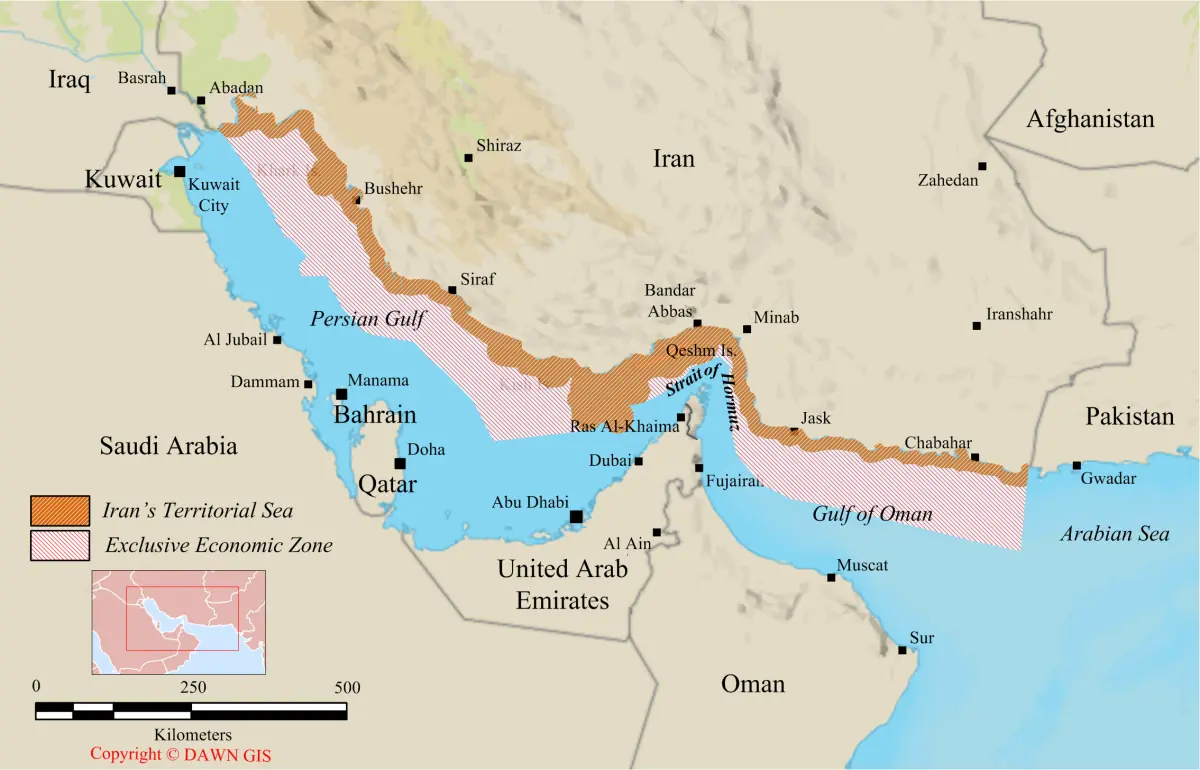 On Sunday, President Donald Trump stepped in to raise the stakes of an already volatile standoff, announcing that the United States Navy would begin “BLOCKADING” the Strait of Hormuz — delivered, in classic Trump fashion, the emphatic all-caps. The deadline passed at 7pm (PST) on Monday. The developments came after a night of diplomacy in Islamabad that promised more than it delivered, with inconclusive takeaways and very little to show for 21 hours of deliberations. The negotiations ended with a terse briefing from JD Vance, confirming what everyone had been hoping to avoid: nothing had been agreed. Judging from the string of off-the-cuff, rhetorically charged posts on Trump’s Truth Social feed, he appears to have revived what once again looks like the ‘madman theory’ — using brinkmanship and unpredictability as a strategic bargaining chip. He seems to be signalling that if Iran can rattle markets by blocking one of the world’s primary energy arteries, Washington can rattle them harder. The rationale is pret...
 -
Dawn - 18:43 Apr 11, 2026
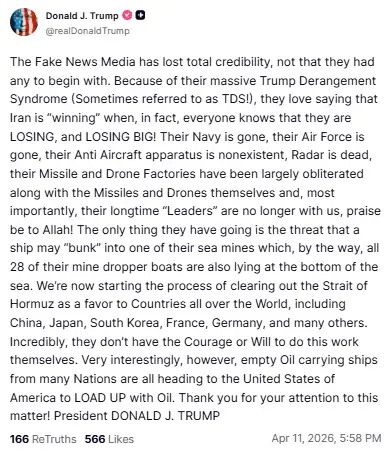 Two US Navy warships transited the Strait of Hormuz at the start of an operation to clear the strategic waterway of mines laid by Iran, US Central Command (Centcom) said on Saturday. The announcement — which marks the first such transit since the US-Israeli war on Iran began — came shortly after President Donald Trump said Washington had started “clearing out” the strait, through which a fifth of the world’s crude oil passes. “Today, we began the process of establishing a new passage and we will share this safe pathway with the maritime industry soon to encourage the free flow of commerce,” said Centcom commander Admiral Brad Cooper. The USS Frank E Peterson and the USS Michael Murphy are the guided-missile destroyers involved in the operation, but Centcom said that “additional US forces including underwater drones” could join the effort in coming days. Earlier, US media outlet Axios reported that the operation was not coordinated with authorities in Tehran. “We’re now starting the process of clearing out the...
 -
Dawn - 11:43 Apr 08, 2026
Two ships have passed through the Strait of Hormuz since Iran agreed to reopen the waterway as part of a ceasefire deal, maritime monitor Marine Traffic said on Wednesday. “The Greek-owned bulk carrier NJ Earth crossed the Strait at 08:44 UTC, while the Liberia-flagged Daytona Beach transited earlier at 06:59 UTC, shortly after departing Bandar Abbas at 05:28 UTC”, MarineTraffic said on X. The United States and Iran agreed overnight from Tuesday to Wednesday to a two-week ceasefire, during which passage through the Strait of Hormuz “will be possible via coordination with Iran’s armed forces”, Iran’s Foreign Minister Abbas Araghchi said on X. “NJ Earth’s transit may be an early sign of movement, but it is still too soon to tell whether this reflects a broader ceasefire-driven reopening or a previously approved exception,” Ana Subasic, analyst at MarineTraffic owner Kpler told AFP. The Greek-owned ship kept its transponder signal on as it transited the strait via an Iranian-approved route near Larak Island, use... -
Dawn - 20:55 Apr 07, 2026
WASHINGTON: Russia and China on Tuesday vetoed a draft resolution at the United Nations Security Council for reopening the Strait of Hormuz, while Pakistan abstained. The draft resolution prepared by Bahrain, which underwent six revisions during negotiations to bridge differences among council members, received 11 votes in favour, two against and two abstentions. Bahrain, the Democratic Republic of the Congo, Denmark, France, Greece, Latvia, Liberia, Panama, Somalia, the United Kingdom and the United States voted in favour of the resolution. Russia and China voted against the measure, exercising their veto power as permanent members of the 15-nation UNSC, thereby blocking its adoption despite majority support. Pakistan and Colombia were the two countries that abstained from voting. Drafted by Bahrain in coordination with Gulf Cooperation Council (GCC) states and Jordan, the resolution strongly urged nations using the commercial route to coordinate defensive measures — including escorting merchant vessels — to... -
Dawn - 02:18 Apr 06, 2026
• Trump warns power plants, bridges to be attacked on Tuesday, hopeful for Hormuz deal; Iran wants world to ‘act now’ to prevent ‘war crime’ • Iranian official says Hormuz strait will be opened only after payment of war damages • China, Russia call for ceasefire; Lavrov tells Washington to abandon ‘language of ultimatums’ • IRGC bombs petrochemical facility in Israel as US strikes target Ahvaz airport WASHINGTON: The US-Israel war with Iran raged on Sunday amid no signs of a ceasefire despite threats by US President Donald Trump, who warned that the US would target power plants and bridges in the besieged country if the Strait of Hormuz was not opened up by Monday. Iran said the statement, which was also denounced in the US, made by the US president was a “clear evidence of intent to commit war crime” and asked the international community to prevent this atrocious act from happening. For almost six weeks, the US and Israeli jets have bombed the length and breadth of Iran, targeting civilian and military infr... -
Dawn - 16:24 Apr 02, 2026
The secretary general of the Gulf Cooperation Council (GCC) on Thursday called for the UN Security Council to authorise the use of force to protect the Strait of Hormuz from Iranian attacks. Iran has placed a stranglehold on the key shipping lane — threatening fuel supplies and buckling the global economy — in retaliation for US-Israeli strikes on the country that triggered the month-old Middle East war. “Iran has closed the Strait of Hormuz, prevented commercial vessels and oil tankers from transiting, and imposed conditions on some to pass through the Strait,” said Jassem al-Budaiwi, head of the GCC. He spoke in New York at the first Security Council meeting on cooperation with the GCC, which comprises Saudi Arabia, the United Arab Emirates, Bahrain, Qatar, Kuwait and Oman. “We call upon the Security Council to assume its full responsibility and take all necessary measures to protect maritime routes and ensure the safe continuation of international navigation,” al-Budaiwi said. Bahrain has proposed a draft ... -
Dawn - 19:24 Mar 28, 2026
Deputy Prime Minister and Foreign Minister Ishaq Dar said late on Saturday that the government of Iran had agreed to allow “20 more ships under the Pakistani flag to pass through the Strait of Hormuz”. In a post on X, he said two ships will cross the Strait daily. “This is a welcome and constructive gesture by Iran and deserves appreciation. It is a harbinger of peace and will help usher stability in the region,” he said. “This positive announcement marks a meaningful step toward peace and will strengthen our collective efforts in that direction,” he said. “Dialogue, diplomacy, and such confidence-building measures are the only way forward,” he said. He also tagged US Vice President JD Vance, US Secretary of State Marco Rubio, Iranian Foreign Minister Abbas Araghchi and US special envoy Steve Witkoff in the post. The world has been facing a global fuel crunch in the aftermath of a US-Israeli war on Iran, which has been going on for nearly a month. The fuel crisis has resulted from the disruption of traffic in... -
Dawn - 18:06 Mar 19, 2026
Leaders from the United Kingdom, France, Germany, Italy, the Netherlands, and Japan have signalled their readiness to support efforts to ensure the safe passage of commercial vessels through the Strait of Hormuz. “We express our readiness to contribute to appropriate efforts to ensure safe passage through the strait. We welcome the commitment of nations that are engaging in preparatory planning,” the leaders said in a joint statement. The Strait of Hormuz, a crucial shipping route, has been virtually paralysed by the Middle East war. The war erupted on February 28 when the US and Israel began bombing Iran, prompting it to retaliate with strikes targeting US assets and bases in the Gulf and restricting access to the strait. Since March 1, 2026, at least 21 commercial vessels, including 10 tankers, have been attacked or reported incidents in the Gulf, the Strait of Hormuz or the Gulf of Oman, according to the British naval maritime security agency UKMTO. Across all types of vessels, an additional four attacks c... -
Dawn - 11:43 Mar 18, 2026
Here are key facts and figures about the blockage of the Strait of Hormuz, a crucial shipping route virtually paralysed by the Middle East war. Around a fifth of global crude oil and liquefied natural gas passes through the waterway in peacetime. The war erupted on February 28 when the US and Israel began bombing Iran, prompting it to retaliate with strikes across the region and restrict access to the strait. 21 security incidents Since March 1, 2026, 21 commercial vessels, including 10 tankers, have been attacked or reported incidents in the Gulf, the Strait of Hormuz or the Gulf of Oman, according to the British naval maritime security agency UKMTO. Across all types of vessels, an additional four attacks claimed by the Iranian Revolutionary Guards have not been confirmed by international authorities. 8 sea workers killed Since the conflict began, at least eight seafarers or dock workers have died in incidents in the region, according to the International Maritime Organisation (IMO). A further four remain mi... -
Dawn - 17:21 Mar 14, 2026
US President Donald Trump said on Saturday that many countries would send warships to keep the Strait of Hormuz open, but did not provide details on which countries would do so. “Many countries, especially those who are affected by Iran’s attempted closure of the Hormuz Strait, will be sending warships, in conjunction with the United States of America, to keep the Strait open and safe,” Trump wrote in a post on Truth Social. Trump said he hoped that China, France, Japan, South Korea, Britain and others would send ships to the area. “In the meantime, the United States will be bombing the hell out of the shoreline, and continually shooting Iranian boats and ships out of the water,” he wrote. The White House did not immediately respond to a request for comment on whether any countries had agreed to send ships. The comments come after Iran’s new supreme leader, Ayatollah Mojtaba Khamenei vowed in his first public remarks to keep the Strait of Hormuz closed to “put pressure” on Washington. “The lever of blocking t...