Cointelegraph.com
Source:
https://cointelegraph.com
Found 10245 news
-
Cointelegraph.com - 21:15 Feb 19, 2026
 Bitcoin is on course to lock in another negative month, but one analyst says major differences in the current market structure could be a sign of a pending trend reversal. Bitcoin (BTC) is forming what may prove to be a fifth consecutive red monthly candle, which would be the longest losing streak since 2018. The silver lining is that data suggests that March may prove to be a profitable month for BTC. Historical price data from CoinGlass confirms Bitcoin is now facing its fifth consecutive red month, down 15% this month after closing the previous four months in the red. The last time this happened was in 2018, when it entered a bear market after reaching record highs in 2017. Read more
 -
Cointelegraph.com - 21:09 Feb 19, 2026
 Paul Atkins and Hester Peirce spoke at ETHDenver on Wednesday on the future of regulation at the SEC and its response to crypto market volatility. Paul Atkins, chair of the US Securities and Exchange Commission (SEC), and the agency’s crypto task force head, Hester Peirce, said Wednesday they would support efforts to clarify how “tokenized securities interact with existing regulation,” better positioning industry developers. Speaking to attendees at the ETHDenver conference on the future of regulation, Atkins and Peirce addressed concerns about volatility in many cryptocurrency prices and how the agency plans to move forward with digital asset regulation amid a potential market structure bill in Congress. In response to “falling crypto prices of late,” likely referring to the price of Bitcoin (BTC) and Ether (ETH) falling by more than 28% and 40%, respectively, in the previous 30 days, Atkins said: Read more
 -
Cointelegraph.com - 21:06 Feb 19, 2026
 A transaction-level analysis of 92 community banks found $78.3 million in net deposits moved to Coinbase over 13 months, with money market accounts losing most outflows. New analysis from banking data company KlariVis found that 90% of community banks in its sample had customers transacting with Coinbase. Across 53 banks where transaction direction could be determined, $2.77 flowed to the crypto exchange for every $1.00 returning, resulting in a net $78.3 million deposit shift over 13 months. The study reviewed 225,577 Coinbase-related transactions across 92 community banks and found that transfers were heavily concentrated in money market accounts, where 96.3% of identifiable transaction volume represented funds leaving banks for the exchange. "In general, community banks can be defined as those owned by organizations with less than $10 billion in assets," the Federal Reserve says on its website. Read more
 -
Cointelegraph.com - 20:15 Feb 19, 2026
 The Bollinger Bands indicator has narrowed to its tightest level on record, a rare technical setup that analysts say is a sign of a pending directional move. A key volatility indicator for Bitcoin (BTC) has narrowed to its tightest measurement on record, a pattern that was followed by a multimonth rally in previous bull and bear markets. Will the Bollinger Bands indicator call the market bottom again? Analyzing the monthly Bitcoin chart, crypto analyst Dorkchicken noted that BTC’s Bollinger Bands are currently at their “tightest” level on record. Such conditions have repeatedly led to bullish breakouts, with the only prior downtrend from similar conditions occurring in 2022, during the drop to $16,000 from $20,000. Bollinger Bands measure price volatility, and extreme compression often leads to a sharp expansion. The analyst added that there are higher odds of an upside trend once expansion begins. Read more
 -
Cointelegraph.com - 20:11 Feb 19, 2026
 The ETF invests exclusively in short-term US Treasurys and is structured for potential use by stablecoin issuers under US reserve requirements. US-based exchange-traded funds issuer ProShares has launched a money market ETF designed to qualify as an eligible reserve asset under the GENIUS Act, positioning it for potential use by stablecoin issuers. The ProShares GENIUS Money Market ETF, trading under the ticker IQMM, invests exclusively in short-term US Treasurys. Unlike conventional government money market funds, it uses a floating net asset value (NAV) based on market pricing and trades intraday on an exchange. According to an announcement on Wednesday, the structure includes same-day settlement and dual NAV features designed for institutional reserve management. Read more
 -
Cointelegraph.com - 19:06 Feb 19, 2026
 Trump administration officials held a similar event last week to discuss stablecoin yield within a market structure bill under consideration in Congress. Update (Feb. 19 at 7:21 pm UTC): This article has been updated to include a statement from the Crypto Council for Innovation. The White House has held another meeting between representatives from the cryptocurrency and banking industries on a market structure bill under consideration in the US Senate, seeking to iron-out differences on stablecoin yield provisions, among other issues. In a Thursday Fox News interview, Ripple CEO Brad Garlinghouse said that the company’s chief legal officer, Stuart Alderoty, attended the meeting with White House officials earlier in the day. The CEO’s comments came after unconfirmed reports that the Trump administration would follow its Feb. 10 meeting on the CLARITY Act, a bill to establish digital asset market structure. That meeting did not result in a deal on stablecoins. Read more
 -
Cointelegraph.com - 18:58 Feb 19, 2026
 Heavy outflows haven’t erased the success of spot Bitcoin ETFs, which still hold $53 billion in cumulative inflows, according to Bloomberg analyst Eric Balchunas. US spot Bitcoin exchange-traded funds (ETFs) may be seeing heavy outflows lately, but the broader picture tells a different story. According to Bloomberg ETF analyst Eric Balchunas, cumulative net inflows into Bitcoin (BTC) ETFs peaked at $63 billion in October and now stand at about $53 billion, even after months of redemptions. “That’s NET NET +$53b in only two years,” Balchunas wrote on X, sharing data compiled by fellow analyst James Seyffart. Read more
 -
Cointelegraph.com - 18:12 Feb 19, 2026
 Bitcoin trades in a tight demand zone that formed in 2024, but previous bear market data suggests the channel will break and lead to new lows. Bitcoin’s (BTC) market structure shifted into a corrective phase after losing a key onchain valuation level in late January. Glassnode data shows that BTC's price is compressing within a 2024-era demand zone as liquidity conditions soften. At the same time, BTC's supply is steadily shifting into long-term, retail-linked wallets while exchange activity has cooled. This mix of technical and onchain data, along with the current capital rotation, may shape the next steps for Bitcoin price. Read more
 -
Cointelegraph.com - 17:10 Feb 19, 2026
 New Bitcoin price analysis set out key safety nets for bulls ahead of a potential showdown with Binance traders' aggregate deposit cost basis. Bitcoin (BTC) has four new key support levels to watch as a fresh wave of bearish BTC price action aims to push the market price below $50,000. Key points: Bitcoin’s realized prices remain important milestones as the market forms a long-term floor. Read more
 -
Cointelegraph.com - 17:05 Feb 19, 2026
 As both the SEC and CFTC explore 24/7 trading hours for US capital markets, several traditional financial exchanges file to expand hours in anticipation of such a move. CME Group, the world’s largest derivatives exchange, said Thursday that crypto options and futures contracts will begin trading 24 hours a day, seven days a week on May 29, pending regulatory approval. “CME Group Cryptocurrency futures and options will trade continuously on CME Globex with at least a two-hour weekly maintenance period over the weekend,” according to the parent of The Chicago Mercantile Exchange’s announcement. All trading activity on market holidays and weekends will be cleared, settled and posted the following business day, with regulatory reporting also filed on the following day, CME Group said. Read more
 -
Cointelegraph.com - 16:52 Feb 19, 2026
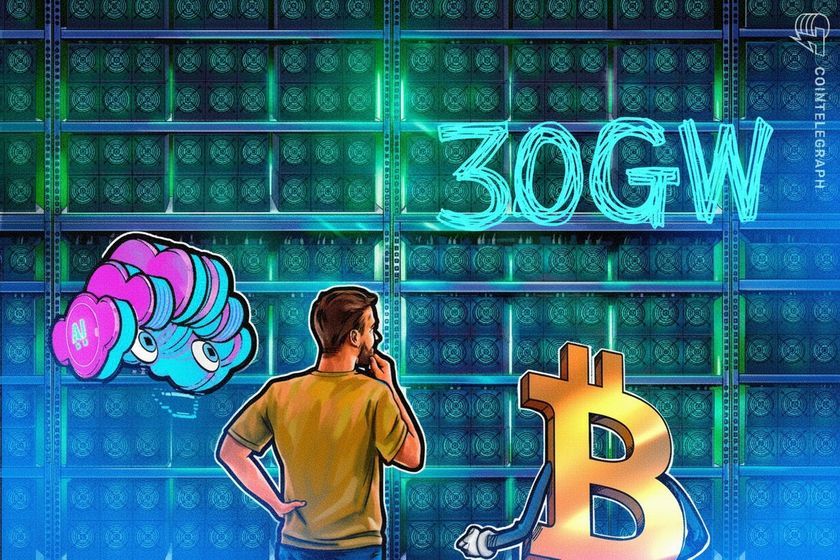 Public Bitcoin miners are developing 30 gigawatts of AI-focused power capacity, nearly triple current levels, as post-halving margin pressure reshapes the industry. Public Bitcoin miners are planning about 30 gigawatts of new power capacity aimed at artificial intelligence workloads, nearly three times the 11 GW they currently have online, as they race to offset shrinking mining margins and reposition for the next growth cycle. The buildout, compiled by TheEnergyMag across 14 publicly traded Bitcoin (BTC) miners, underscores how aggressively the industry is pivoting away from traditional hashpower amid persistently weak hashprice conditions. On paper, the planned expansion amounts to what TheEnergyMag described as “a small country’s worth of power infrastructure.” In reality, much of the 30 GW sits in development pipelines, interconnection queues or early-stage plans, rather than operational facilities. Read more
 -
Cointelegraph.com - 16:25 Feb 19, 2026
 Bitcoin fed into "extreme bearish sentiment" as a tight BTC price range fueled daily crypto liquidations of over $200 million. Bitcoin (BTC) fielded fresh downside predictions Thursday as BTC price action kept long liquidations high. Key points: Bitcoin price analysis sees lower levels coming amid a lack of a “strong bounce.” Read more
 -
Cointelegraph.com - 15:17 Feb 19, 2026
 Initial features will support basic transfers, setting the stage for subsequent upgrades, including privacy features for tokenized real-world assets. Dash, a layer-1 blockchain protocol with privacy-preserving features, announced on Thursday the integration of Zcash’s “Orchard” shielded pool into the Dash Evolution chain, a secondary layer on the L1 network that supports smart contract functionality. The integration will go live following the completion of cybersecurity audits and is expected to launch in March, according to an announcement shared with Cointelegraph. Initially, the integration will support basic transfers of Zcash (ZEC) from one party to another on the Evolution chain, with subsequent upgrades adding Orchard’s privacy features for tokenized real-world assets (RWAs), the announcement said. Read more
 -
Cointelegraph.com - 14:10 Feb 19, 2026
 Crypto’s reputation is improving, but investors still complain that their banks are blocking their accounts for interacting with digital assets. Across the globe, it remains common for crypto users to have their bank accounts frozen and transfers blocked, even as institutional adoption rises. Panos Mekras, co-founder and CEO of blockchain fintech Anodos Labs, began dealing with crypto in Greece in the late 2010s. Most Greek banks didn’t allow transfers to crypto exchanges back then. Mekras experienced blocked card payments until one bank finally permitted his transfers, but first, he was questioned to ensure he understood he was interacting with a “risky” counterparty. Mekras told Cointelegraph that those early rejections are symptomatic of how banks treat digital assets as inherently high risk. That label often led to account closures or sudden freezes without explanation, ultimately pushing his business to rely solely on onchain tools and payment rails. Read more
 -
Cointelegraph.com - 14:00 Feb 19, 2026
 Voltage has launched a US dollar‑settled revolving credit line that plugs directly into Bitcoin and Lightning payment flows, letting businesses send instant, Lightning‑style payments. Bitcoin infrastructure company Voltage has announced the launch of Voltage Credit, a programmatic revolving line of credit designed to let businesses send payments with Lightning-style instant finality while still repaying the credit line in US dollars from a standard bank account or in Bitcoin. In a Thursday release shared with Cointelegraph, the company, which provides enterprise-grade solutions for regulated businesses, said it was targeting chief financial officers and treasurers who wanted “send now, pay later” flexibility on the fastest payment rails available, without having to hold crypto on their balance sheet. Rather than positioning it as just another Lightning-backed loan, Voltage pitched the product as an embedded piece of the payment flow, and the “first revolving line of credit that delivers instant payment finali...
 -
Cointelegraph.com - 13:35 Feb 19, 2026
 Carlo Kölzer says tokenization is not threatening but is reshaping traditional markets after the company's 360T platform integrates Kraken-backed xStocks. A Deutsche Börse Group executive said tokenization is a natural evolution of market infrastructure, not a threat to traditional markets, and added that the exchange operator is positioning itself to integrate tokenized and traditional assets. Carlo Kölzer, head of digital assets at Deutsche Börse and CEO of the group’s trading platform 360T, expressed a bullish outlook on real-world (RWA) asset tokenization, forecasting a future in which digital and traditional markets operate in a closely linked ecosystem. “Our role as Deutsche Börse Group is not just to build a bridge between two separate worlds, but to create a truly hybrid market,” Kölzer told Cointelegraph, describing the company’s vision for a unified trading environment. Read more
 -
Cointelegraph.com - 13:16 Feb 19, 2026
 “Bitcoin going to zero” Google searches have spiked to their highest level since the FTX collapse, even as institutional buyers accumulate BTC and macro uncertainty hits record highs. Google searches for “Bitcoin going to zero” have surged to their highest level since the post‑FTX panic in November 2022, according to Google Trends data for the past five years. The spike aligns with Bitcoin’s latest drawdown from its Oct. 6, 2025, all‑time high near $126,000 to about $66,500 at the time of writing on Thursday, according to data from CoinGecko, leaving the asset almost 50% below its peak. At the same time, the Bitcoin Fear and Greed Index has plunged into extreme fear around 9, levels previously seen during the Terra ecosystem collapse and the FTX fallout in 2022. Read more
 -
Cointelegraph.com - 13:00 Feb 19, 2026
 Larger crypto payments to darknet markets were linked to higher stimulant hospitalizations and deaths in Canadian health data. Blockchain transaction data tied to cryptocurrency payments may provide an early signal of emerging drug crises, according to a new report from blockchain analytics firm Chainalysis. The study, which examined illicit market activity across darknet drug and fraud ecosystems, found that crypto flows connected to darknet markets reached nearly $2.6 billion in 2025, showing that online drug markets continue to operate at scale despite repeated law-enforcement takedowns. Vendors typically receive payments from personal wallets and centralized exchanges. Beyond measuring criminal activity, Chainalysis argued that the data can track real-world health outcomes. Crypto payments to suppliers of fentanyl precursor chemicals declined sharply beginning in mid-2023. Months later, overdose deaths also fell in the United States and Canada after peaking in 2023. Read more
 -
Cointelegraph.com - 12:27 Feb 19, 2026
 Polymarket’s lawsuit challenges state authority and could redefine whether the CFTC controls US prediction markets or whether states set their own rules. Polymarket’s federal lawsuit against Massachusetts could determine whether prediction markets are regulated solely by the CFTC or also by states. The dispute centers on whether event contracts qualify as financial derivatives under the Commodity Exchange Act or as gambling under state laws. The lawsuit followed state-level actions against platforms like Kalshi, with Massachusetts and Nevada moving to restrict sports-related prediction contracts. Read more
 -
Cointelegraph.com - 11:55 Feb 19, 2026
 Robinhood plans a mainnet launch later this year as the testnet hosts experimental assets, including stock-style tokens. Robinhood’s Ethereum layer-2 network processed 4 million transactions in its first week of public testnet activity, according to CEO Vlad Tenev. In a Thursday post on X, Tenev said developers have begun experimenting with applications on the L2 network, which was built for tokenized real-world assets (RWAs) and blockchain-based financial services. “The next chapter of finance runs onchain,” he wrote. The trading platform launched the Robinhood Chain testnet last week as an Ethereum layer 2 built using Arbitrum technology. The launch followed about six months of private testing and is intended to serve as a high-throughput environment for financial applications. Read more
10245 items