Cointelegraph.com
Source:
https://cointelegraph.com
Found 10245 news
-
Cointelegraph.com - 14:38 Feb 15, 2026
Crypto exchange Coinbase reported a net loss in the fourth quarter of 2025, Ether’s price may rebound: Hodler’s Digest -
Cointelegraph.com - 14:38 Feb 15, 2026
Crypto exchange Coinbase reported a net loss in the fourth quarter of 2025, Ether’s price may rebound: Hodler’s Digest -
Cointelegraph.com - 13:04 Feb 15, 2026
 Trump-linked WLFI dropped more than five hours before a $6.9 billion crypto liquidation event, raising questions about early market stress signals. World Liberty Financial Token (WLFI), a DeFi governance token affiliated with the Trump family, may have signaled a major market breakdown hours before Bitcoin moved, according to a new analysis by data provider Amberdata. The report examines trading activity on Oct. 10, 2025, when roughly $6.93 billion in leveraged crypto positions were liquidated in under an hour. Bitcoin (BTC) fell about 15% and Ether (ETH) dropped roughly 20%, while smaller tokens lost as much as 70%. Amberdata found that WLFI began a sharp decline more than five hours before the broader market downturn. At the time, Bitcoin was still trading near $121,000 and showed little immediate stress. Read more
 -
Cointelegraph.com - 10:04 Feb 15, 2026
 Mirae Asset Consulting agreed to acquire a 92.06% controlling stake in South Korean crypto exchange Korbit for about $93 million in cash. Mirae Asset Consulting, an affiliate of South Korean multinational financial services company Mirae Asset Group, has agreed to acquire a controlling stake in local crypto exchange Korbit. The company plans to purchase 26.9 million shares of Korbit for 133.48 billion won (about $93 million), a transaction that would give it a 92.06% ownership interest in the exchange, according to a Friday regulatory filing. The payment will be made entirely in cash Mirae Asset said the purpose of the acquisition is “to secure future growth drivers through digital-asset (virtual-asset) businesses,” per the filing. The company’s board approved the decision on Feb. 5, while reports on the planned deal initially surfaced last year. Read more
 -
Cointelegraph.com - 07:15 Feb 15, 2026
 Elizabeth Warren and Andy Kim call on Treasury’s Scott Bessent to review a UAE-backed investment in the Trump-linked crypto firm over national security concerns. Two US senators are pressing the Treasury Department to investigate a reported foreign investment in a crypto venture tied to the Trump family, raising concerns about national security, foreign influence and access to sensitive financial data. In a Friday letter to Treasury Secretary Scott Bessent, Massachusetts Senator Elizabeth Warren and New Jersey Senator Andy Kim asked the government to determine whether the Committee on Foreign Investment in the United States (CFIUS) should investigate a deal in which a UAE–backed investment vehicle agreed to purchase a 49% stake in World Liberty Financial (WLFI) for roughly $500 million. The lawmakers wrote that the transaction reportedly occurred days before Donald Trump’s inauguration and would make the foreign fund the firm’s largest shareholder and its only publicly known outside investor. They asked Besse...
 -
Cointelegraph.com - 06:17 Feb 15, 2026
 Bitcoin developers must address the quantum risks to Bitcoin fast to avoid a successful “corporate takeover,” according to venture capitalist Nic Carter. Major Bitcoin-holding institutions may eventually lose patience with Bitcoin developers for not addressing quantum computing concerns quickly enough, according to venture capitalist Nic Carter. “I think the big institutions that now exist in Bitcoin, they will get fed up, and they will fire the devs and put in new devs,” Carter said during the Bits and Bips podcast episode published on Thursday. “I think the devs will continue to do nothing,” Carter said. Read more
 -
Cointelegraph.com - 03:04 Feb 15, 2026
 The ETF issuer warned that investors who pick the fund tied to the losing US presidential outcome could lose nearly all invested capital. US-based ETF issuer Roundhill Investments has filed with the US securities regulator to launch six exchange-traded funds (ETFs) tied to event contracts on the outcome of the 2028 US presidential election. ETF analyst Eric Balchunas said in an X post on Saturday that, if approved, the ETF products would be “potentially groundbreaking.” “Opens up huge door to all kinds of stuff,” Balchunas said, adding that prediction market applications are easy to sign up to, but ETFs are “just that much easier.” Read more
 -
Cointelegraph.com - 22:16 Feb 14, 2026
 Prediction markets should pivot from short-term betting and move toward becoming price stability instruments for consumers, Buterin argued. Ethereum co-founder Vitalik Buterin said he is starting to “worry” about the direction of prediction markets and suggested that they shift to become marketplaces to hedge against price exposure risk for consumers. Prediction markets are “over-converging” to “unhealthy” products that are focused on short-term price betting and speculative behavior as opposed to long-term building, Buterin said in an X post. Instead, onchain prediction markets coupled with AI large-language models (LLMs) should become general hedging mechanisms to provide consumers with price stability for goods and services, Buterin said. He explained how this system would work: Read more
 -
Cointelegraph.com - 21:00 Feb 14, 2026
 An announcement in January teased the potential in-app trading feature, fueling online speculation about X's upcoming Smart Cashtags. The upcoming Smart Cashtags feature on the X social media platform will allow users to trade stocks and crypto directly within the application, according to Nikita Bier, X’s head of product. “We are launching a number of features in a couple of weeks, including Smart Cashtags that will enable you to trade stocks and crypto directly from the timeline,” Bier said in an X post on Saturday. Bier announced the upcoming rollout of Smart Cashtags in January, teasing the possibility of in-app trading in an image showing the feature in the announcement, but no official confirmation. Read more
 -
Cointelegraph.com - 18:20 Feb 14, 2026
 Hong Kong, Thailand, and the Marshall Islands are exploring tokenized debt instruments and administering social benefit programs onchain. Blockchain technology is an effective medium for administering social benefit programs, but key compliance challenges remain, according to Julie Myers Wood, CEO of compliance and monitoring consulting firm Guidepost Solutions. Guidepost Solutions advised the Republic of the Marshall Islands’ government on a regulatory compliance and sanctions framework for its USDM1 bond, a tokenized debt instrument issued by the government, backed 1:1 by short-term US Treasuries. The Marshall Islands government launched a Universal Basic Income (UBI) program in November 2025 that distributes quarterly benefits to citizens directly through a mobile wallet. Wood told Cointelegraph: Read more
 -
Cointelegraph.com - 12:57 Feb 14, 2026
 ShinyHunters hackers leaked user data after a social-engineering attack on a Figure employee and the company reportedly refused to pay a ransom. Figure Technology, a blockchain-based lending firm, was reportedly hit by a data breach after attackers manipulated an employee in a social-engineering scheme. The incident allowed hackers to obtain “a limited number of files,” a company spokesperson told TechCrunch. The company said it has begun notifying affected parties and is offering free credit-monitoring services to anyone who receives a breach notice. Details about the scope of the incident, including how many users were affected or when the intrusion was detected, were not disclosed publicly. Cointelegraph reached out to Figure for comment, but had not received a response by publication Read more
 -
Cointelegraph.com - 10:19 Feb 14, 2026
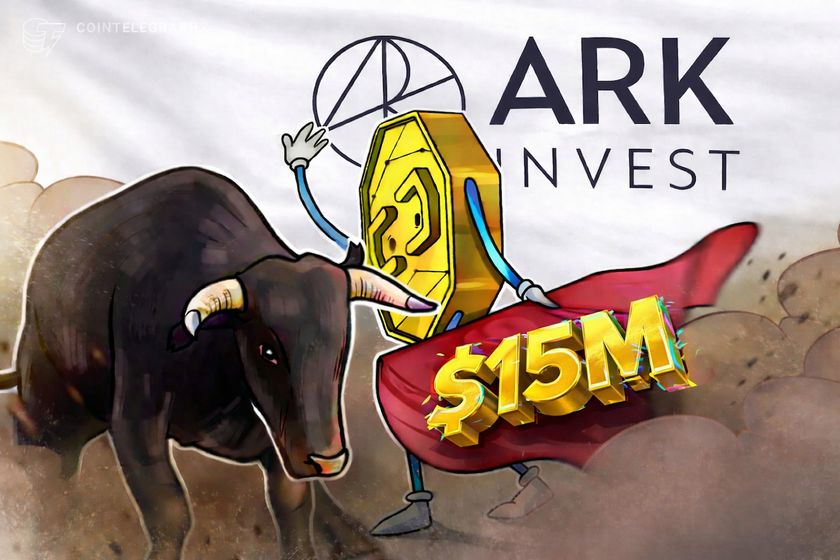 Cathie Wood’s ARK Invest added nearly $15.2 million in Coinbase stock across three ETFs, reversing course days after offloading more than $39 million in shares. ARK Invest has returned to buying shares of Coinbase Global after trimming its position, adding roughly $15 million worth of stock across several of its actively managed exchange-traded funds (ETFs) on Friday. The Cathie Wood-led asset manager purchased 66,545 Coinbase shares through the ARK Innovation ETF (ARKK), 16,832 shares through Next Generation Internet ETF (ARKW) and 9,477 shares through Fintech Innovation ETF (ARKF), according to the firm’s daily trade disclosures. The buying activity coincided with a sharp surge in Coinbase stock. Shares closed the trading session at $164.32, up about 16.4% on the day, before edging higher in after-hours trading, according to data from Google Finance. The surge put the firm’s total purchase at roughly $15.2 million. Read more
 -
Cointelegraph.com - 07:47 Feb 14, 2026
 US spot Bitcoin ETFs recorded four straight weeks of net outflows, with about $360 million withdrawn in the latest week. US President Donald Trump’s media conglomerate, Trump Media & Technology Group, has filed paperwork with the United States Securities and Exchange Commission (SEC) for two new exchange-traded funds (ETFs) linked to major cryptocurrencies. According to a Friday announcement by its Truth Social Funds arm, the company plans to launch the Truth Social Bitcoin (BTC) and Ether (ETH) ETF alongside the Truth Social Cronos (CRO) Yield Maximizer ETF. The filing has not yet taken effect and remains subject to SEC review. “We plan to provide an investment platform for investors covering multiple aspects of digital and crypto investing with both capital appreciation and income opportunities,” Steve Neamtz, president of Yorkville America Equities, which will act as investment adviser for both funds, said. Read more
 -
Cointelegraph.com - 06:24 Feb 14, 2026
 The total memecoin market capitalization has dropped roughly 34% over the past month as the broader market sold off, but Santiment suggests the slump may not last long. A reversal in memecoins could come sooner than traders expect, even amid choppy conditions across the broader crypto market, if history is any indication, according to crypto sentiment platform Santiment. “There is a growing narrative of "nostalgia" regarding memecoins, with many traders treating the sector as if it is permanently dead,” Santiment said in a report published on Friday. “This collective acceptance of the 'end of the meme era' is a classic capitulation signal,” Santiment said, explaining that when a sector of the market is completely written off, it is often the “contrarian time” to start paying attention. Read more
 -
Cointelegraph.com - 03:38 Feb 14, 2026
 Bitcoin will become “more valuable than ever” after deflation stops covering “up the impact" on the US dollar, according to Bitcoin entrepreneur Anthony Pompliano. Bitcoin investors are being forced to rethink why they hold the asset as inflation data cools, according to Bitcoin entrepreneur Anthony Pompliano. “I think the challenge for Bitcoin investors, can you hold an asset when there is not high inflation in your face on a day-to-day basis?” Pompliano said during an interview with Fox Business on Thursday. “Can you still believe in what Bitcoin’s value proposition is, which is that it’s a finite-supply asset. If they print money, Bitcoin is going higher,” he said. “Bitcoin and gold are great long-term things,” he said. The US Consumer Price Index (CPI), a widely used measure of inflation, fell to 2.4% in January from 2.7% in December, according to the US Bureau of Labor Statistics. However, Mark Zandi, Moody’s chief economist, recently told CNBC that inflation “looks better on paper than in reality.” Read...
 -
Cointelegraph.com - 23:37 Feb 13, 2026
 Ether holds $2,000, but may remain under pressure as traders watch corporate earnings, US government debt and growing global tensions. Key takeaways: Institutional demand for Ether is cooling as investors shift toward the safety of short-term US government bonds. High interest rates and rising ETH supply make the current staking yield less attractive for long-term holders. Read more
 -
Cointelegraph.com - 21:54 Feb 13, 2026
 Crypto companies and platforms that provide stablecoin rewards have become a major point of contention in the CLARITY crypto market structure bill. The banking industry should not be threatened by crypto companies offering stablecoin yield to customers, and both sides must compromise on the issue, according to White House crypto adviser Patrick Witt. Witt said it was “unfortunate” that the issue of stablecoin yield has become a major point of contention between the crypto industry and banks, adding that crypto service providers sharing yield with customers does not threaten the banking industry’s business model or market share. He told Yahoo Finance: In the future, I don't think this is going to be an issue,” he continued, adding, “I think they're going to find opportunities to use these products and leverage them and offer new products to their customers and expand their businesses.” Read more
 -
Cointelegraph.com - 21:30 Feb 13, 2026
 Traders say Ether’s declining open interest and futures funding rates could set the groundwork for a significant short squeeze on bearish leveraged positions and a rally to $2,500. Ether (ETH) traded back above $2,000 on Friday, and its gains extended after the US Consumer Price Index (CPI) print came in cooler than expected. The recovery put ETH/USD on track for its first bullish weekly candle close since mid-January, fueling speculation for a rally toward $2,500. Key takeaways: Read more
 -
Cointelegraph.com - 20:30 Feb 13, 2026
 Bitcoin and several major altcoins are attempting a relief rally, signaling that the bulls are trying to form a higher low. Key points: Bitcoin is attempting a comeback, which is expected to face stiff resistance at the breakdown level of $74,508. Several major altcoins are attempting a recovery, signaling that lower levels are attracting buyers. Read more
 -
Cointelegraph.com - 20:05 Feb 13, 2026
 Certain assets, like equity in a qualifying start-up company and physical property used for non-investment, were exempt from the 36% tax. The Netherlands’ House of Representatives advanced a legislative proposal on Thursday to introduce a 36% capital gains tax on savings and most liquid investments, including cryptocurrencies. The legislation reached the 75-vote threshold required to advance, with 93 lawmakers voting in favor of it, according to the House tally. Under the proposal, savings accounts, cryptocurrencies, most equity investments and gains made from interest-bearing financial instruments are subject to the tax, whether or not the assets are sold. Read more
10245 items