Cointelegraph.com
Source:
https://cointelegraph.com
Found 10266 news
-
Cointelegraph.com - 10:31 Nov 25, 2025
 Federal Decree Law No. 6 expands the UAE central bank’s authority over DeFi, ending the “just code” defense and imposing penalties of up to $272 million. A new financial law in the United Arab Emirates is set to bring decentralized finance (DeFi) and the broader Web3 industry under regulatory parameters, signaling an important shift for the industry. The UAE’s new central bank law, Federal Decree Law No. 6 of 2025, introduces “one of the most consequential regulatory shifts” for the crypto industry in the region, Irina Heaver, a local crypto lawyer and founder of NeosLegal, told Cointelegraph. “It brings protocols, DeFi platforms, middleware, and even infrastructure providers into scope if they enable activities such as payments, exchange, lending, custody, or investment services,” Heaver said. Read more
 -
Cointelegraph.com - 09:17 Nov 25, 2025
 The Pump.fun co-founder disputed claims of a massive off-ramp and said Pump.fun’s USDC shifts were routine treasury operations. Pseudonymous Pump.fun co-founder Sapijiju rejected claims that the project cashed out more than $436 million in stablecoins, calling the allegations “complete misinformation” from the blockchain analytics firm Lookonchain. In an X post, Sapijiju addressed the report, insisting that none of the transferred funds were sold. He said the USDC originated from the PUMP token’s initial coin offering (ICO) and was simply redistributed to internal wallets as part of the company’s treasury management process. “What’s happening is a part of Pump’s treasury management, where USDC from the $PUMP ICO has been transferred into different wallets so the company’s runway can be reinvested into the business,” Sapijiju. “Pump has never directly worked with Circle.” Read more
 -
Cointelegraph.com - 08:03 Nov 25, 2025
 Exodus is using its Bitcoin reserves to back a $175 million acquisition of W3C Corp, bringing Monavate and Baanx under its roof as it expands into onchain payments. Crypto wallet provider Exodus plans to use its Bitcoin reserves to finance a major push into onchain payments, striking a $175 million deal to acquire W3C Corp, the parent company of payment infrastructure providers Monavate and Baanx. The agreement, announced on Monday, marked a major shift in strategy for the NYSE-listed company. By bringing Monavate and Baanx in-house, Exodus aims to become one of the few self-custodial wallets to control the entire payments stack, from crypto storage to card issuance. “By bringing card and payments infrastructure in-house, we are closing the gap between holding and spending, and positioning Exodus as the only platform you need for your money,” CEO JP Richardson said. Read more
 -
Cointelegraph.com - 07:50 Nov 25, 2025
 Bitcoin price tools returned to levels last seen several years ago as calls for a BTC price relief rally continued to grow louder. Bitcoin (BTC) risk-reward has delivered a rare bullish signal as multiple metrics flip green. Key points: Bitcoin price metrics are showing multiyear opportunities when it comes to risk versus reward. Read more
 -
Cointelegraph.com - 00:30 Nov 25, 2025
 SOL price rallied to $140, but weak derivatives market metrics and stagnate network fees show limited investor confidence. Is a retest of the $160 possible? Key points Solana’s activity growth has not offset falling leverage demand and weak network fees, keeping SOL short-term bullish prospects limited. A short squeeze to $160 needs firmer derivatives support and stronger investor conviction amid persistent macroeconomic uncertainty. Read more
 -
Cointelegraph.com - 22:14 Nov 24, 2025
 Mining margins weaken as hash price declines and rig payback periods stretch, even as listed miners rally on analyst upgrades and new HPC agreements. Profitability across the Bitcoin mining industry is facing new strain amid rising network competition and declining revenue conditions. Bitcoin miners are facing a fresh squeeze as the network’s hashrate — a measure of the total computing power competing to secure the Bitcoin network — climbed to a record 1.16 ZH/s in October while Bitcoin’s (BTC) price fell toward $81,000 entering November, according to a report by The Miner Mag. Hashprice, which tracks miner revenue per unit of computing power, fell below $35 per hash, dropping under the $45/PH/s median total hashprice reported by public mining companies. The decline leaves several operators approaching breakeven levels. Read more
 -
Cointelegraph.com - 21:45 Nov 24, 2025
 An advisory body to Japan's FSA will reportedly release a report recommending crypto companies hold reserves to compensate users for events such as hacks. The Financial Services Agency in Japan will reportedly require cryptocurrency exchanges to maintain liability reserves as part of measures to guard against hacks or unforeseen events. According to a Monday Nikkei report, Japan’s FSA will revise its requirements for local companies to include methods for quickly compensating users affected by security breaches or other causes. The financial watchdog cited recent hacks of global exchanges as part of the reason behind the change. The Financial System Council, an advisory body to the FSA, is set to release a report on the matter following a meeting on Wednesday. One of the expected recommendations would require crypto firms to create liability reserve funds. Read more
 -
Cointelegraph.com - 21:04 Nov 24, 2025
 Revolut has completed a private share sale with participation from major investment firms. The transaction also allowed employees to sell shares. Neobank Revolut has completed a share sale that values the company at $75 billion, placing it among the world’s most valuable fintechs. The funding deal was led by investment firms Coatue, Greenoaks, Fidelity and Dragoneer, with additional backing from a16z, Franklin Templeton, and T. Rowe Price. Nvidia’s venture arm, NVentures, also participated. The company said Monday that employees were able to sell shares as part of the deal, marking the fifth time Revolut has offered staff a liquidity event through its employee share program. Read more
 -
Cointelegraph.com - 20:22 Nov 24, 2025
 The investment vehicle tied to XRP launched amid other offerings from Grayscale, Bitwise Asset Management and Canary Capital. Asset management company Franklin Templeton launched an exchange-traded fund tracking the XRP token on the NYSE Arca amid regulatory approvals clearing the way for other crypto investment vehicles. On Monday, the Franklin XRP ETF launched on the NYSE Arca under the ticker XRPZ, providing investors with access to the cryptocurrency. Its trading debut coincides with the launch of the Grayscale XRP Trust ETF (GXRP) and follows other similar launches from Bitwise Asset Management and Canary Capital. XRP (XRP) is the native asset of the XRP Ledger, an open-source blockchain developed by Ripple. The cryptocurrency has risen 8.25% over the past 24 hours, according to Cointelegraph Markets data. Read more
 -
Cointelegraph.com - 20:00 Nov 24, 2025
 One analyst said that Bitcoin’s dip to $80,000 marked the bottom and that there is a 91% chance that the current trend reversal will send BTC price back to $118,000. Bitcoin (BTC) traders are navigating through one of the fastest capitulation events since late 2022, but one market analyst argued that historical data confirms that $80,000 was the bottom. Key takeaways: A Bitcoin analyst assigned a 91% probability that BTC will not see a weekly close below the current lows. Read more
 -
Cointelegraph.com - 18:51 Nov 24, 2025
 Several analysts claim that Bitcoin bottomed at $80,000 and that the market has been reset. Do BTC and altcoin charts agree or show a different set of facts? Key points: Bitcoin is attempting a recovery from $80,600, which several analysts believe to be a bottom. Several altcoins are struggling to start a rebound, indicating a lack of demand from buyers. Read more
 -
Cointelegraph.com - 18:37 Nov 24, 2025
 The investment broadens Ondo Finance’s onchain Treasury reserves and comes amid a renewed push into crypto-backed lending across fintechs, lenders and exchanges. Ondo Finance has purchased $25 million of YLDS, the yield-bearing stablecoin issued by Figure Technology Solutions, to diversify the assets backing its tokenized US Treasurys fund. The company said Monday that YLDS will be added to a reserves portfolio that already includes tokenized Treasury products from major asset managers, including funds issued by BlackRock, Fidelity, Franklin Templeton, and WisdomTree. Designed for institutional investors, the Ondo Short-Term US Government Bond Fund (OUSG) offers onchain exposure to Treasurys with 24/7 redemptions and an estimated annual return of 3.68%. The tokenized fund has about $777 million in total value locked (TVL) as of this writing. Read more
 -
Cointelegraph.com - 18:09 Nov 24, 2025
 After the crypto industry’s success in influencing the 2024 US elections, an advocacy group announced plans to continue its efforts for the 2026 midterms. Update (Nov. 24 at 7:35 pm UTC): This article has been updated to include a response from Stand With Crypto. The cryptocurrency advocacy organization backed by Coinbase has started surveying federal and state candidates on their positions on digital assets ahead of the 2026 midterm elections in the United States. In a Monday notice shared with Cointelegraph, Stand With Crypto said it had sent a questionnaire to an unspecified number of candidates in state and federal races, asking for information related to their positions on “digital assets, crypto innovation, de-banking, crypto mining and zoning, consumer protections,” and more. The organization also requested that respondents disclose whether they had ever held crypto or used blockchain technology. Read more
 -
Cointelegraph.com - 17:24 Nov 24, 2025
 Bitcoin reclaimed $86,000 as the US dollar strengthened, but one analyst warned the rally may be structurally weak. Bitcoin (BTC) held above $86,000 on Monday after recovering steadily over the weekend from Friday’s flush to $80,600, its lowest price since April. The rebound came as traditional markets opened the week on a cautious footing, with the US Dollar Index (DXY) steady above 100, hovering near a six-month high. Key takeaways: The US Dollar Index held 100 after a blowout Nonfarm Payrolls (NFP) print of 119,000 against 53,000. Read more
 -
Cointelegraph.com - 15:40 Nov 24, 2025
 Analysts warn of “pump-and-dump” risks associated with ZEC’s sudden surge in hype, even as major crypto figures maintain a long-term bullish outlook. Key takeaways: ZEC charts mirror BNB’s pre-crash parabola, hinting at a potential correction to the $220–$280 range next. Analysts warn of “pump-and-dump” dynamics amid paid promotions, although some crypto veterans remain bullish long term. Read more
 -
Cointelegraph.com - 15:13 Nov 24, 2025
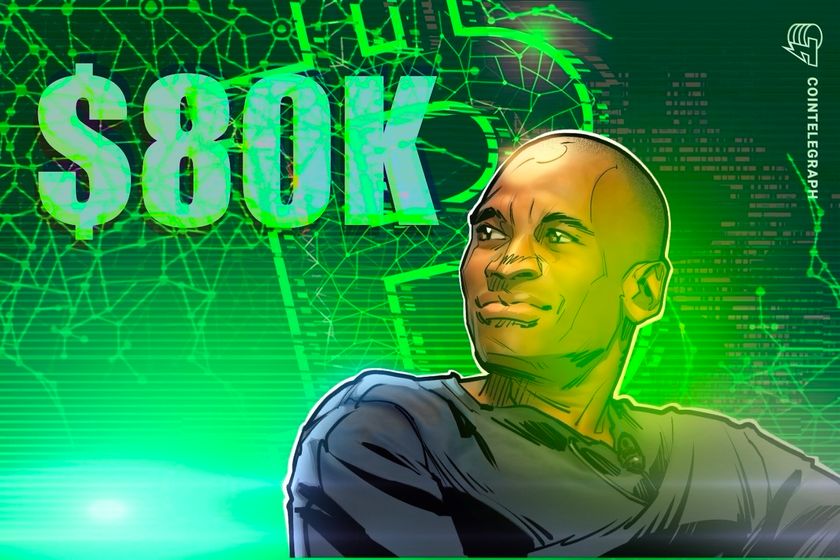 Bitcoin found its latest floor when it dropped to nearly $80,000 last week, the latest BTC price prediction by ex-BitMEX CEO Arthur Hayes said. Key points: Bitcoin should have bottomed out at $80,000 last week, according to former BitMEX CEO Arthur Hayes. Liquidity conditions are poised to turn in the crypto bulls’ favor, with the US Federal Reserve set to end QT. Read more
 -
Cointelegraph.com - 13:59 Nov 24, 2025
 Bitcoin analyst James Check argued Bitcoin’s quantum risk is chiefly a consensus dilemma — not a tech one — because the network is unlikely to freeze legacy coins. James Check, founder and lead analyst at Bitcoin onchain analysis service Checkonchain, said Monday that the quantum threat is more of a consensus problem than a technology issue. In a Monday X post, Check claimed that “there is no chance we come to consensus to freeze” Bitcoin (BTC) that is not moved to quantum-resistant addresses, with development politics limiting the community’s ability to react. This means that a large amount of lost Bitcoin will flood the market as old addresses are compromised when quantum computer attacks become feasible. BitBo data shows that 32.4% of all Bitcoin has not been moved in the last five years, 16.8% in over 10 years, 8.2% in seven to 10 years and 5.4% in five to seven years. How much of those assets are actually lost or inaccessible, and how many are kept in storage for is subject to debate. Read more
 -
Cointelegraph.com - 13:41 Nov 24, 2025
 BitMEX co-founder Arthur Hayes said Hyperliquid’s $314 million unlock brings unavoidable sell pressure, and insider assurances can’t remove uncertainty. A $314 million Hyperliquid token unlock scheduled for Saturday puts the perpetuals decentralized exchange (DEX) under its most significant tokenomics spotlight yet, as one community member calls for clearer communication on how the core contributor unlock will be managed. Tokenomist data shows that on Saturday, Hyperliquid will release 9.92 million HYPE tokens, which is 2.66% of the supply. The tokens are worth about $314 million at the time of writing. The HYPE allocation will be released in a “cliff unlock,” which means they will be released all at once. The unlock ignited public conversations among holders, including an open letter from an X user named Andy, who urged the team to address the community before the tokens are unlocked. At the time of writing, HYPE trades at $31, a 23% decline over the past month. Read more
 -
Cointelegraph.com - 13:30 Nov 24, 2025
 Blockchain can still serve its purpose while catering to institutional finance needs through privacy technology, says Aztec Labs’ Zac Williamson. Blockchain is being pulled between traditional finance and its decentralized ethos as the industry shifts to serve institutional products. Zac Williamson, CEO of Aztec Labs, said early decentralized governance failures shifted blockchain’s trajectory away from community coordination. “There is a real risk that blockchain just becomes a slightly more efficient settlement layer than Visa or Mastercard,” he told Cointelegraph. “If we lose the social coordination side of this, then the entire point of the technology gets hollowed out.” Read more
 -
Cointelegraph.com - 13:26 Nov 24, 2025
 Crypto investment products neared $5 billion in outflows in the last four weeks, but late-week inflows show early signs of improving sentiment despite heavy selling, CoinShares said. Cryptocurrency investment products have hit almost $5 billion in outflows over the past four weeks, but inflows during the final days of last week offered a small sign of improving sentiment. Crypto exchange-traded products (ETPs) saw $1.94 billion in outflows last week, a small decline from the $2 billion exodus the previous week, according to a Monday research report from CoinShares. The four-week total now stands at $4.9 billion, marking the third-largest outflow run on record. Only the March tariff-driven sell-off and the February 2018 downturn were bigger. Read more
10266 items