Dawn
Source:
https://www.dawn.com
Found 10418 news
-
Dawn - 12:13 May 20, 2026
China and Russia condemned United States President Donald Trump’s Golden Dome missile defence shield plans and Washington’s “irresponsible” nuclear policy at a joint summit on Wednesday, a week after President Xi Jinping hosted Trump in Beijing. A statement from Xi and Russian President Vladimir Putin said Trump’s plan for a ground- and space-based missile interceptor system posed a threat to global strategic stability. It also criticised the United States over the expiry of the last remaining treaty restricting the size of the US and Russian nuclear arsenals, which lapsed in February with Trump failing to respond to Moscow’s proposal to extend the limits by a year. Both sides jointly signed a statement on strengthening comprehensive strategic coordination and a declaration advocating multi-polarity in the world order. “The global agenda of peace and development is facing new risks and challenges, with the danger of fragmentation of the international community and a drift back toward the ‘law of the jungle’,”... -
Dawn - 10:06 May 20, 2026
Deputy Prime Minister and Foreign Minister Ishaq Dar on Wednesday said Islamabad and Beijing shared a “converging vision” on regional and global matters. “Pakistan and China share a converging vision on regional and global issues,” said Dar while addressing the Senate. A Chinese delegation was present in the visitors’ gallery to mark the 75th anniversary of the establishment of diplomatic relations between Pakistan and China. “We are committed to upholding the purposes and principles of the UN Charter in a world facing complex challenges,” the foreign minister said. Dar stressed that cooperation between Pakistan and China at the United Nations, the Shanghai Cooperation Organisation (SCO), and other international forums had been “vital in defending the interests of developing countries and promoting global peace”. During his address, Dar said that he will be accompanying PM Shehbaz Sharif on his state visit to China from May 23 to 26, during which they will also attend celebrations marking the 75th anniversary... -
Dawn - 09:37 May 20, 2026
Indian Prime Minister Narendra Modi and Italian Prime Minister Giorgia Meloni took selfies at the Colosseum and admired the view over Rome ahead of talks focused on trade on Wednesday. In a video posted on X, Meloni also thanked Modi for bringing along a packet of “Melody” toffees on his visit, with the two seen laughing over the present — a play on their names. Wrapping up a tour of Europe, Modi landed in Rome on Tuesday for the first bilateral visit by an Indian prime minister to Italy in 26 years. Modi previously visited Italy for a G20 meeting in 2021 and a G7 summit in 2024. In a joint opinion in Italy’s Corriere della Sera daily, the two said they wanted to “reach and exceed the €20 billion ($23bn) target for trade between Italy and India by 2029”. Particular sectors of interest would include defence, aerospace, car parts, clean technologies and textiles, they said. “We aim to forge a powerful synergy between Italian design, manufacturing excellence, and world-class supercomputers… and India’s rapid eco... -
Dawn - 08:54 May 20, 2026
Israeli authorities have begun detaining hundreds of activists seized from a Gaza-bound flotilla at the southern port of Ashdod on Wednesday, a rights group said, after Israeli forces intercepted their vessels at sea. The Global Sumud Flotilla set sail from Turkiye last week in the latest attempt by activists to breach Israel’s blockade of the Palestinian territory, after Israeli forces intercepted a previous convoy last month. Israeli authorities said 430 activists aboard the flotilla were en route to Israel, while rights group Adalah said some had already arrived at Ashdod port and were being held there. “Having set sail toward Gaza to deliver humanitarian aid and challenge the unlawful blockade, these civilian participants were forcefully abducted from international waters and taken into Israeli territory entirely against their will,” Adalah said. “These acts are a direct extension of Israel’s policies of collective punishment and starvation of Palestinians in Gaza.” The Israeli foreign ministry dismissed ... -
Dawn - 07:15 May 20, 2026
ISLAMABAD: The Islamabad High Court (IHC) on Wednesday issued notices on multiple applications seeking early hearing of sentence suspension pleas filed by human rights lawyers Imaan Zainab Mazari-Hazir and Hadi Ali Chatha in the social media posts case. During the hearing, the couple’s lawyer, Faisal Siddiqi, requested Justice Muhammad Azam Khan to fix the matter for Monday (May 25). Issuing notices, Justice Khan remarked, “Let us hear the other side as well.” At the same time, the judge observed that Monday would be the last working day before Eidul Azha and said the matter could not be fixed on that day. Siddiqi responded that if the other side sought an adjournment on Monday, his clients would not object. Justice Khan then remarked that the case would instead be fixed for the first working day after Eid, adding, “Now your fate is like this, what should I do?” Former president of the Islamabad High Court Bar Association (IHCBA) Riasat Ali Azad also requested the court to fix the matter for Monday, saying bo... -
Dawn - 06:28 May 20, 2026
Ahead of Eidul Azha, the Punjab government has prohibited several activities “injurious to public health” and that also disturb public peace under Section 144 from May 27 to June 2. A notification issued by the Punjab Home Department, dated May 19, said that during Eidul Azha, people sit by the roadside and roast the heads and feet of sacrificial animals, which caused “unhealthy smoke” and an unpleasant smell. It said that people also throw the entrails of sacrificial animals by the roadside and or in drains, which resulted in unsanitary conditions and the blockage of the sewerage system. It stated that citizens also swim and bathe in canals, ponds, lakes, river banks, and distributaries during Eidul Azha holidays, which may endanger their lives. It further stated that cattle sellers illegally set up points for the sale of sacrificial animals within populated areas, which hindered traffic and contributed to the spread of diseases. The Home Department said that the aforementioned activities “are not only injur... -
Dawn - 06:28 May 20, 2026
Spinner Taijul Islam took six wickets to lead Bangladesh to a 78-run win over Pakistan in the second Test and clinch a famous 2-0 series win on Wednesday. Pakistan, who started the fifth day on 316-7 while chasing a record 437, were bowled out for 328 in the first session in Sylhet after Mohammad Rizwan hit a valiant 94. It was Bangladesh’s first Test series win at home against Pakistan and a second successive sweep after their 2-0 triumph on Pakistani soil in 2024. Wicketkeeper Rizwan kept Pakistan in the hunt for an unlikely win with a 166-ball stay after the visitors had slumped to 162-5 on day four. Rizwan put on an eighth-wicket partnership of 54 with overnight partner Sajid Khan, who made 28. Taijul broke through to dismiss Sajid for his 18th Test five-wicket haul and Shoriful Islam had Rizwan caught in the next over to end Pakistan’s resistance. Taijul took the final wicket of Khurram Shahzad to return figures of 6-120 and trigger Bangladesh celebrations. The left-arm spinner also took 3-67 during Paki... -
Dawn - 05:06 May 20, 2026
Opening batters Fakhar Zaman and Saim Ayub have been ruled out of the upcoming one-day international (ODI) series against Australia, scheduled to begin on May 30, the Pakistan Cricket Board (PCB) said on Wednesday. According to a press release issued by the cricket board, both players are “currently recovering from injuries and have been advised to continue their rehabilitation programmes under the supervision of the PCB medical panel”. “Consequently, they have been ruled out of selection for the ODI series,” it added. The cricket board wished both players a speedy recovery and said it looked forward to seeing them return to competitive cricket at the earliest opportunity. It added that further updates regarding the squad and player fitness would be shared in due course. The Australian men’s cricket team is scheduled to tour Pakistan for a three-match ODI series. According to the schedule announced, the visitors will arrive in Islamabad on May 23 and face the Green Shirts in the first ODI at the Rawalpindi Cr... -
Dawn - 02:55 May 20, 2026
INDIAN PM Narendra Modi’s penchant for not taking questions during interactions with the press did not go down well with journalists in Norway, who wanted to quiz the visiting dignitary. Mr Modi is on a six-day, five-nation tour, and landed in Oslo on Monday to attend the third India-Nordic Summit. According to The Hindustan Times, the episode unfolded at a joint press statement by PM Modi and his Norwegian counterpart Jonas Gahr Støre. As the two leaders were leaving the venue after their briefing, which did not include a Q&A, a voice rang out across the room: “Prime Minister Modi, why don’t you take some questions from the freest press in the world?” The voice belonged to Helle Lyng, a journalist with the local newspaper Dagsavisen, who was part of the media contingent covering the visit. “Prime Minister of India, Narendra Modi, would not take my question, I was not expecting him to,” she subsequently posted on X. She later also attended the Ministry of External Affairs (MEA) briefing on PM Modi’s Norway vi... -
Dawn - 02:13 May 20, 2026
WASHINGTON: Pakistan is among the countries that could benefit from a new United States temporary licence allowing selected energy-importing nations to access Russian oil, diplomatic sources told Dawn. The US has introduced a 30-day general licence issued by the US Department of the Treasury to ease immediate supply pressures in global crude markets and provide relief to energy-vulnerable countries. Diplomatic sources said the arrangement may also apply to Pakistan, though they cautioned that Islamabad might not be able to fully take advantage of the concession due to limited technical capacity. US offers 30-day relief to energy-vulnerable countries They noted that Pakistan has not previously imported Russian crude at scale and may lack the refining infrastructure required to process such shipments. US Treasury Secretary Scott Bessent said on a social media post released on Monday that his department is issuing a temporary 30-day general licence to “provide the most vulnerable nations with the ability to temp... -
Dawn - 18:48 May 19, 2026
Nigeria’s military on Tuesday said that joint airstrikes with the United States had killed 175 Islamic State (IS) fighters in the country’s northeast, including the militant group’s global second-in-command. The remote region has been gripped by an extremist insurgency since 2009, first by Boko Haram, then its offshoot and rival, the Islamic State West Africa Province (ISWAP). According to the United Nations, more than 40,000 people have been killed and two million others displaced. US and Nigerian forces killed Abu Bilal al-Minuki, an IS leader described as the “most active terrorist” in the world, at a remote village in the northeast last weekend. The Nigerian military said on Tuesday that 175 IS militants had so far been “eliminated from the battlefield”. “The joint strikes have resulted in the destruction of ISIS checkpoints, weapons caches, logistical hubs, military equipment and financial networks used to sustain terrorist operations,” it added. As director of global operations for IS, al-Minuki provide... -
Dawn - 18:19 May 19, 2026
KARACHI: An individual involved in a fatal hit-and-run incident on a major Karachi thoroughfare remains on the run days after his vehicle hit another, killing one person and injuring two teenagers. On Thursday, a video of the incident went viral on social media. It showed a speeding double-cabin vehicle ploughing into a small car on Karachi’s Abdul Sattar Edhi Avenue in the Defence Housing Authority (DHA) area. The double-cabin vehicle hit the other car with such force that it spun around multiple times before coming to a stop on the side of the busy road. The speeding vehicle did not stop, and the individual fled the scene. South Deputy Inspector General of Police (DIG) Syed Asad Raza told Dawn that Darakhshan police had lodged a first information report (FIR) against the absconding driver of the speeding SUV, and further legal proceedings were underway. According to the FIR, seen by Dawn, at around 12:05am on May 14, 2026, a speeding Revo vehicle collided with a car at the crossing of main Sea View road and... -
Dawn - 17:42 May 19, 2026
Security forces killed 22 India-sponsored terrorists in Khyber Pakhtunkhwa’s North Waziristan district, the military’s media affairs wing said on Tuesday. In a statement, the Inter-Services Public Relations (ISPR) said an area sanitisation operation has been underway since May 17 in North Waziristan’s Shewa general area, “based on credible intelligence leads with respect to the presence of khwarij.” Fitna al Khawarij is a term the state uses for terrorists belonging to the banned Tehreek-i-Taliban Pakistan (TTP). During the operation, troops “effectively engaged khwarij location and after [an] intense exchange of fire, 22 khwarij belonging to Indian sponsored Fitna-al-Khwarij have [been] sent to hell” in the last 24 hours, the ISPR said. It added that weapons and ammunition were also recovered from the killed terrorists, who “remained actively involved in numerous terrorist activities in the area”. The ISPR revealed that “evidence further confirms that khwarij coerced and intimidated the local population, for... -
Dawn - 17:39 May 19, 2026
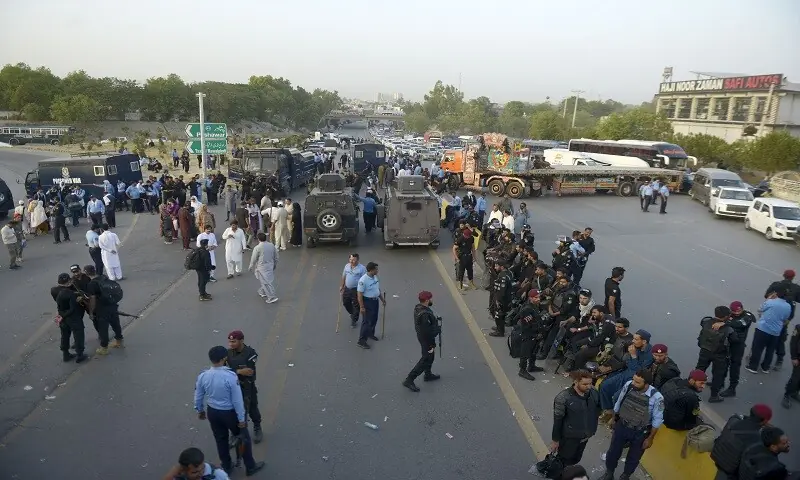 ISLAMABAD: Capital police on Tuesday stopped Khyber Pakhtunkhwa Chief Minister Sohail Afridi from reaching Adiala jail in Rawalpindi to meet incarcerated PTI founder Imran Khan. Imran — imprisoned since Aug 5, 2023, for concealing details of Toshakhana gifts — is serving a 14-year sentence at Rawalpindi’s Adiala jail in a £190 million corruption case, also known as the Al-Qadir Trust case. The Islamabad High Court (IHC) allowed the ex-premier to have twice-a-week meetings — on Tuesdays and Thursdays — with his family, lawyers and other associates. Despite the order, the former premier has been restricted from meeting visitors for several months. Afridi set off for the Rawalpindi jail earlier today. He was accompanied by Imran’s sisters and a number of PTI workers and leaders. However, police stopped the delegation at Islamabad’s Chungi No. 26 from proceeding towards Adiala Jail, despite heated arguments. Police personnel form a line to stop PTI workers and leaders from proceeding towards the prison. — Mohamma...
 -
Dawn - 17:16 May 19, 2026
ISLAMABAD: The Privatisation Commission on Tuesday invited expressions of interest (EOIs) from local and international investors for the much-delayed sale of three of the country’s most viable electricity distribution companies (Discos). The deadline for submitting EOIs for the partial or full sale of the Discos falls in the first quarter of the next fiscal year. The three companies are Faisalabad Electric Supply Company (Fesco), Gujranwala Electric Power Company (Gepco), and Islamabad Electric Supply Company (Iesco). The three are considered the most viable Discos among the 11 electricity distribution companies originally carved out of the Water and Power Development Authority (Wapda) in 1998. The divestment aimed to improve service quality through private-sector management practices. The plan was supposed to be completed within five years but failed to take off over the following three decades. The transaction offers investors an opportunity to acquire between 51pc and 100pc shareholding, along with managem... -
Dawn - 16:46 May 19, 2026
Prime Minister Shehbaz Sharif on Tuesday underscored Pakistan’s strides as a net regional stabiliser contributing to peace and stability in the region and beyond, according to the Prime Minister’s Office (PMO). The prime minister made the remarks during his address to faculty members and student officers at the Command and Staff College in Quetta on Tuesday. “The prime minister underscored the importance of military diplomacy and cooperation and the strides made by Pakistan as Net Regional Stabiliser to contribute towards peace, stability and progression in the region and beyond,” said the PMO statement. PM Shehbaz, referring to Marka-i-Haq, also paid tribute to the Pakistan Armed Forces’ historic victory under the leadership of Chief of Army Staff and Chief of Defence Staff Field Marshal Syed Asim Munir. “The enemy falsely perceived itself as stronger than Pakistan. They rejected our sincere offer of dialogue to resolve differences and remove misunderstandings; instead, they chose the path of provocation, vi... -
Dawn - 16:24 May 19, 2026
ISLAMABAD: An Islamabad sessions court sentenced Umar Hayat, the main accused in the Sana Yousaf murder case, to death on Tuesday after finding him guilty of killing the teenage TikTok influencer at her residence in June last year. Hayat was arrested a day after 17-year-old Yousaf was shot dead in her Islamabad house on June 2, 2025. On Monday, 23-year-old Hayat — son of a retired government official and a TikToker himself — retracted his earlier confessional statement admitting to Yousaf’s murder. Additional District and Sessions Judge Muhammad Afzal Majoka announced the verdict on Tuesday, handing Hayat the death sentence under Section 302(b) of the Pakistan Penal Code (PPC) for committing qatl-i-amd (intentional murder) of Yousaf. The death sentence would be subject to confirmation by the Islamabad High Court (IHC) under Section 374 (sentence of death to be submitted by court of session) of the Code of Criminal Procedure (CrPC). The court also directed the convict to pay Rs2.5 million as compensation to th... -
Dawn - 15:56 May 19, 2026
HYDERABAD: Adilpur police registered a first information report (FIR) of the alleged gang rape of a teenage girl in Sindh’s Ghotki district on Tuesday, more than two weeks after the incident was said to have taken place. The FIR, a copy of which is available with Dawn, was registered against 5 suspects on the complaint of the girl’s father under Section 376(2) of the Pakistan Penal Code. The said provision states: “When rape is committed by two or more persons in furtherance of common intention of all, each of such persons shall be punished with death or imprisonment for life.” According to the FIR, the incident took place on May 3 when the girl and her parents were working in the fields of a wadera (land owner). The FIR quoted the complainant as saying that his daughter was working some distance away from him and after a while, he heard her cries coming from the landowner’s dera (sitting room). He said his wife ran toward the dera after hearing their daughter’s cries. The landowner was present there along wi... -
Dawn - 15:06 May 19, 2026
ISLAMABAD: Pakistan and the Asian Infrastructure Investment Bank (AIIB) on Tuesday signed a $320 million loan agreement for the reconstruction and improvement of critical sections of the N-5 highway — the country’s longest national highway from Karachi to Torkham near the Afghan border. The loan agreement was signed for “Reconstruction of National Highway N-5 under Pakistan’s Resilient Recovery, Rehabilitation and Reconstruction Framework Project,” amounting to $320.16 million. The project will cover critical sections of the N-5, which traverses Sindh, Punjab, and Khyber Pakhtunkhwa, serving as a backbone of Pakistan’s transport network. The loan agreement was signed by Muhammad Humair Karim Kidwai, Secretary, Economic Affairs Division, on behalf of the Government of Pakistan, and Mr Konstantin Limitovskiy, Chief Investment Officer, Public Sector & Project and Corporate Finance (Global) Clients of the Beijing-based AIIB. Federal Minister for Economic Affairs Ahad Khan Cheema also attended the signing ceremony... -
Dawn - 14:41 May 19, 2026
ISLAMABAD: The Federal Investigation Agency (FIA) Karachi Zone on Tuesday suspended two officers and registered a case against a private individual over a recent raid on a jewellery shop in the metropolis’s Sarafa Bazaar. The development came days after FIA Director General Dr Usman Anwar took notice of the incident and demanded a full inquiry, with the report to be submitted within 48 hours. According to an FIA spokesperson, FIA Karachi Zone Director Muntazir Mehdi ordered immediate legal and departmental action. Two FIA officers present at the scene were suspended, while a case was registered against a private individual for allegedly slapping a citizen. Assistant Director Syed Ali Mardan Shah, in charge of the FIA’s Karachi Anti-Corruption Circle (ACC), was removed from his post and attached to headquarters, while Assistant Director Rabab Qazi was transferred from FIA ACC to the Human Trafficking and Smuggling Wing. A departmental inquiry was also initiated against all officers and officials present during...
10418 items