Dawn
Source:
https://www.dawn.com
Found 10418 news
-
Dawn - 13:40 May 19, 2026
 A ban on Indian civilian and military aircraft using Pakistani airspace has been extended for another month, until June 24, according to a Notice to Airmen (Notam) issued by the Pakistan Airports Authority (PAA) on Tuesday. The previous extension was set to expire on May 24. The ban extension took effect on May 19 at 10:40am and the restriction was extended until 4:59am on June 24, according to the Notam. “Pakistan airspace not available for Indian registered aircraft and aircraft operated/owned or leased by Indian airlines/operators, including military flights,” the Notam, available with Dawn, read. Pakistan’s airspace is divided into two flight information regions (FIRs) — Karachi and Lahore, according to a Pakistan Civil Aviation Authority (PCAA) document from 2022. The Notam applies to both the Karachi (OPKR) and Lahore (OPLR) FIRs. India and Pakistan closed their airspaces to each other’s airlines since late April 2025, when tensions between them escalated in the wake of a deadly attack in Indian-occupie...
 -
Dawn - 13:30 May 19, 2026
 Bangladesh are three wickets away from a famous Test series win at home after spinner Taijul Islam took 4-113 to rattle Pakistan despite a rearguard by the opposition batters on Tuesday. Pakistan ended day four on 316-7, needing another 121 runs for victory in what would be a record chase of 437 on the fifth and final day in Sylhet. Mohammad Rizwan, on 75, and Sajid Khan, on eight, were unbeaten at the close of play. Left-arm spinner Taijul struck key blows, including Babar Azam for 47 and Salman Agha on 71, to keep Bangladesh in the hunt for their first-ever Test series win over Pakistan at home. Pakistan’s Mohammad Rizwan plays a shot during the fourth day of the second Test cricket match between Bangladesh and Pakistan at the Sylhet International Cricket Stadium in Sylhet on May 19, 2026. — AFP Bangladesh, who won the opener of the two-match series, also closed in on back-to-back Test series victories over Pakistan —having whitewashed them 2-0 on Pakistani soil in 2024. Pakistan slumped to 162-5 and were h...
 -
Dawn - 13:27 May 19, 2026
 Iranian authorities held mass public weddings in Tehran for couples who signed up to a state-sponsored scheme declaring their readiness to sacrifice their lives in the war against the US and Israel. The ceremonies conducted late on Monday involved hundreds of couples in several major squares in the capital, including more than 100 in the vast Imam Hossein square in central Tehran, according to reports in Iranian media. They were broadcast on state TV in a bid to boost wartime morale, with US President Donald Trump repeatedly threatening new military action against Iran amid a shaky ceasefire which halted the fighting that began on February 28. Those involved had signed up, according to Iranian media, for the so-called “self-sacrifice” scheme (janfada in Persian) where people pledged to put their lives on the line in the war by, for example, forming human chains outside power stations. Iranian authorities say millions of people, including top figures such as Parliament Speaker Mohammad Bagher Ghalibaf and Pres...
 -
Dawn - 13:12 May 19, 2026
PESHAWAR: Two people lost their lives and 11 were injured in rain-related incidents in Khyber Pakhtunkhwa on Monday, according to the Provincial Disaster Management Authority (PDMA). The Met Office has forecast dust-thunderstorm and rain with occasional gaps in upper parts of the country till May 23. According to the PDMA’s report, two deaths were reported in rain-related incidents last night from Mardan. Meanwhile, four people were injured in Battagram, one in Mardan and six in Swat. Four houses — one in Battagram and three in Shangla — were fully damaged. Twenty-seven houses were partially damaged in Shangla, two in Swat, five in Torghar and one each in Upper Dir and Mardan, according to the report. A school also suffered damage due to adverse weather in Shangla, the data showed. According to the PDMA’s daily weather report, the highest amount of rainfall in KP over the past 24 hours was recorded in Kalam at 12mm, followed by 11 in Chitral, 8mm in Malam Jabba, 7mm in Saidu Sharif and Balakot, and 4mm each i... -
Dawn - 13:10 May 19, 2026
The head of the World Health Organisation (WHO) on Tuesday expressed concern at the speed and scale of the Ebola outbreak in central Africa — declared a “continental” emergency — as the number of deaths in the Democratic Republic of Congo (DRC) jumped to 131. The toll from the Ebola outbreak in the DRC has risen to an estimated 131 deaths from 513 suspected cases, health minister Samuel Roger Kamba said. There has also been one death in neighbouring Uganda. However, speaking to Congolese national television overnight, Kamba cautioned that the toll was an estimate and further research was needed to confirm whether all 131 suspected deaths were indeed linked to Ebola. No vaccine or treatment exists for the Bundibugyo strain of Ebola behind the latest outbreak of the deadly disease, which has killed more than 15,000 people in Africa in the past half century. The outbreak’s epicentre is in the northeastern Ituri province on the border with Uganda and South Sudan, whose status as a gold-mining hub leads to people ... -
Dawn - 13:07 May 19, 2026
ISLAMABAD: Opposition alliance Tehreek Tahaffuz Ayeen-e-Pakistan (TTAP) and PTI on Tuesday announced countrywide protests on Friday against Imran Khan’s imprisonment, rising inflation and other issues. The announcement was made by senior PTI leaders during a press conference held out the Parliament House after a parliamentary party meeting. The press conference was addressed by former National Assembly speaker Asad Qaiser and PTI parliamentary leader Shahid Khattak. Addressing the media, Qaiser said the entire party and the people of Pakistan were deeply concerned about the health of former prime minister and PTI founder Imran Khan and his wife, Bushra Bibi. He said that the parliamentary party had unanimously endorsed the decisions taken at yesterday’s summit of the TTAP. “Protests will be held across the country on Friday against inflation, the increase in petroleum prices, concerns over the health of PTI founder Imran Khan and Bushra Bibi, demands for their transfer to hospital, the release of political pr... -
Dawn - 10:23 May 19, 2026
Sindh Inspector General Javed Alam Odho on Tuesday vowed transparency in investigations into drug queenpin Anmol alias Pinky, noting that the probes stretched across multiple “domains”. Anmol was arrested last week from her apartment in Karachi in connection with the possession of narcotics and an unlicenced weapon. She is in police custody till May 22 in two of the 15 cases active against her, while her judicial remand in other cases extends till May 30. Responding to media queries at an event held at the Karachi Chambers of Commerce and Industry, the Sindh police chief said multiple agencies were involved in probing Anmol’s alleged criminal activities. “There are now different institutions involved […] so there will be transparency, and secondly, each [authority] will work under its domain,” he affirmed. “You referred to one bank account with Rs30 million, indicating a huge quantum, so you are absolutely correct. We are working on this exact aspect,” IG Odho said in response to a question by a reporter. He ... -
Dawn - 10:18 May 19, 2026
Thailand is drastically cutting the length of visa-free stays for tourists from more than 90 countries in an effort to curb crime involving foreign nationals, officials said on Tuesday. Tourism is vital to the Southeast Asian nation’s economy, but foreign arrivals are yet to return to their pre-Covid highs. A recent series of high-profile arrests of foreigners has included cases linked to drug offences, sex trafficking and foreigners operating businesses such as hotels and schools without proper permits. Under Thailand’s current tourism scheme, travellers from more than 90 countries — including Europe’s 29-nation Schengen area, the United States, Israel and several South American countries — are eligible to visit for up to 60 days without a visa. Thailand’s cabinet approved reducing visa-free stays for travellers from those countries on Tuesday, Tourism Minister Surasak Phancharoenworakul told reporters in Bangkok. The new visa-free duration would be decided on a country-by-country basis, with most foreign na... -
Dawn - 10:12 May 19, 2026
Khyber Pakhtunkhwa Governor Faisal Karim Kundi on Tuesday said that Prime Minister Shehbaz Sharif had constituted a committee on the compressed natural gas (CNG) crisis in the province. The development comes a day after, in a rare show of unity, the KP government and opposition joined hands over wheat and CNG crises in the province and demanded that the federal government resume wheat supply and withdraw its orders for the closure of CNG stations in the province. The province has been affected by a CNG crisis since April, with several filling stations shut and millions of citizens struggling for affordable fuel. The situation has also negatively impacted the economic activity in the province. In a post on the social media platform X on Tuesday, Kundi said, “Thankful to PM Shehbaz for constituting a committee on the critical issue of CNG closure in KP. “KP is producing nearly 508 million cubic feet per day (mmcfd) of natural gas against a requirement of around 130 mmcfd, yet our people continue to face unneces... -
Dawn - 08:00 May 19, 2026
Two teenage gunmen opened fire on Monday at the Islamic Centre of San Diego, California, killing a security guard and two other men outside the mosque before the suspects were found dead, apparently from self-inflicted gunshot wounds, police said. San Diego Police Chief Scott Wahl said local law enforcement and the FBI were investigating the attack on the largest mosque in San Diego County as a hate crime. However, no precise motive or precipitating incident for the gun violence has been publicly suggested by authorities. All of the children attending a day school at the mosque complex were accounted for and safe after the shooting, which erupted at about 11:40am PDT (1840 GMT), officials said. At an evening news conference, Wahl disclosed that the mother of one of the two suspects had called police about two hours before the shooting to report that her son, whom she described as suicidal, had run away from home, taking three guns she owned and her vehicle. Two teens dressed in camouflage According to the chi... -
Dawn - 07:17 May 19, 2026
ISLAMABAD: The Islamabad High Court (IHC) on Tuesday raised objections over the non-submission of certified copies of Supreme Court orders during the hearing of miscellaneous petitions seeking early hearing of appeals filed by convicted human rights lawyers Imaan Zainab Mazari-Hazir and Hadi Ali Chattha in the controversial social media posts case. Justice Muhammad Azam Khan heard the petitions seeking fixation of the sentence suspension petitions at an early date in light of directions issued earlier by the SC directing the IHC to decide the plea within a fortnight. Senior lawyer Faisal Siddiqi appeared before the court on behalf of the couple on Tuesday. Former president of the Islamabad High Court Bar Association (IHCBA) Riasat Ali Azad, District Bar President Chaudhry Naeem Gujjar, former federal minister and Imaan’s mother Shireen Mazari and other lawyers were also present in the courtroom during the proceedings. At the outset of the hearing, Siddiqi informed the court that miscellaneous petitions had be... -
Dawn - 07:13 May 19, 2026
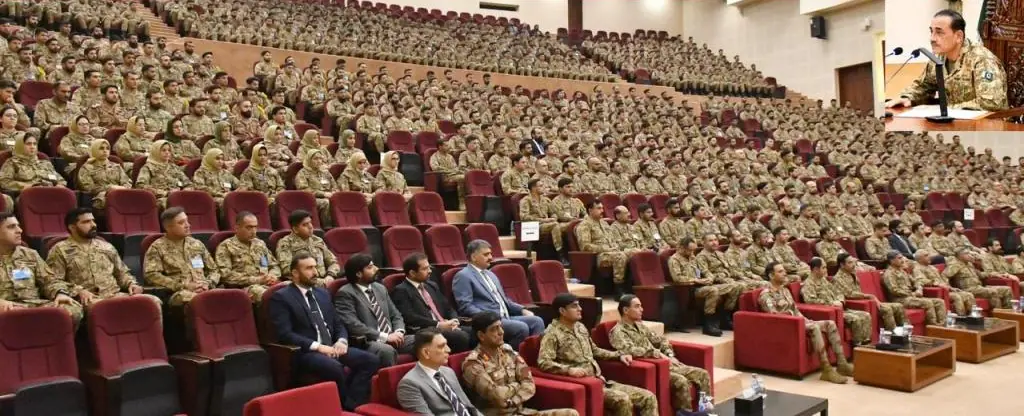 Chief of Defence Forces (CDF) and Chief of the Army Staff Field Marshal Asim Munir on Tuesday asserted that “propaganda, fake news or externally-sponsored terrorism” could not derail Pakistan’s progress. The field marshal made the remarks while interacting with officers and troops of formations deployed in Balochistan during his visit to Quetta, according to the military’s media affairs wing. “The field marshal emphasised that Pakistan’s destined rise cannot be obstructed through propaganda, fake news or externally sponsored terrorism,” Inter-Services Public Relations (ISPR) quoted him as saying. “He reiterated that hostile forces attempting to derail Pakistan’s progress through proxies and propaganda will ultimately fail due to the resilience of the state and the unity of its people,” the statement added. Highlighting the contours of the prevailing security environment, the military chief reaffirmed that the armed forces, with the “steadfast support of the people, remain fully committed to the eradication of...
 -
Dawn - 07:00 May 19, 2026
Prime Minister Shehbaz Sharif arrived in Quetta on Tuesday for a one-day visit, according to the Prime Minister’s Office (PMO). Balochistan Governor Jaffar Khan Mandokhail received the prime minister upon his arrival, his office said on a post on the social media platform X. During the visit, the premier will hold a meeting with the provincial leadership in Quetta and chair a meeting of the provincial apex committee of the National Action Plan, state-run Radio Pakistan reported. PM Shehbaz had also visited Quetta on Jan 18, where he addressed political leaders and announced several development projects worth billions of rupees for the province’s education and infrastructure sectors. “Be it the soldiers and officials of the army, Rangers personnel, or those of the Levies, and the common man, their sacrifices will be remembered in history,” PM Shehbaz said during his visit. “Balochistan is a beautiful part of Pakistan, and their demand was valid to an extent,” the premier added, noting that it was “obvious that... -
Dawn - 06:34 May 19, 2026
Pakistan and nine other countries on Tuesday issued a joint statement condemning Israel’s interception of the Global Sumud Flotilla. The joint statement by the foreign ministers of Pakistan, Turkiye, Bangladesh, Brazil, Colombia, Indonesia, Jordan, Libya, Maldives and Spain was shared by the Foreign Office on the social media platform X. It said that the ministers “condemn in the strongest terms the renewed Israeli assaults against the Global Sumud Flotilla, a peaceful civilian humanitarian initiative aimed at drawing international attention to the catastrophic humanitarian suffering of the Palestinian people”. “The ministers recall with grave concern the Israeli interventions against previous flotillas in international waters and condemn the continuation of hostile acts targeting civilian vessels and humanitarian activists,” it said. “Such assaults, including attacks against the vessels and the arbitrary detention of activists, constitute blatant violations of international law and international humanitarian... -
Dawn - 05:27 May 19, 2026
Russian President Vladimir Putin arrives in Beijing on Tuesday for talks with his Chinese counterpart and his “long-time good friend” Xi Jinping, intending to show their ties are unshakeable days after a visit by Donald Trump. The confirmation of Putin’s trip came just hours after Trump wrapped up his visit on Friday, the first by a US president to China in nearly a decade and one aimed at stabilising their turbulent relations. Putin and Xi are set to discuss how to “further strengthen” Russia and China’s strategic partnership and “exchange views on key international and regional issues”, according to a Kremlin statement. Their ties have deepened since Russia’s invasion of Ukraine in 2022, with Putin visiting Beijing every year since. Setting warm tones for the visit, the two leaders exchanged “congratulatory letters” on Sunday to mark 30 years of their countries’ strategic partnership. Xi said cooperation between Russia and China had “continuously deepened and solidified”, according to Chinese state media. A... -
Dawn - 02:29 May 19, 2026
ISLAMABAD: The federal government asked the provinces on Monday to increase their revenue contribution by at least Rs400 billion, nearly 40 per cent of their existing share, in the coming fiscal year through more effective collection strategies in agriculture, property and services to remain in the good books of the International Monetary Fund (IMF). At a consultative meeting with provincial finance ministers, Finance Minister Muhammad Aurangzeb conveyed the IMF’s deep satisfaction over the robust fiscal performance of both the four provinces and the Centre during the current fiscal year. Speaking to provincial ministers via video link, Mr Aurangzeb said the IMF mission currently visiting Islamabad, as well as the federal government, expected the federating units to remain equally prudent in their fiscal operations for the remainder of the current year and to perform even better next year, a senior Ministry of Finance official who attended the meeting told Dawn. The IMF staff mission, led by mission chief I... -
Dawn - 02:12 May 19, 2026
ISLAMABAD: Pakistan is likely to link its Naya Pakistan Certificates (NPCs) and sovereign bonds to a regulated blockchain via Digitally Native Notes (DNNs) to enable swift settlement for retail investors, particularly overseas Pakistanis. A meeting, presided over by Finance Minister Muhammad Aurangzeb with the State Bank of Pakistan (SBP) and the newly created Pakistan Virtual Assets Regulatory Authority (PVARA) on Monday, discussed the tokenisation of sovereign debt instruments and NPCs. It examined potential structures, implementation pathways, regulatory considerations, and next steps for exploring tokenised sovereign instruments within Pakistan’s evolving financial ecosystem. A central element of the discussion was the international precedent for sovereign and quasi-sovereign debt tokenisation and how Pakistan can adopt a structure aligned with established global market infrastructure. “It was agreed that PVARA, Ministry of Finance and SBP will continue to coordinate on the design, governance, and phased ... -
Dawn - 01:47 May 19, 2026
ISLAMABAD: The Federal Shariat Court on Monday declared the decriminalisation of suicide attempts repugnant to the injunctions of Islam and struck down a 2022 legislation through which that act had been omitted its as an offence from the Pakistan Penal Code (PPC). A three-member bench comprising Chief Justice Iqbal Hameedur Rehman, Justice Syed Muhammad Anwar and Justice Amir Khan announced the reserved verdict on two separate petitions challenging the amendments introduced through the Criminal Laws (Amendment) Act, 2022. One of the petitions was filed by Advocate Hammad Saeed Dar in 2023 and the other by Advocates Muhammad Azam Malik and Muhammad Kashif Sulehri in 2025. Giving its ruling on the pleas, the court declared relevant provisions of the 2022 law repugnant to injunctions of Islam and consequently void. Moreover, it restored Section 325 of the Pakistan Penal Code. Prior to the 2022 amendment, Section 325 prescribed simple imprisonment or a fine or both for a person who attempted suicide. The provisio... -
Dawn - 19:02 May 18, 2026
A US jury on Monday ruled against Elon Musk in his lawsuit against OpenAI, finding the artificial intelligence company not liable to the world’s richest person for having allegedly strayed from its original mission to benefit humanity. In a unanimous verdict, the jury in Oakland, California federal court said Musk had brought his case too late. The jury deliberated less than two hours. The trial had widely been seen as a critical moment for the future of OpenAI and artificial intelligence generally, both in how it should be used and who should benefit from it. Following the verdict, Musk’s lawyer said he reserved the right to appeal, but the judge suggested he may have an uphill battle because whether the statute of limitations ran out before Musk sued was a factual issue. “There’s a substantial amount of evidence to support the jury’s finding, which is why I was prepared to dismiss on the spot,” US District Judge Yvonne Gonzalez Rogers said. In his 2024 lawsuit, Musk accused OpenAI, its Chief Executive Sam A... -
Dawn - 18:51 May 18, 2026
Pakistan on Monday strongly condemned drone attacks on Saudi Arabia and expressed solidarity with the kingdom, a statement from the Foreign Office (FO) said. In a post on X, Saudi Arabia’s defence ministry reported that three drones were intercepted and destroyed on Monday morning, having originated from Iraqi airspace. The United Arab Emirates condemned the incident earlier today, while Iraq said it is investigating the incident. In its statement, the FO condemned in the strongest possible terms the drone attacks carried out against Riyadh, noting: “Such attacks constitute a serious violation of the kingdom’s sovereignty and territorial integrity, and appear to be an attempt to further undermine regional peace and stability.” It added that the government and the people of Pakistan stand in solidarity with the Saudi government and people, reaffirming their “full and unwavering support for the kingdom’s security, peace and prosperity.” The incident occurred after strikes on the Barakah nuclear plant in the UAE...
10418 items