Iran | Pakistan
"Iran" in Pakistan feed
-
Dawn - 11:55 Apr 08, 2026
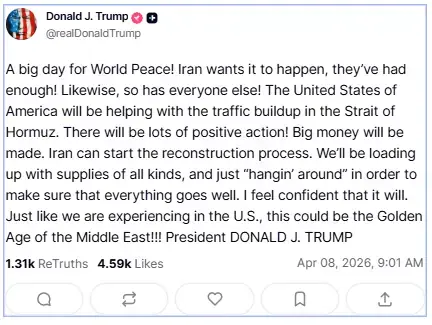 Pakistan on Wednesday announced that the Islamic Republic of Iran and the United States of America, along with their allies, had agreed to an immediate ceasefire, including in Lebanon, effective immediately, and invited their delegations to Islamabad on April 10 for talks aimed at reaching a lasting settlement of disputes. Prime Minister Shehbaz Sharif announced the ceasefire in an early-morning post on X, welcoming the move and extending his “deepest gratitude” to the leadership of both countries. Both sides have displayed “remarkable wisdom and understanding” and remained constructively engaged in furthering the cause of peace and stability, the prime minister said, expressing hope that the ‘Islamabad Talks’ would succeed in achieving sustainable peace and that more positive developments would follow in the coming days. The prime minister, who helped mediate the ceasefire, also invited delegations from both countries to Islamabad on April 10 to “hold further negotiations towards a conclusive agreement to se...
 -
Dawn - 08:53 Apr 08, 2026
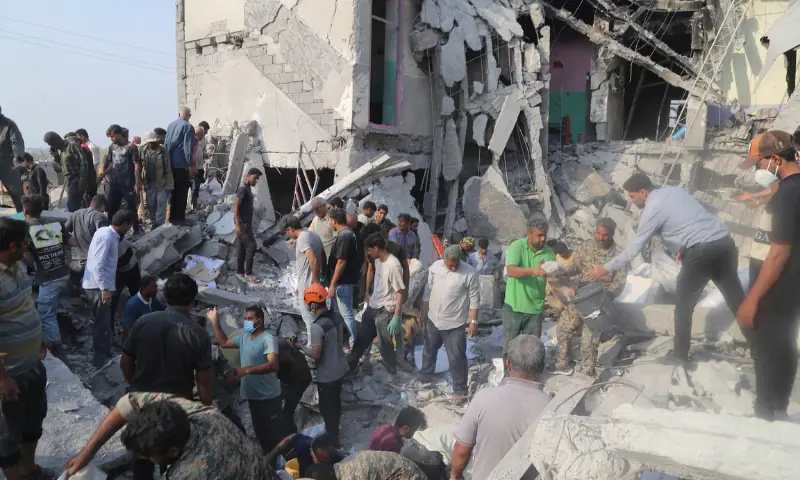 Backchannel diplomatic efforts by Pakistan appear to have finally paid off, as the United States and Iran agreed to a two-week ceasefire after weeks of escalating hostilities triggered by US-Israeli strikes on February 28 that quickly spiralled into a wider regional conflict. During this time, the crisis has unfolded through a mix of military escalations, retaliatory attacks, and behind-the-scenes negotiations, with failed ceasefire proposals and last-minute mediation all shaping the path to this vital breakthrough. Here is a timeline of the key events and statements that defined the conflict: February 28 The US and Israel launched an attack on Iran via air and sea: a series of blasts in Tehran, including near the residence of the supreme leader. A US-Israel airstrike on an elementary school in southern Iran killed more than 170 people, most of them schoolgirls. In retaliation, Iran attacked at least seven Gulf states, striking civilian infrastructure, damaging airports in the UAE and Kuwait, deploying a dron...
 -
Dawn - 01:46 Apr 08, 2026
Pakistan on Wednesday announced that the Islamic Republic of Iran and the United States of America, along with their allies, had agreed to an immediate ceasefire, including in Lebanon, effective immediately, and invited their delegations to Islamabad on April 10 for talks aimed at reaching a lasting settlement of disputes. Prime Minister Shehbaz Sharif announced the ceasefire in an early-morning post on X, welcoming the move and extending his “deepest gratitude” to the leadership of both countries. Both sides have displayed “remarkable wisdom and understanding” and remained constructively engaged in furthering the cause of peace and stability, the prime minister said, expressing hope that the ‘Islamabad Talks’ would succeed in achieving sustainable peace and that more positive developments would follow in the coming days. The prime minister, who helped mediate the ceasefire, also invited delegations from both countries to Islamabad on April 10 to “hold further negotiations towards a conclusive agreement to se... -
Dawn - 20:56 Apr 07, 2026
ISLAMABAD: Deputy Prime Minister and Foreign Minister Ishaq Dar expressed regret on Tuesday that an attack by Israel on Iran set out events that “severely damaged the peace process” at a time when Washington and Tehran were close to coming to the table. His statement in the Senate came ahead of an 8pm ET deadline for April 8 that US President Donald Trump has given to Iran to enter a ceasefire agreement with Washington. Trump has warned of wider bombing on power plants and other critical infrastructure otherwise. Pakistan has positioned itself as a facilitator in the peace process between the two sides, leveraging its ties with the US and its working relationship with Iran. Addressing the Senate, Dar said Pakistan had been playing a proactive diplomatic role to reduce tensions, but recent developments had dealt a severe blow to peace efforts. “Just as both parties were close to sitting at the negotiating table, Israel attacked Iran, which led Iran to target oil installations in Saudi Arabia’s Jubail city. Thi... -
Dawn - 15:35 Apr 07, 2026
US President Donald Trump on Thursday threatened that “a whole civilisation will die tonight” as Iran showed no sign of accepting his ultimatum to open the Strait of Hormuz. Trump had initially vowed to carry out the “complete demolition” of Iran’s critical infrastructure, particularly bridges and power plants, only if a deal was not reached. But writing on Truth Social, Trump elevated his ultimatum for Iran, stating that “a whole civilisation will die tonight, never to be brought back again. I don’t want that to happen, but it probably will”, if the country does not heed his call for a deal. It was not clear exactly what he meant or by what means he intended to carry out the threat. His remarks drew a strong reaction from politicos, with several calling for him be removed from office by invoking the 25th amendment, which allows for the vice president and a majority of the cabinet to declare a president unfit for office. Democratic Leader in the US Senate Chuck Schumer assailed Trump’s threats, branding him “... -
Dawn - 14:38 Apr 07, 2026
Efforts to facilitate talks between the US and Iran are still ongoing, two Pakistani sources with knowledge of the discussions told Reuters on Tuesday, as US strikes on Iran intensified and US President Donald Trump’s deadline to unleash “hell” neared. One of the sources, a senior security official, said Iran’s overnight strike on Saudi Arabia’s industrial facilities linked to US firms threatened to derail the talks. If Saudi Arabia were to respond to the strikes, the talks would be over, the source said, adding that retaliation could also draw Pakistan into the conflict under its defence pact with Riyadh. The second source said Iran was “walking on thin ice” and that the next three to four hours were critical for the future of dialogue. Pakistan has been at the centre of negotiations between the US and Iran in recent weeks, acting as the main go-between for proposals shared by both sides, but there has been no sign of a compromise. “We are in touch with Iranians. They have lately shown flexibility that they ... -
Dawn - 20:47 Apr 06, 2026
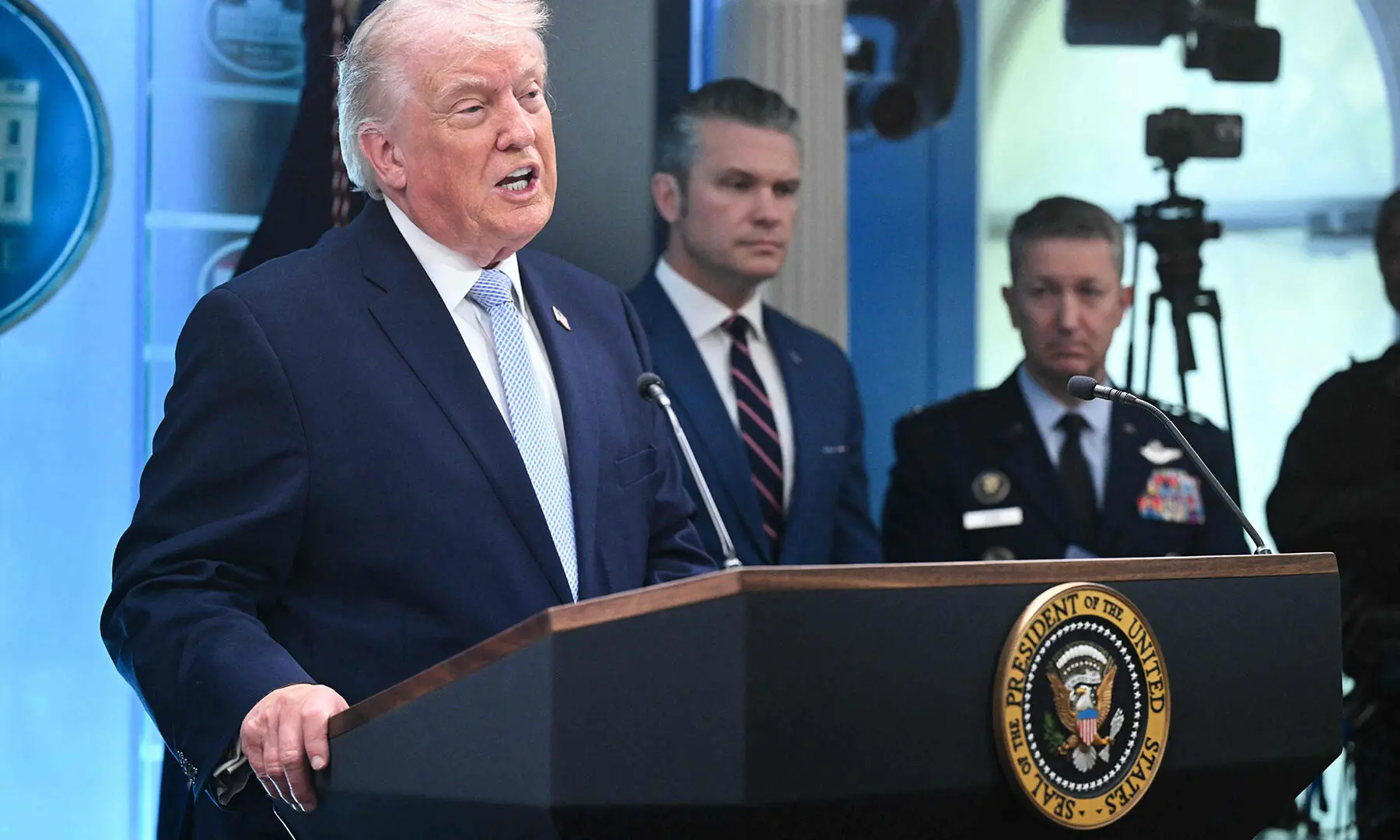 US President Donald Trump asserted on Monday that Iran could be taken out in one night, “and that night might be tomorrow night”, even as he said shortly afterwards that US officials, including Vice President JD Vance, were talking to intermediaries in Pakistan. His statements from two different events came ahead of a looming Tuesday night deadline he gave to Tehran to agree to a ceasefire deal with Washington, warning of wider bombing on power plants and other critical infrastructure. Trump is demanding that Iran forswear nuclear weapons and reopen the Strait of Hormuz oil transit waterway. Iranian media reported on Monday that Tehran had rejected the US ceasefire proposal through intermediary Pakistan, and had instead shared a 10-point proposal, demanding an end to conflicts in the region, a protocol for safe passage through the Strait of Hormuz, lifting of sanctions and reconstruction. Addressing a White House press conference on Monday, Trump told reporters that Iran could be taken out in one night, warni...
 -
Dawn - 18:37 Apr 06, 2026
Iran has conveyed its response to the US proposal for ending the war to intermediary Pakistan, rejecting a ceasefire and emphasising the necessity of a permanent end to the war, the official IRNA news agency said on Monday. The Iranian response consisted of 10 clauses, including an end to conflicts in the region, a protocol for safe passage through the Strait of Hormuz, lifting of sanctions, and reconstruction, the agency added. US President Donald Trump, who has threatened to rain “hell” on Tehran if it did not make a deal by 8pm EDT Tuesday (midnight GMT) to open the vital route for global energy supplies, rejected the Iranian proposal on Monday and said his deadline was final. “They made a proposal, and it’s a significant proposal. It’s a significant step. It’s not good enough,” Trump told reporters at an annual White House Easter event, referring to Iran. Iran responded to US and Israeli attacks in February by effectively closing Hormuz, a conduit for about a fifth of the world’s oil and natural ... -
Dawn - 13:00 Apr 06, 2026
Prime Minister Shehbaz Sharif on Monday expressed concern over an incident at the Khor Fakkan port in the United Arab Emirates, where a missile interception injured three Pakistani nationals. Gulf countries, including the UAE, have come under attack in Iran’s retaliatory campaign against the ongoing US-Israeli war on the country. In a post on X, the premier said, “Deeply concerned at the incident at Khor Fakkan port in the UAE, where an intercepted projectile caused injuries to civilians, including Pakistani nationals”. He prayed for the “swift recovery” of the injured. The prime minister stated that Pakistan remained in “close contact” with the UAE authorities to extend all possible support to Pakistani nationals in the country. “Pakistan stands in solidarity with the brotherly people of the UAE and reiterates the urgent need for restraint and de-escalation in the region,” the premier added. On Sunday, the Sharjah Media Office said that three Pakistani nationals and a Nepalese national sustained injuries aft... -
Dawn - 12:34 Apr 06, 2026
ISLAMABAD: The Pakistan International Airlines has ended all discounts being provided to passengers, with concessions remaining in place only for children and infants, and has also cut its flight operations due to the continuous rise in the prices of jet fuel, the carrier’s spokesperson said on Monday. In recent weeks, jet fuel (JP-1) rates have soared amid global supply chain uncertainty spurred by the US-Israel war on Iran. “The PIA has made a principled decision to end all discounts, with concessions remaining only for children and infants,” the spokesperson said. He added that a strategy was formulated in a high-level meeting to address the rising prices of fuel and potential losses to the airline. The spokesperson said PIA would also restrict its flight operation to the United Arab Emirates (UAE) to 16 flights per week. “The carrier is also going to suspend flight to Gulf countries, with the exception of the UAE and Saudi Arabia, until the end of April,” he added. Further, he said that the PIA would also... -
Dawn - 11:25 Apr 06, 2026
The Foreign Office said on Monday that the peace process is “ongoing” but declined to confirm or deny reports that Pakistan has proposed a framework to end the US-Israel war on Iran, according to state broadcaster Pakistan TV. “There have been several reports of a 45-day ceasefire offer, or 15-point exchange. We do not comment on these individual, specific incidents,” said FO Spokesperson Tahir Andrabi. The comments by the FO spokesperson follow a Reuters report that claimed Iran and the United States have received a plan to end hostilities, which was put together by Pakistan. The Reuters report, which cited a “source aware of the proposals”, claimed the framework was exchanged with the two sides overnight. Axios, citing US, Israeli and regional sources, first reported on Sunday that the US, Iran and regional mediators were discussing a potential 45-day ceasefire as part of a two-phase deal that could lead to a permanent end to the war. Separately, Iran said it has formulated its positions and demands in resp... -
The Nation - National - 05:07 Apr 06, 2026
Efforts by Pakistan, Türkiye and Egypt to mediate between Iran and the United States have yet to produce tangible results, according to U. -
Dawn - 19:41 Apr 05, 2026
US President Donald Trump did not take a break from his polarising rhetoric on Easter Sunday, delivering an expletive-laden attack on Iran that sparked criticism on Capitol Hill and beyond. In his message, he warned Iran that “you’ll be living in hell” if the Strait of Hormuz was not opened. He renewed his threat to unleash heavy bombing on Iranian power plants and bridges if Tehran refused to unblock the strategic Strait of Hormuz. While the Republican president is well known for his straight talk, the post on his Truth Social network raised eyebrows, especially on a Christian holiday. “Happy Easter, America. As you head off to church and celebrate with friends and family, the president of the United States is ranting like an unhinged madman on social media,” Democratic Senate Minority Leader Chuck Schumer said on X. “He’s threatening possible war crimes and alienating allies. This is who he is, but this is not who we are. Our country deserves so much better.” For Democratic Senator Chris Murphy of Connectic... -
Dawn - 11:04 Apr 05, 2026
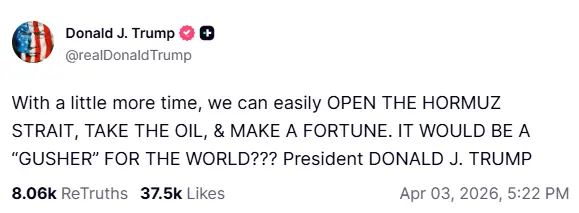 United States President Donald Trump said on Sunday that US forces had safely recovered a second airman downed in Iran, calling it “one of the most daring search and rescue operations in US history”. The announcement came as Iran launched missiles and drones at Israel and Kuwait earlier on Sunday, and a day after Trump warned the Islamic republic it had 48 hours to cut a deal or face “all Hell”. “This brave Warrior was behind enemy lines in the treacherous mountains of Iran, being hunted down by our enemies,” Trump said on Truth Social. “He sustained injuries, but he will be just fine,” he added. “This miraculous Search and Rescue Operation comes in addition to a successful rescue of another brave Pilot, yesterday, which we did not confirm, because we did not want to jeopardise our second rescue operation. “This is the first time in military memory that two US Pilots have been rescued, separately, deep in Enemy Territory. WE WILL NEVER LEAVE AN AMERICAN WARFIGHTER BEHIND!” Trump asserted. He repeated his clai...
 -
The Nation - National - 09:22 Apr 05, 2026
Deputy Prime Minister and Foreign Minister Ishaq Dar held separate telephone conversations with the Foreign Ministers of Iran, Abbas Araghchi, and Egypt, Badr Abdelatty, to discuss the evolving regional situation and ongoing diplomatic efforts. -
Dawn - 17:18 Apr 04, 2026
Iran’s Foreign Minister Abbas Araghchi on Saturday said that Tehran’s leadership “never refused to go to Islamabad” for possible peace talks that Pakistan has offered to host to bring the ongoing US-Israeli war on the Islamic republic to an end. “Iran’s position is being misrepresented by US media,” Araghchi wrote on X. “We are deeply grateful to Pakistan for its efforts and have never refused to go to Islamabad. What we care about are the terms of a conclusive and lasting END to the illegal war that is imposed on us,” he emphasised. He also shared a video showing Iranians waving Pakistan’s flags in an apparent show of appreciation for Pakistan and its people. The Iranian official ended his post with “Pakistan Zindabad” written in Urdu. Araghchi’s statement comes a day after the Wall Street Journal (WSJ), citing unnamed mediators, reported that the “current round of efforts by regional countries led by Pakistan to reach a ceasefire” between the United States and Iran had reached a “dead end”. Deputy Prime Min... -
Dawn - 16:46 Apr 04, 2026
PPP Chairman Bilawal Bhutto-Zardari on Saturday stressed political unity in the country amid the economic crisis triggered by the US-Israeli war on Iran. He made the remarks while speaking in Garhi Khuda Bakhsh to mark the 47th death anniversary of PPP founder and former prime minister Zulfikar Ali Bhutto. “We feel that there should be consensus in Pakistan and political differences should be kept aside in order to work together,” he said. He also appreciated Khyber Pakhtunkhwa Chief Minister Sohail Afridi for constructively participating in consultations held with the president and the prime minister. He thanked Afridi for participating in the meetings, and playing a “positive role” in the process. “Together, the Centre, provinces, political parties … will face these difficulties as one. If there is no division among us, there is no force in the world that can break Pakistan,” he said. In his remarks, Bilawal had also condemned the US-Israeli war on Iran, saying that the entire world, including Pakistan, was... -
Dawn - 09:38 Apr 04, 2026
Iran’s forces were hunting on Saturday for a missing United States pilot from one of two warplanes downed over Iran and the Gulf, officials from both sides said, while two airmen were rescued. The incidents show the risks still facing US and Israeli aircraft over Iran as the war entered its sixth week, despite assertions by President Donald Trump and his Defense Secretary Pete Hegseth that US forces had total control of the skies. The prospect of a US service person alive and on the run in Iran raises the stakes for Washington in a conflict with low public support among Americans and no sign of an imminent end. Tehran mocks Trump’s war aims Iranian fire brought down a two-seat US F-15E jet, officials in both countries said, while two US officials said the pilot ejected from an A-10 Warthog fighter aircraft that crashed in Kuwait after being hit by Iranian fire. Two Black Hawk helicopters engaged in the search for the missing pilot were hit by Iranian fire but made it out of Iranian airspace, the two US offici... -
Dawn - 02:56 Apr 04, 2026
LONDON: Four ships, including one co-owned by a Japanese company and one by a French company, crossed the Strait of Hormuz on Thursday as Iran said it is drafting a peacetime protocol to supervise maritime traffic through the Strait of Hormuz with Oman. The near closing of the Strait due to US-Israeli war against Iran in Middle East has led to fuel shortages and soaring energy prices across the globe. The few vessels that have crossed the chokepoint have passed using an Iranian-approved route through its waters near Larak Island, dubbed the “Tehran Toll Booth” by leading shipping journal Lloyd’s List. Two laden very large crude carrier (VLCC) — the Habrut and the Dhalkut — and one empty Sohar LNG tanker crossed the strait on Thursday morning. The Sohar LNG is the first LNG tanker to have crossed the strait since March 1, when Iranian attacks against ships near the Strait of Hormuz reduced crossings to a near stop. Earlier, a French-owned container ship passed through the Strait of Hormuz, according Marine Tra... -
Dawn - 23:05 Apr 03, 2026
Iranian and American forces were racing each other early Saturday to recover the crew of the first US fighter jet to go down inside Iran since the start of the war. Tehran said it had shot down the F-15 warplane, while US media reported American special forces had rescued one of two crew members. It was unclear which of the two crew members was recovered, and the US official who confirmed the recovery did not offer any details on how it took place. Iran’s military also said it downed a US A-10 ground attack aircraft in the Gulf, with US media saying the pilot was rescued. A statement from Ebrahim Zolfaghari, the spokesperson for Iran’s Khatam al Anbiya central headquarters, said that the F-15 was shot down using Iran’s “new advanced defence system”, and that “an advanced hostile fighter jet was also targeted south of Qeshm Island, crashing into the waters between Qeshm and Hengam Islands”. US Central Command did not immediately respond to a request for comment on the loss of the F-15, but White House Press Se...