Pakistan
-
The Express Tribune - 14:33 May 10, 2026
Colonial-era building continues to stand as symbol of heritage, interfaith harmony -
The Express Tribune - 14:33 May 10, 2026
Dehydration, weak immunity make children susceptible to waterborne diseases -
The Express Tribune - 14:33 May 10, 2026
Minister praises Armed Forces' unwavering national defence role -
The Express Tribune - 14:33 May 10, 2026
Mother lodges murder case against son after fatal shooting over family dispute -
Dawn - 12:00 May 10, 2026
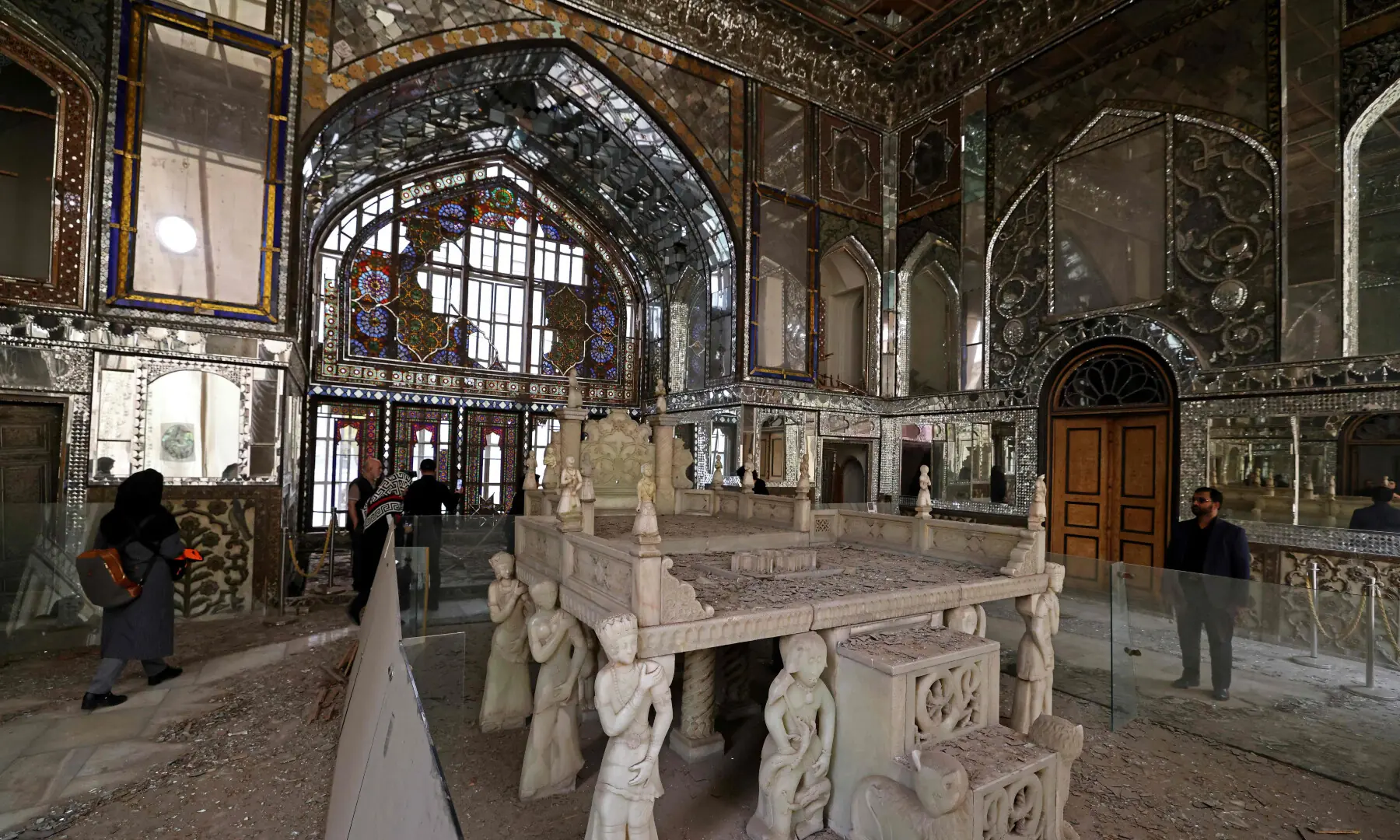 As fears of renewed conflict hang over Iran, conservationists are shoring up battered historic sites and taking stock of the damage caused by the war with the United States and Israel, though experts warn some repairs could take years. At Golestan Palace, a defining cultural landmark in central Tehran, shattered mirrors, broken doors and debris from ornate ceilings now lie scattered across parts of the site after shockwaves from strikes on the capital following the outbreak of war on February 28. The former royal residence, known for its sprawling gardens, pools and royal halls, has been listed as a Unesco World Heritage site since 2013. The fragile truce in place since April 8 has allowed experts to begin gauging the scale of the damage, though the complex remains closed to the public. Visitors walk through the damaged interiors of the historic Golestan Palace in Tehran on April 4, 2026. — AFP/File “The damage has been assessed at several levels, but a more detailed specialised evaluation is still underway,”...
 -
The Nation - National - 11:35 May 10, 2026
Asif Ali Zardari on Sunday paid tribute to police personnel martyred in a terrorist attack carried out by Fitna al-Khawarij on the Fateh Khel police station in Bannu. -
The Nation - National - 11:31 May 10, 2026
Maryam Nawaz is set to formally inaugurate the newly renamed “Marka-e-Haq Square” in Rawalpindi on Sunday, as authorities finalised extensive security arrangements for the ceremony. -
Dawn - 11:13 May 10, 2026
 Sana stood outside the gates of the police station with her young son, clutching her hand as she trembled from fear of what people would say if she went inside. The 26-year-old had been subjected to four years of physical, emotional and financial violence at home, and now her husband was threatening to leak their private videos. What held her back was not fear of her abuser but a sentence she had heard her whole life: Sharif larkiyaan thaney nahi jaati. Good girls don’t go to police stations. At our gate, Sana was not just dealing with her husband’s violence but also battling a deeper, more systemic violence in the shape of a belief system that decided how far she was allowed to seek justice. This story is not an isolated one. I often hear it as a Sub-Divisional Police Officer serving with the Sindh Police. Each complainant who happens to be a woman or her family apologises to me: “We come from a respectable family. We have never stepped inside a police station.” This disclaimer signals that the act of going ...
 -
Dawn - 11:04 May 10, 2026
MIRANSHAH: A large-scale security operation against militants continued for the third consecutive day in the Shewa tehsil and adjoining areas of North Waziristan, with reports claiming that seven militants, including two key commanders, were killed during search and clearance operations. According to sources, several militant hideouts were destroyed during the operation, while security forces intensified actions in multiple localities of the region. In the Dorwazanda area of Shewa tehsil, the Alam Khel Market was reportedly almost completely demolished during the operation. Local residents claimed that militants had allegedly been using the market as hideouts and movement routes. Meanwhile, in the Anarkhel area, an alleged militant hideout and a residential compound were also destroyed with explosive material. Sources added that security forces had taken control of several important buildings and installations during the operation, including the Governor Model School, which militants were allegedly using for ... -
Dawn - 10:13 May 10, 2026
Pakistan Telecommunication Company Ltd (PTCL) said on Sunday that consumers may face internet disruptions due to maintenance work on a submarine cable between May 11 and 18. In a post on X, PTCL said: “A maintenance activity is planned on one of our submarine cables to repair a fault by the International Cable Consortium,” adding that the work will begin on May 11 and may continue until May 18. “During this period, customers may face internet service degradation during evening hours,” PTCL said. The state-owned telecom giant manages three undersea optical fibre cable networks that provide international internet connectivity to Pakistan. Internet users in Pakistan often face disruptions due to persistent submarine cable faults. According to a report by Top10VPN.com, Pakistan led the world in financial losses from outages and shutdowns of internet and social media apps in 2o23. -
Dawn - 10:11 May 10, 2026
THE Sindh government’s 28-point list of restrictions imposed on Aurat March Karachi is a distressing example of familiar double standards: women are celebrated in speeches and choreographed photo opportunities, only for the state to recoil the moment they demand their rights. The organisers sought permission to march peacefully for women’s rights. What they received, instead, was a document dripping with authoritarian anxiety. The message could not have been clearer: women may gather, but only if they remain politically harmless. Rather than facilitating peaceful assembly, the administration chose to police slogans, speech and even clothing. The vague and sweeping conditions betray insecurity. Why does a march calling attention to gender violence and economic inequality provoke such discomfort in official circles? Why are women demanding bodily autonomy and constitutional rights treated as a threat? Secure governments do not fear placards, nor do they attempt to dictate what citizens may wear while exercising... -
The Nation - National - 09:59 May 10, 2026
Shehbaz Sharif on Sunday telephoned Muhammad Sohail Afridi and strongly condemned the terrorist attack on a police post in Bannu that claimed the lives of police personnel. -
The Nation - National - 09:57 May 10, 2026
Murad Ali Shah on Sunday directed authorities to accelerate construction work on the Bus Rapid Transit (BRT) Red Line project and adjoining roads during his visit to various sections of the under-construction corridor in Karachi. -
Dawn - 09:50 May 10, 2026
Prime Minister Shehbaz Sharif on Sunday said he and his Qatari counterpart Sheikh Mohammed bin Abdulrahman bin Jassim Al Thani reaffirmed their “shared commitment” to support “constructive dialogue” in the Middle East. In a post on X, PM Shehbaz said he was “delighted to receive a telephone call from my brother […] earlier today”. “We exchanged views on the evolving regional situation and reaffirmed our shared commitment to support all ongoing efforts aimed at promoting lasting peace, stability, and constructive dialogue across the region,” the premier added. The prime minister said he conveyed his “sincere appreciation to my dear brother”, Qatar’s Emir Sheikh Tamim bin Hamad Al Thani, “for his wise leadership and for Qatar’s continued support for Pakistan’s sincere efforts to advance regional peace and stability through dialogue and diplomacy”. PM Shehbaz further said he looked forward to the Qatari emir’s visit to “Pakistan very soon”. In its statement on the phone call, the Prime Minister’s Office (PMO) sa... -
Dawn - 09:15 May 10, 2026
 Kim Su-jin and her husband have set aside their doubts and embraced parenthood, joining a small but notable wave of South Korean couples having children despite the country’s steep demographic decline. South Korea has one of the world’s lowest birth rates, and the government has spent billions of dollars trying to encourage citizens to have more babies and cushion the worst impacts of a shrinking population. The Asian nation is still nowhere near reversing the trend, but a modest baby bump has come after years of consistently low statistics — even as experts disagree on the underlying causes. Kim, 32, a freelance music industry worker, gave birth to her daughter in January last year despite earlier financial concerns during her four-year marriage. She shook off worries over housing, schooling and work “because we believed that having (a baby) would bring us happiness”, she told AFP. This picture taken on April 30, 2026 shows a man pushing a stroller as he visits a baby fair in Seoul. — AFP South Korea’s ferti...
 -
Dawn - 08:43 May 10, 2026
Israel deported on Sunday two foreign activists seized from a Gaza-bound flotilla, in what a rights group representing them described as a “punitive attack” on a civilian mission. Saif Abu Keshek, a Spanish national of Palestinian origin, and Brazilian Thiago Avila were among dozens of activists aboard a flotilla intercepted by the Israeli navy in international waters off the coast of Greece on April 30. The pair were seized by Israeli forces and brought to Israel for questioning, while the others were taken to the Greek island of Crete and released. “Saif Abu Keshek and Thiago Avila, from the provocation flotilla, were deported today from Israel” following an investigation, the Israeli foreign ministry posted on X on Sunday. Israel would “not allow any breach” of the blockade on Gaza, it added. Spain, Brazil and the United Nations had all called for the men’s swift release. On Wednesday, an Israeli court rejected an appeal contesting the pair’s detention. “From their abduction in international waters to thei...